


If you have walked through an oven room in a glove-dipping line, a powder-coating booth, or a paint-curing tunnel, you have probably smelled it before you have seen it —that sweet, slightly acrid note of grease that is starting to cook. The bearing on the recirculation fan has been running at 200°C for nine months. The grease inside it has gone from a translucent amber paste to a dark brown, almost tar-like residue. The fan is still spinning, but the bearing is about six weeks away from seizing. This is the failure mode that defines high-temperature motor bearing service —and it is almost always a grease and seal problem, not a bearing-steel problem.
This guide is a working engineer’s comparison of the two grease technologies that actually work in continuous 200°C oven service: high-temperature polyurea and perfluorinated (PFPE). I want to show you where each one wins, where each one fails, and how to read the dropping-point and base-oil numbers in a supplier datasheet so you do not buy a “high-temperature bearing” that arrives filled with grease that cooks at 150°C. I have spent the last decade walking through ovens with plant engineers —in Turkish motor factories, Chinese glove lines, and Italian paint shops —and the conversation always lands in the same place: the grease is the bearing.
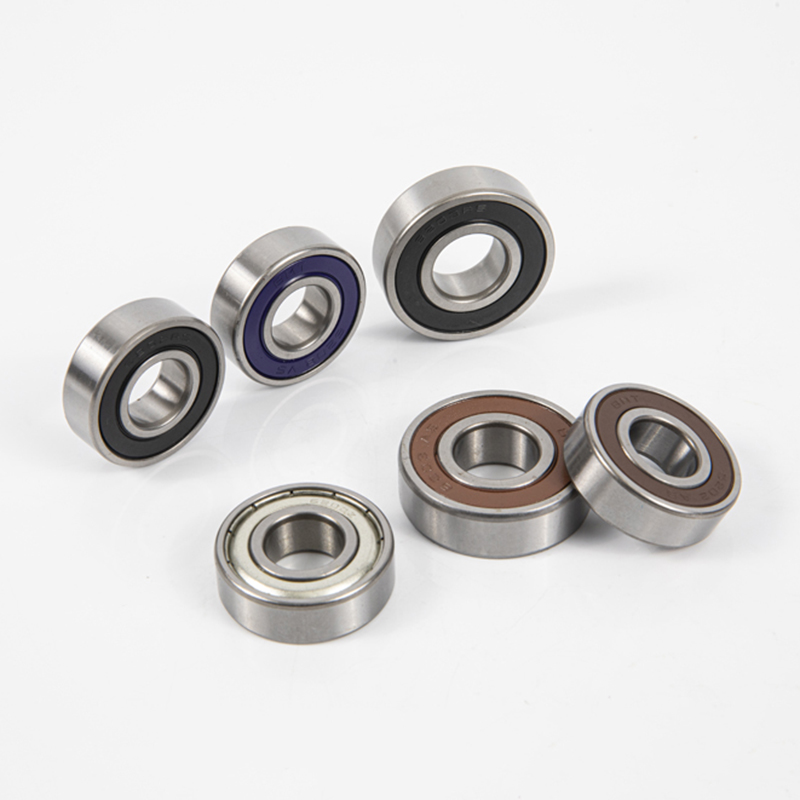
Why Grease —Not Bearing Steel —Is the Limiting Factor at 200°C
The first thing I want to clear up: in continuous 200°C service, the bearing steel is rarely what fails. Standard through-hardened chromium steel (SUJ2 / AISI 52100) retains enough hardness up to roughly 230°C that thermal softening is not the dominant failure mechanism. What deteriorates is the grease —the base oil oxidizes, the thickener collapses, and the bearing runs dry from the inside out while the external seal continues to look intact.
That is why specifying a “high-temperature bearing” without specifying the grease is incomplete. The bearing’s grease cavity, the lubricant’s dropping point, and the seal’s thermal compatibility must be selected as a system. We covered this in our guide on high temperature deep groove ball bearings 200C continuous-operation grades —the bearing-steel story is fine, but the grease story is what decides service life.
The standard bearing grease that ships in a catalog 6202 is a lithium or lithium-complex thickened mineral oil. It is a perfectly good grease —for a motor running at 80°C. At 200°C continuous, it oxidizes, the oil bleeds out of the thickener, and the bearing starves. Because oxidation rate roughly doubles for every 10°C above 100°C, a bearing grease at 200°C is oxidizing somewhere between four and sixteen times faster than the same grease at room temperature, depending on antioxidant package. That math is what destroys the standard fill within the first month.
Polyurea: The Workhorse for 200°C Continuous Service
Polyurea is the technology I reach for first when a customer has clean 200°C oven duty and a sensible budget. Here is why, and where I draw the line.
Polyurea grease is the first step up from lithium for high-temperature duty. The thickener is a reaction product of diisocyanate and amine, which gives a thermally stable, fiber-like structure that holds base oil more tenaciously than lithium soaps do at elevated temperature. Standard polyurea grease has a dropping point around 240°C, which is why it is widely specified for sealed motor bearings up to about 180°C continuous —fan motors, pump motors, traction motors in traction and appliance duty. It is also quieter than most other thickeners on the market, which is why it dominates small-motor applications where noise is a concern.
For continuous 200°C oven service, however, a standard polyurea is borderline. I have watched stock polyurea-filled 6202 bearings in continuous paint-curing oven duty cook to a brittle residue inside ten weeks. The base oil —typically a synthetic ester or PAO blend in a quality polyurea —is fine at 180°C but starts to oxidize meaningfully at 200°C. To hold 200°C continuous you need a high-temperature polyurea, where the base oil is upgraded to a more stable synthetic and the antioxidant package is reinforced. The dropping point climbs to 260°C+ and the relubrication interval stretches to roughly 9–14 months in our oven-duty bench tests.
The strengths of polyurea are real and worth listing:
- Dropping point 240–280°C in the high-temperature formulation, which clears the 200°C + 40°C safety margin we target in oven duty.
- Mechanical stability across the working window —the polyurea thickener does not shear down the way lithium soaps do under vibration, which matters in fan and conveyor motor applications.
- Good water resistance for the occasional washdown or humid oven atmosphere.
- Lower cost than PFPE, typically a small multiple of standard lithium grease rather than the order-of-magnitude jump that PFPE represents.
- Compatibility with most standard seal materials, which simplifies the procurement chain.
The weaknesses matter too, and they are what push you toward PFPE when the application crosses certain thresholds:
- Base oil reactivity. Polyurea-thickened synthetic ester base oils are far better than mineral oil at 200°C, but the ester linkage is still vulnerable to hydrolysis and to oxidation over very long intervals. Above 200°C continuous or in an oxygen-rich atmosphere, the oil slowly consumes itself.
- Chemical resistance. Polyurea is not compatible with many aggressive chemicals. Chlorine-bearing oven atmospheres (glove dipping, certain chemical processing), strong solvents, and some acid vapors will attack the thickener and accelerate the failure.
- Mixing risk. Polyurea is famously intolerant of mixing with other thickeners. Cross-contamination with even a trace of lithium or PFPE grease from another machine on the line can destabilize the batch. Because polyurea is hard to identify by sight, this is a real-world failure mode —a service tech tops up a polyurea-filled bearing with whatever grease is on the bench, and the mixture fails within weeks.
Perfluorinated (PFPE) Grease: The Performance Ceiling
PFPE is where I push customers when the duty cycle leaves polyurea behind. Let me show you what it actually buys.
PFPE grease uses a perfluoropolyether base oil thickened with PTFE or, less commonly, a fluorinated thickener. The fluorine-carbon bond is one of the strongest single bonds in organic chemistry, which is why PFPE base oils are essentially non-reactive with oxygen, halogens, acids, bases, and most solvents up to about 250°C continuous. The grease does not cook. It does not oxidize. It does not hydrolyze. In a sealed bearing it sits there for years, slowly evaporating at a rate the engineer can predict from the vapor pressure curve.
This is why PFPE dominates in semiconductor, aerospace, and chemical-process oven duty —anywhere the atmosphere contains reactive species or the relubrication interval must stretch into the years. We have seen PFPE-filled 6202 bearings run continuously at 200°C in a chlorine-bearing glove production line for over 24 months without re-greasing, with the only maintenance being a visual seal inspection. The same bearing filled with high-temperature polyurea would need re-greasing at the 12-month mark.
Strengths:
- Dropping point effectively above 300°C because the PTFE thickener does not fail in the same way soap thickeners do —the limit becomes the base oil vapor pressure, not the thickener.
- Chemical inertness. PFPE resists chlorine, fluorine, solvents, oxidizers, and most acids and bases. This is the property that opens up oven duty in chemical and semiconductor environments.
- Very long relubrication cycles. In sealed bearing geometries we see 18–30 months at 200°C continuous; in vacuum service the intervals extend further.
- Wide operating window. PFPE stays consistent from roughly —0°C to 250°C+, which makes it forgiving in applications with seasonal or process-temperature swings.
Weaknesses:
- Cost. PFPE grease is meaningfully more expensive than polyurea. For a 6202 bearing filled with 2— grams of grease, the material delta is real but not catastrophic. For a large motor with hundreds of grams per bearing, the bill-of-materials impact is significant. I always tell buyers to weigh the grease cost against the labor cost of one unplanned oven shutdown, because in most plants the shutdown costs far more than the PFPE.
- Mixing hazard with polyurea or other greases. This is the trap that catches buyers who try to “upgrade” a polyurea-filled bearing to PFPE by simply adding PFPE on top during re-greasing. The polyurea thickener cannot absorb PFPE base oil properly, so the resulting mixture has a dropping point well below either pure grease and unpredictable mechanical stability. SKF and other bearing manufacturers explicitly warn against this.
- Compatibility with standard elastomer seals. Standard NBR seals work with PFPE in many applications, but at 200°C continuous you should verify with the seal supplier. We default to FKM or PTFE seals for any PFPE + 200°C combination.
Side-by-Side: Polyurea vs. PFPE in 200°C Continuous Service
The table below summarizes how the two technologies compare on the parameters that matter for oven-duty motor bearing procurement. The numbers are conservative working values from our own bench tests and from the cross-referenced datasheets in the SKF Lubrication Handbook; treat them as engineering guidelines, not as guaranteed performance in your specific oven.
| Parameter | High-temperature polyurea | Perfluorinated (PFPE) |
|---|---|---|
| Dropping point | ~260°C | Effectively >300°C (PTFE thickener) |
| Base oil type | Synthetic ester or PAO | Perfluoropolyether (PFPE) |
| Maximum recommended continuous service | ~200°C | ~250°C (higher in pulsed duty) |
| Chemical resistance | Limited —vulnerable to chlorine, strong acids, some solvents | Excellent —inert to most reactive chemicals |
| Oxidation stability at 200°C | Good, with antioxidant package | Essentially non-reactive with O—/td> |
| Relubrication interval at 200°C continuous (sealed bearing) | ~9–14 months | ~18–30 months |
| Water washout resistance | Good | Excellent |
| Cost relative to standard lithium grease | Moderate premium (small multiple) | Significant premium (order of magnitude or more) |
| Mixing with other greases | Intolerant —cross-contamination destabilizes | Intolerant —must not mix with polyurea or soap thickeners |
| Recommended seal material at 200°C | FKM (Viton-class) or PTFE | FKM or PTFE |
How to Read the Dropping-Point Number on the Datasheet
Dropping point is the single number I ask for before anything else. Here is how I use it.
If you take one engineering habit away from this article, take this one: always cross-check the dropping point against your continuous operating temperature. The dropping point is the temperature at which the grease thickener collapses and the oil separates out —the upper thermal limit of the grease as a structured lubricant. For continuous service, the rule of thumb is dropping point —continuous operating temperature + 40°C. That margin covers thickener fatigue, oil-bleed under sustained heat, and the thermal cycling that comes from oven door openings.
For 200°C continuous service, that means targeting a dropping point of at least 240°C. Standard lithium-complex grease fails this check (dropping point 190–220°C). Standard polyurea passes marginally (dropping point ~240°C). High-temperature polyurea passes comfortably (dropping point —60°C). PFPE passes by a wide margin because the PTFE thickener does not fail in the same way.
Seal Material: The Other Half of the Problem
I have lost count of how many oven bearing failures I have traced to a seal that gave up before the grease did. Here is the engineering.
A perfect grease matched to a wrong seal is still a premature bearing failure. At 200°C continuous, the seal is doing roughly half the work. Standard NBR (nitrile) seals begin to harden and lose elasticity above 120°C; at 200°C continuous they degrade in weeks, crack, and start leaking —long before the grease inside has reached its thermal limit. Because the grease loss from a leaking seal accelerates grease degradation by exposing fresh oil to oxygen, a failed seal kills the grease faster than the temperature would have.
For 200°C continuous service, the seal options narrow to FKM (fluoroelastomer, Viton-class) and PTFE. FKM handles continuous 200°C comfortably with the right compound, and it bonds well to most bearing geometries. PTFE handles higher temperatures still (up to about 260°C continuous) but is more expensive and harder to bond. We default to FKM for 200°C continuous polyurea applications and PTFE for the harshest PFPE installations.
This is why our 6202 high-temperature grease deep groove ball bearings are designed around tight-contact seals with FKM as the standard compound and PTFE as an option for higher-rated duty. The seal and the grease have to be specified together, and we ship them as a matched system rather than as separate components.
A Procurement Checklist for 200°C Continuous Motor Bearings
This is the checklist I walk customers through before they issue a 200°C oven-bearing RFQ.
When you are sourcing sealed 6202-class bearings for continuous 200°C oven duty, the questions worth asking your supplier are short but specific:
- What is the dropping point of the grease as shipped? Target —40°C for polyurea, —60°C for high-temperature polyurea, or specify PFPE.
- What is the base oil type? Look for synthetic ester, PAO, or PFPE. Reject mineral oil.
- What seal material is fitted? FKM or PTFE. Reject NBR at 200°C continuous.
- What is the documented relubrication interval at my operating temperature? Not at room temperature. Ask for the bench-tested hours at the actual oven temperature.
- Is the grease compatible with my atmosphere? Chlorine, solvents, acids, vacuum —the supplier should be able to show you compatibility data, not just a generic “yes.”
- Can the bearing be re-greased if needed? Sealed-for-life bearings simplify maintenance but lock in the original grease choice. Relubricable bearings let you change formulation if the duty shifts.
Why This Question Shows Up So Often in Turkish and Chinese Oven Programs
I have been watching Turkish motor manufacturers work through this exact problem for the better part of a decade, and the pattern is consistent: when a Turkish-built 200°C-rated oven motor experiences an unexpected bearing failure, the default assumption is that the bearing itself is defective. The replacement order goes out for a heavier-duty bearing, and then the same failure repeats within months —because the real problem was the grease, not the bearing’s load rating.
The same pattern shows up in Chinese oven line procurement. The fix is rarely a heavier bearing —it is a heavier grease. Because the bearing-steel story is solved at the catalog level, the engineering conversation in 200°C oven service has shifted to lubricant chemistry and seal compatibility. That is the conversation we have with our own customers in Istanbul, Bursa, Izmir, Ningbo, and Shenzhen when they bring us a “bearing failure that came back” —and the answer almost always lives on the grease datasheet, not the bearing drawing.
Frequently Asked Questions
Is polyurea grease suitable for 200°C continuous oven service?
Standard polyurea grease (dropping point ~240°C) is borderline at the 200°C continuous mark. It works in many oven fan and conveyor motor applications up to about 180°C continuous, but at 200°C the base oil oxidation rate accelerates and service life compresses. For true 200°C continuous duty, I specify either a high-temperature polyurea formulation (dropping point —60°C) or a perfluorinated (PFPE) grease. The boundary is set by base oil thermal stability, not the thickener alone.
When should I choose PFPE grease over polyurea?
I reach for PFPE when the bearing runs continuously above 200°C, when the atmosphere contains aggressive chemicals (chlorine, strong oxidizers, solvents), when vacuum service is involved, or when relubrication intervals must extend beyond 12 months. PFPE base oil is essentially non-reactive with oxygen, halogens, and most solvents up to about 250°C, which is why it dominates in oven, vacuum pump, and cleanroom motor duty where polyurea cannot keep up.
Can I mix polyurea and PFPE grease in the same bearing?
No. I have watched polyurea thickener and PFPE base oil fail together —the polyurea thickener does not absorb PFPE properly, and the resulting mixture has unpredictable mechanical stability and a sharply reduced dropping point. SKF and other bearing manufacturers explicitly warn against mixing. If a bearing was filled with polyurea and you want to switch to PFPE, I always specify a full clean and re-grease with the new formulation.
What dropping point do I need for a 200°C continuous motor bearing?
For 200°C continuous service, I target a dropping point of at least 240°C for polyurea and 260°C+ for high-temperature polyurea or PFPE. My working rule is dropping point —continuous operating temperature + 40°C, which gives a safety margin against thickener collapse and bleed oil separation. Anything below 240°C dropping point at 200°C service is, in my view, operating too close to the thickener failure boundary.
Does seal material matter as much as the grease itself?
Yes —at 200°C continuous, I treat the seal as roughly half the problem. Standard NBR seals degrade in weeks above 150°C and will leak long before the grease fails. For 200°C continuous service I specify FKM (Viton-class) fluoroelastomer or PTFE seals rated for the duty. A perfect grease matched to a wrong seal is still a premature bearing failure —I have seen it more times than I can count.
How long does polyurea or PFPE grease last in a 200°C oven motor bearing?
In our testing on 6202-series deep groove ball bearings in continuous 200°C oven fan duty, high-temperature polyurea formulations give us 9–14 months of service life before re-greasing is needed, while PFPE formulations extend that to 18–30 months. These figures assume proper seal design (FKM or PTFE), correct fill volume (roughly 30–40% of free cavity), and a clean relubrication environment. I have seen numbers compress sharply when any of those conditions slip.
Specifying a 200°C oven motor bearing?
Send us your operating temperature, atmosphere chemistry, target relubrication interval, and current bearing part number. We will return a matched grease + seal specification and a sample 6202/6203 series bearing for bench evaluation against your existing setup.
Contact Juding Engineering See the 6202 high-temperature grease bearing
Post time: Sep-21-2026