


TL;DR – Key Takeaways
- 200C continuous operation is achievable with polyurea or perfluorinated greases – not with standard petroleum lubricants which fail at 120-150C.
- Grease is the limiting factor not the bearing steel itself. The right grease can extend bearing service life by 3-5x in industrial oven environments.
- FKM or PTFE seals are mandatory above 150C. Standard NBR seals degrade in weeks causing grease loss and premature failure.
- Bearing 6202 with high-temperature grease and sealed design extends service life to 12+ months even in chlorine-rich glove production environments according to Juding Engineering testing.
- Thermal cycling from door openings stresses bearings more than constant-temperature operation – factor this into your maintenance schedule.
I’ve spent the better part of fifteen years talking with plant managers and maintenance engineers about bearing failures and there is one scenario that comes up over and over: the industrial oven fan bearing that keeps dying well before its expected life. They are running at what they think are reasonable temperatures yet the bearings are seizing or showing significant Brinell damage within weeks. The problem almost always traces back to one thing – they are using a standard petroleum-based grease in an application that demands something far more resilient.
Deep groove ball bearings are the workhorses of industrial ovens. They support the fans that circulate heated air they ride on the drive shafts of conveyor systems inside thermal processing equipment and they are asked to perform reliably at temperatures that would destroy a standard bearing in days. If you are specifying bearings for any application touching 150C or above this guide will walk you through exactly what separates a bearing that survives 200C continuous operation from one that fails catastrophically.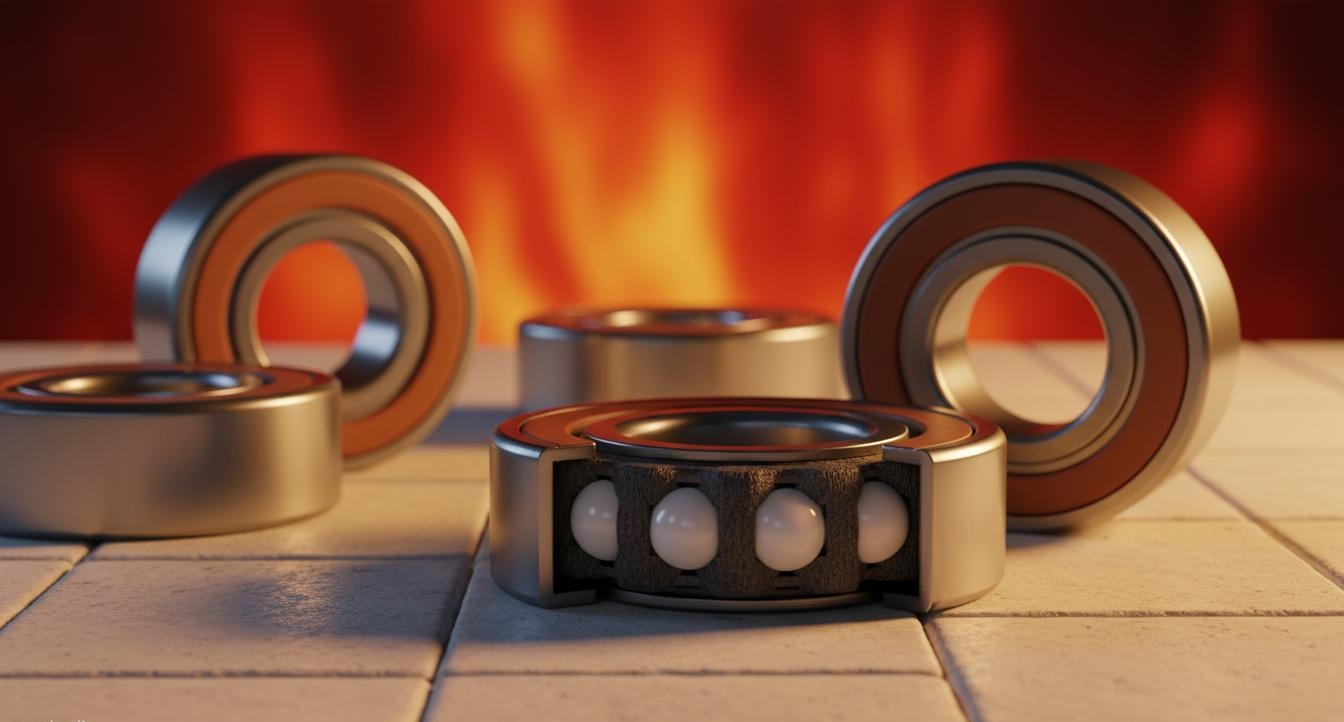
What Makes Industrial Oven Environments So Harsh on Bearings?
Most engineers understand that heat accelerates bearing wear. But in an industrial oven the challenge is not just thermal – it is multi-factor and that is where a lot of specification mistakes originate.
The first killer is sustained high ambient temperature. Unlike a motor bearing that runs hot from internal friction an oven fan bearing operates in an environment where the surrounding air is the heat source. That means there is no cooldown cycle. A bearing in a 200C oven is absorbing radiant and convective heat continuously 24 hours a day. Standard petroleum-based lubricants begin oxidizing rapidly above 120C and the grease essentially cooks inside the housing. According to ASTM Friction and Wear Testing standards the oxidation rate doubles for every 10C above ambient which means a bearing at 200C is oxidizing roughly 16x faster than one at room temperature.
The second killer is thermal cycling. Every time an oven door opens – shift changes product loading routine inspection – the ambient temperature around the bearing fluctuates by 40-80C in seconds. This causes repeated expansion and contraction of the bearing raceway accelerating crack propagation in the steel. A bearing rated for constant-temperature operation may still fail prematurely under thermal cycling conditions.
The third factor is corrosive atmosphere. Many industrial ovens – paint curing lines powder coating booths chemical processing kilns – contain reactive gases: chlorine compounds sulfur dioxide acidic vapors. Standard open-groove deep groove ball bearings have micro-gaps at the seal-to-inner-ring interface and if those seals are not specifically designed for chemical resistance corrosive gas penetrates directly to the raceway and rolling elements. This is exactly why Juding Engineering’s Bearing 6202 with high temperature grease features a tight-contact seal design specifically engineered to block chlorine and particulate ingress.
When I look at a bearing failure in an oven application I can usually pinpoint the root cause within one of those three categories. Let me break down what actually separates a high-temperature capable bearing from a standard one.
The Critical Role of Grease in High-Temperature Bearing Performance
Here is the thing most bearing catalogs will not tell you plainly: the bearing steel is rarely the limiting factor in a high-temperature application. The grease is. Standard bearing steel (SUJ2 or AISI 52100) retains good hardness up to about 230C before thermal softening becomes a concern. But standard petroleum grease – the kind most catalog bearings ship with – hits its thermal limit between 120C and 150C depending on the thickener chemistry.
So when we are talking about a bearing rated for 200C continuous operation we are really talking about a bearing filled with the right high-performance lubricant. Because the grease oxidizes and loses viscosity at 200C we must specify synthetic alternatives with higher thermal stability.
Grease Types and Their Temperature Ceilings
There are four grease categories relevant to high-temperature deep groove ball bearings and the performance gap between them is substantial:
1. Standard petroleum (lithium/ep-complex) grease: Lithium-based greases have drop points around 160-180C but their actual continuous operating temperature is usually limited to 120-130C. Above this the thickener structure collapses and the grease becomes fluid leading to leakage and rapid wear. I would not specify this for any application above 150C period.
2. Synthetic polyurea grease: This is the workhorse of industrial high-temperature applications. Polyurea-thickened synthetic oils (typically diester or polyalphaolefin bases) offer drop points of 250C or higher and maintain consistent viscosity up to 200C. They are the most common choice for oven fan bearings operating in the 160-200C range. Cost-wise they sit at a moderate premium – roughly 2-3x the price of standard lithium grease but the service life extension is worth it.
3. Perfluorinated polyalkyl ether (PFPE) grease: Fluorinated greases like Chemours Krytox and Astrochemical FGL-series offer exceptional thermal stability up to 280-300C with virtually zero vapor pressure. They resist oxidation completely are chemically inert to most reactive gases and maintain their viscosity over extraordinary temperature ranges. The tradeoff is cost – they are 8-15x more expensive than polyurea greases. But for the most demanding applications (semiconductor furnaces aerospace heat treatment kilns) they are the right choice.
4. Solid lubricants (graphite MoS2 PTFE): In extreme temperature zones above 250C where oil or grease would vaporize solid lubricant coatings or solid-graphite plugs become necessary. Deep groove ball bearings with solid-film lubricants can operate in intermittent contact up to 500C though load capacity is significantly reduced compared to grease-lubricated versions.
How to Read Grease Temperature Ratings Correctly
One mistake I see constantly: engineers look at the drop point of a grease and assume that is its continuous operating temperature. It is not. The drop point (the temperature at which the grease transitions from semi-solid to liquid) is a theoretical maximum that does not account for oxidation evaporation or seal compatibility at temperature.
For continuous operation at 200C you want a grease with a demonstrated continuous operating rating of at least 230C providing a 30C safety margin. When evaluating any high-temperature bearing ask the supplier for the actual grease specification sheet – not just the bearing catalog page. The grease data sheet will show the worked penetration (ASTM D217) the dropping point (ASTM D2265) and the high-temperature endurance hours at a given temperature. Juding Engineering’s Bearing 6305ZZ (OD65mm) with high temperature grease uses Japanese-origin synthetic polyurea grease with a continuous rating of 250C which gives us that safety margin comfortably.
Bearing Steel Cage Materials and Clearance Ratings at 200C
Beyond grease the bearing itself needs to be selected with the right steel grade cage material and internal clearance for high-temperature operation.
Steel Grade
Standard deep groove ball bearings use vacuum-degassed AISI 52100 (SUJ2) steel with a typical hardness of 60-65 HRC. This is fine up to about 180C for short durations. For sustained 200C operation some manufacturers spec a higher-temperature stabilized steel or specify ASTM A295 (high-carbon anti-friction bearing steel) which has better retained austenite control. If you are buying commodity catalog bearings it is worth asking the supplier what steel specification they use and whether the hardness is tested after final heat treatment.
Cage Material
The cage is often overlooked but it is critical in high-temperature applications. Standard stamped steel cages (low-carbon steel approximately 0.15% C) begin losing strength above 150C. At 200C they are operating in a partially annealed state.
For continuous high-temperature operation specify one of the following cage materials:
- Hardened steel cage (quenched and tempered): Machined from hardened steel suitable up to 300C. Most robust option for industrial ovens.
- PTFE (Teflon) cage: Self-lubricating chemically inert rated to 260C continuously. Good choice for clean-room or food-adjacent ovens. Load capacity is lower than steel.
- Graphite-filled nylon (polyamide) cage: Lower temperature limit (~180C continuous) but excellent wear resistance and self-lubricating properties. Acceptable for moderate high-temp applications.
Internal Clearance (C3 and Above)
Thermal expansion during heating means that a bearing assembled at room temperature will have reduced internal clearance at operating temperature. For a bearing operating at 200C the inner ring will expand by approximately 0.02-0.04mm relative to its cold state. If you start with a standard C0 or CN clearance bearing the thermal fit reduction can preload the rolling elements dramatically accelerating fatigue failure.
For 200C operating temperatures specify C3 clearance (or tighter if your housing design allows). Some applications even require C4 or C5 clearance to account for the thermal fit condition. Work with your bearing supplier to calculate the actual thermal interference fit at your operating temperature or specify a bearing with Juding Engineering’s Bearing 6203 series which offers C0 C2 and C3 clearance grades to match your thermal conditions.
Seal Selection: Why Your Standard Seal Will Fail at 200C
This is where I have seen the most specification failures. Engineers select a high-temperature bearing with the right grease then install it with a standard nitrile rubber (NBR) seal and wonder why the bearing is leaking grease after six weeks.
NBR seals are typically rated for continuous temperatures of -30C to +120C. Above 120C they begin hardening and cracking. At 200C they will be completely degraded within days. The failure mode is characteristic: the seal lip hardens gaps open at the seal-to-shaft interface and the high-temperature grease – now fluid at operating temperature – exudes from the bearing cavity.
For 200C continuous operation you need one of these seal materials:
- FKM (Fluoroelastomer Viton): Continuous rating to 230-260C depending on compound. Excellent chemical resistance including chlorinated compounds. The standard choice for industrial oven bearings.
- FFKM (Perfluoroelastomer): Extended rating to 300C+. Used in the most demanding thermal processing applications. Significantly more expensive than FKM.
- PTFE (Teflon) seal: Continuous rating to 260C chemically inert low friction. The lip seal design is critical – PTFE has different flex characteristics than elastomers so verify the seal is designed specifically for rotary motion under thermal cycling.
- Metal bellows seal: For extreme temperatures where any elastomer would fail. Metal bellows seals use corrugated stainless steel to seal the housing rated to 500C+ but requiring precise installation.
When Juding Engineering designed the Bearing 6202 with high-temperature grease for demanding former-holder and glove production applications – which involve chlorine-rich atmospheres and temperatures above 180C – the engineering team specifically chose a tight-contact seal design with FKM-grade elastomer to provide both chemical resistance and thermal stability. We guarantee a minimum 12-month service life under those conditions which is 4-6x what a standard bearing delivers.
Specifying the Right Bearing for Your Industrial Oven: A Practical Checklist
Let me walk through the decision framework I use when helping customers spec bearings for industrial oven applications. I have broken it into five questions that collectively determine the right bearing solution.
1. What is your actual maximum operating temperature?
And I mean actual – not the setpoint on the oven controller. Thermocouple measurements at the bearing location are the only reliable data. In many forced-air convection ovens the bearing ambient temperature runs 20-40C below the oven setpoint because of air circulation patterns. But in direct-fired radiant ovens or small batch furnaces the bearing can run at or above the setpoint because of localized hot spots. Measure before you spec. If you cannot measure spec 30C above your setpoint as a safety margin.
2. Is the application thermal-cycling or constant-temperature?
Constant temperature at 200C is actually easier on the bearing than aggressive thermal cycling because thermal stress fatigue (the expansion-contraction cycle that causes rolling contact fatigue) is driven by temperature delta not absolute temperature. If your oven cycles multiple times per shift your bearing selection needs to account for additional clearance and thermal cycling stress. We typically recommend C3 clearance minimum for any application with more than 2 thermal cycles per day.
3. What is the corrosive atmosphere composition?
If your oven processes materials that release chlorine SO2 or acid vapors you need FKM or better seals – not standard NBR. A chlorine-rich atmosphere will attack NBR seals in days and the resulting corrosion will pit the raceway within weeks. Bearing 6202 with tight-contact FKM seals is specifically developed for these environments.
4. What is your required bearing life?
Industrial oven bearing replacement is disruptive and expensive – it typically requires partial disassembly of the oven or conveyor system. Most plant managers want at minimum 12 months of trouble-free operation. At 200C with proper grease and seals a quality deep groove ball bearing should deliver 8000-15000 hours of L10 life which translates to roughly 12-24 months depending on duty cycle. If you are getting less than 6 months something in your specification is wrong.
5. Do you need open or sealed bearings?
Sealed bearings (2RS or ZZ type) are the standard choice for industrial ovens because they retain the high-temperature grease internally and prevent contaminant ingress. Open bearings (no seals) require an external lubrication system and are generally reserved for large bearings where relubrication is practical. For most industrial oven fan applications in the 17-65mm bore range sealed bearings are the right choice. Juding Engineering’s Bearing 6203 series and 6305ZZ series both offer sealed configurations with high-temperature grease as standard.
OEM Sourcing vs. Catalog Bearings: What Actually Matters
One question I get from procurement teams constantly: Can we just buy standard high-temperature bearings from a major catalog distributor? Technically yes and the price point is attractive. But here is what they typically discover when they dig into it.
Major bearing brands (SKF NSK NTN Timken) do offer high-temperature bearing lines with documented 200C ratings. These are legitimate well-tested products with ISO 281 (fatigue life) and ASTM Bearing Standards compliant test data. However they come with a significant premium – typically 3-6x the cost of a well-manufactured OEM bearing with equivalent specs.
The gap narrows considerably when you source from a quality-focused OEM manufacturer like Juding Engineering which has been producing deep groove ball bearings since 2007 with ISO/TS 16949:2009 certification. The key is verifying the following before you buy:
- Grease specification: Request the actual grease data sheet. It should show continuous operating temperature >= 230C and high-temperature endurance hours (ASTM D3336 or equivalent) >= 1000 hours at your target temperature.
- Seal material verification: Verify FKM or PTFE construction – not just high-temperature seal in the product name.
- Clearance grade: Confirm C3 or above for thermal interference fit at your operating temperature.
- Traceable test data: Reputable suppliers provide batch-level test reports for hardness roughness (Ra <= 0.2um for raceway) and noise grade (ISO 15242).
For OEM quantities or recurring applications I would also strongly recommend requesting a bearing sample and performing a teardown inspection before committing to volume orders. Look at the cage material the seal lip geometry and whether the grease fill is adequate (typically 25-35% of the internal cavity volume for sealed bearings).
Installation and Maintenance Practices for High-Temperature Oven Bearings
Even the best high-temperature bearing will fail prematurely if installed incorrectly. Here are the installation factors that most critically affect performance in industrial oven applications:
Mounting fit: For high-temperature applications an inner ring should be mounted with a tight interference fit on the shaft (typically m6 or p6 fit for steel shafts) to prevent inner ring creep. Outer ring should be mounted with a loose clearance fit (H7 or H11) in the housing to allow thermal expansion without inducing preload. If your housing is aluminum adjust fits accordingly – aluminum expands at approximately 2x the rate of steel.
Thermal expansion gaps: The bearing housing bore must be machined to allow for thermal expansion of the outer ring. A general guideline: for 200C operation with a steel housing specify housing bore at 0.03-0.05mm larger than the outer ring OD at room temperature.
Preload management: During assembly verify that the bearing is seated squarely against the shoulder or housing face. Any angular misalignment during mounting creates point loading on the rolling elements dramatically reducing fatigue life.
Initial running-in: I recommend running a new high-temperature bearing at 50-60% of rated speed for the first 2-4 hours at operating temperature before loading to full duty. This allows the grease to equilibrate and the seal lips to seat properly. Skipping this step is one of the most common causes of early seal leakage in newly installed high-temperature bearings.
Temperature monitoring: Install a thermocouple or infrared probe on the bearing housing during the first production run and at regular maintenance intervals. Any bearing housing temperature exceeding 220C (at the bearing location) warrants immediate investigation – either the grease is degrading or there is a thermal design problem in the machine.
Common Failure Modes and How to Diagnose Them
Over fifteen years of watching bearing failures across industrial oven applications I have seen a clear pattern of recurring failure modes. Let me walk through the most common ones:
Brinell indentation (false Brinelling): This appears as evenly spaced indentations on the raceway matching the spacing of rolling elements. It is caused by vibration while the bearing is stationary under load – common in ovens where fans coast down slowly. The solution is anti-vibration mounting or a bearing with higher load capacity.
Oxidation/pitting fatigue: Caused by lubricant breakdown and water or reactive gas ingress. Shows as irregularly distributed pits rather than Brinell marks. If you see this check your seals and your atmosphere composition.
Thermal cracking (spalling): This is the classic heat-related failure. It appears as irregular flaking or spalling in a band around the raceway caused by exceeding the steel’s thermal fatigue limit. If you see thermal cracking your operating temperature may be higher than your specification assumed – measure it directly.
Seal hardening and grease leakage: As I mentioned earlier if the seal material is not rated for your temperature it will harden crack and leak grease. This is the most common cause of premature high-temperature bearing failure that I see in the field and it is entirely preventable through correct seal material specification.
Cage wear or fracture: A broken or worn cage – typically at the pockets where rolling elements ride – indicates thermal overloading or inadequate cage material for the temperature. Specify machined steel or PTFE cages for elevated temperature applications.
Frequently Asked Questions
What is the maximum continuous operating temperature for a high temperature deep groove ball bearing?
High temperature deep groove ball bearings with premium synthetic greases can sustain 200C continuous operation when the grease seals and cage are all specified for that temperature range. The actual limit is determined by the weakest component. With perfluorinated greases and FFKM seals ratings up to 280-300C are possible for specialized applications. The most common mis-specification I see is a high-temperature bearing with standard NBR seals – those seals will fail at 120C regardless of the grease rating.
Why does bearing life drop significantly above 150C in standard deep groove ball bearings?
Above 150C three degradation mechanisms activate simultaneously in standard bearing components: the petroleum lubricant oxidizes rapidly (increasing acid number and decreasing viscosity) the bearing steel begins losing hardness through retained austenite transformation (especially above 180C) and standard stamped steel cages lose their tensile strength. The combined effect can reduce L10 fatigue life by 60-80% in uncontrolled conditions. According to ISO 281 bearing life calculations temperature is one of the primary adjustment factors – and the thermal adjustment factor becomes increasingly severe above 125C.
How do industrial oven fan bearing failures differ from general machinery bearing failures?
Industrial oven fans face three unique stressors that do not exist in general machinery: sustained high ambient temperature from the oven cavity rather than from bearing-generated heat aggressive thermal cycling from door openings that stress the steel and seals repeatedly and reactive process atmospheres (chlorine SO2 acid vapors) that attack seals and steel. General machinery bearing failures are typically caused by contamination improper mounting or overload. Oven bearing failures are dominated by thermal and chemical factors – which is why a bearing that works fine in a motor will fail in days inside an industrial oven.
Can standard rubber seals withstand 200C continuous operation?
No. Standard NBR (nitrile rubber) seals have a continuous temperature limit of approximately 100-120C and a short-term maximum of around 130C. At 200C NBR hardens cracks and loses its sealing lip geometry in days to weeks. For 200C operation you need FKM (Viton-type fluoroelastomer rated to 230C continuous) PTFE seals (rated to 260C) or metal bellows seals for extreme temperatures. Never substitute standard seals in high-temperature applications – this is one of the most preventable causes of bearing failure.
How often should high-temperature oven bearings be inspected?
I recommend a monthly visual inspection during planned maintenance shutdowns checking for grease discoloration (which indicates thermal oxidation) seal hardening or cracking and abnormal noise during operation. Any bearing running at elevated temperature should be replaced at the first sign of irregular noise (whining grating or clicking) – the cost of an unexpected seizure and oven downtime far exceeds the cost of a scheduled replacement. If bearings are exceeding 18 months without incident consider extending the inspection interval; if they are failing before 12 months investigate the root cause rather than just replacing them.
Summary: Matching Bearing Specs to Application Requirements
Let us cut through the complexity. If you are specifying deep groove ball bearings for an industrial oven running at 200C here is the minimum specification checklist:
| Parameter | Minimum Specification | Recommended Specification |
|---|---|---|
| Grease continuous rating | >= 220C (polyurea synthetic) | >= 250C (Japanese polyurea or PFPE) |
| Seal material | FKM fluoroelastomer | FKM or PTFE (rated >= 250C) |
| Internal clearance | C3 clearance minimum | C3 or C4 for thermal cycling applications |
| Cage material | Hardened steel cage | Hardened steel or PTFE cage |
| Steel grade | AISI 52100 (SUJ2) hardness verified post-heat treatment | ASTM A295 high-carbon anti-friction steel with retained austenite control |
| Thermal cycling accommodation | C3 clearance minimum | C4 or C5 + running-in procedure for >=2 cycles/day |
| Bearing life target | >= 8000 hours L10 at operating temperature | >= 12000 hours L10 with Japanese polyurea grease |
| Inspection interval | Monthly visual inspection | Monthly + temperature monitoring during first run |
Selecting the right high-temperature deep groove ball bearing for your industrial oven is not complicated once you understand what is actually limiting bearing life at elevated temperatures. The grease is almost always the weak link – not the steel. When you spec a bearing for 200C operation and the grease inside it is a standard petroleum lithium product rated for 130C you are setting yourself up for early failure regardless of how good the bearing steel is.
Work with your bearing supplier to confirm three things: the grease continuous rating is at least 230C the seal material is FKM or PTFE (not NBR) and the clearance grade is C3 or tighter to account for thermal interference fit at your operating temperature. Do this and you will get 12-24 months of reliable service from a quality deep groove ball bearing at 200C – which is exactly what Juding Engineering’s bearing line is engineered to deliver.
If you need help specifying the right bearing for your specific industrial oven application feel free to reach out. We have helped dozens of plant engineers solve exactly this problem.
Post time: May-28-2026