


Precision spindle bearings are one of the most critical components in high-performance CNC machine tools. They directly influence spindle rotation accuracy, thermal stability, vibration behavior, and long-term machining consistency. In applications such as aerospace components, optical molds, medical devices, and precision automotive parts, even microscopic spindle errors can affect surface finish, dimensional tolerance, and tool life.
For CNC machine builders and maintenance engineers, selecting the right spindle bearing is not only about load capacity or speed rating. It is also about understanding how bearing design, preload, lubrication, mounting accuracy, and operating conditions interact to deliver stable nanometer-level performance.
Why Spindle Bearings Determine CNC Machining Accuracy
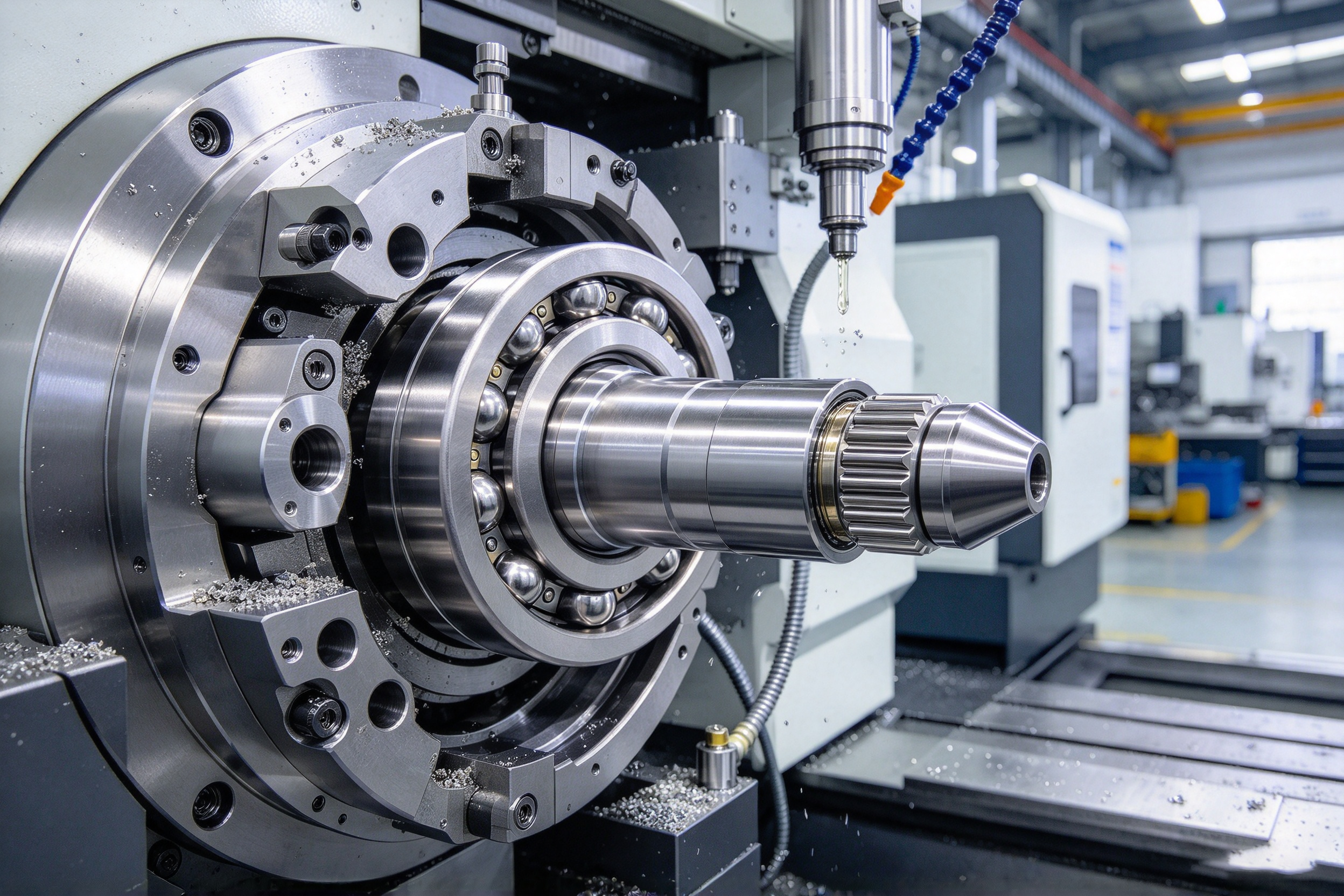
The spindle is the heart of a CNC machine. Any radial or axial deviation in spindle rotation is transferred to the cutting tool and workpiece. Precision spindle bearings reduce these deviations by maintaining strict control over internal geometry, surface finish, and rotational stability.
High-accuracy spindle bearings help achieve:
- Lower runout during high-speed rotation
- Improved surface finish on machined parts
- More consistent dimensional accuracy across production batches
- Reduced vibration and chatter during cutting
- Better thermal stability under continuous operation
- Extended tool life due to smoother spindle behavior
In precision machining, accuracy is not defined by a single parameter. It depends on the complete spindle system, including bearing arrangement, housing design, cooling method, and operating environment.
Key Design Features of Precision Spindle Bearings
Precision spindle bearings are engineered differently from general-purpose rolling bearings. Their design focuses on high rotational accuracy, controlled internal clearance, and predictable stiffness under load.
| Design Feature | Influence on CNC Performance | Typical Consideration |
|---|
| Design Feature | Influence on CNC Performance | Typical Consideration |
|---|---|---|
| Accuracy class | Determines radial and axial runout | P4, P2, or higher grades |
| Contact angle | Affects axial stiffness and load distribution | Commonly 15° or 25° |
| Preload level | Controls stiffness and rotational precision | Light, medium, or heavy preload |
| Cage design | Influences friction, heat, and speed capability | Phenolic, polyamide, or metal cages |
| Lubrication method | Impacts temperature rise and service life | Grease, oil mist, or oil-air |
Angular contact ball bearings are widely used in CNC spindles because they can support combined radial and axial loads while providing high rotational accuracy. In many high-speed spindles, bearings are arranged in pairs or sets to improve stiffness and balance internal forces.
Bearing Accuracy Classes and CNC Applications
Bearing accuracy class is one of the first selection criteria for precision spindles. Higher accuracy classes provide tighter tolerances for bore diameter, outer diameter, width, and runout. However, higher accuracy does not always mean better performance if the surrounding mechanical design cannot support it.
| Accuracy Class | Typical Runout Control | Common CNC Application |
|---|
| Accuracy Class | Typical Runout Control | Common CNC Application |
|---|---|---|
| P0 / Normal | General tolerance | Standard industrial machinery |
| P6 / Class 6 | Improved accuracy | General-purpose spindles |
| P5 / Class 5 | High accuracy | Precision turning and milling |
| P4 / Class 4 | Very high accuracy | High-speed machining centers |
| P2 / Class 2 | Ultra-high accuracy | Ultra-precision grinding and optical machining |
For most high-speed CNC machining centers, P4-class angular contact spindle bearings provide a strong balance between accuracy, speed, cost, and service life. P2-class bearings are usually reserved for ultra-precision applications where nanometer-level stability is required.
Preload, Stiffness, and Thermal Behavior
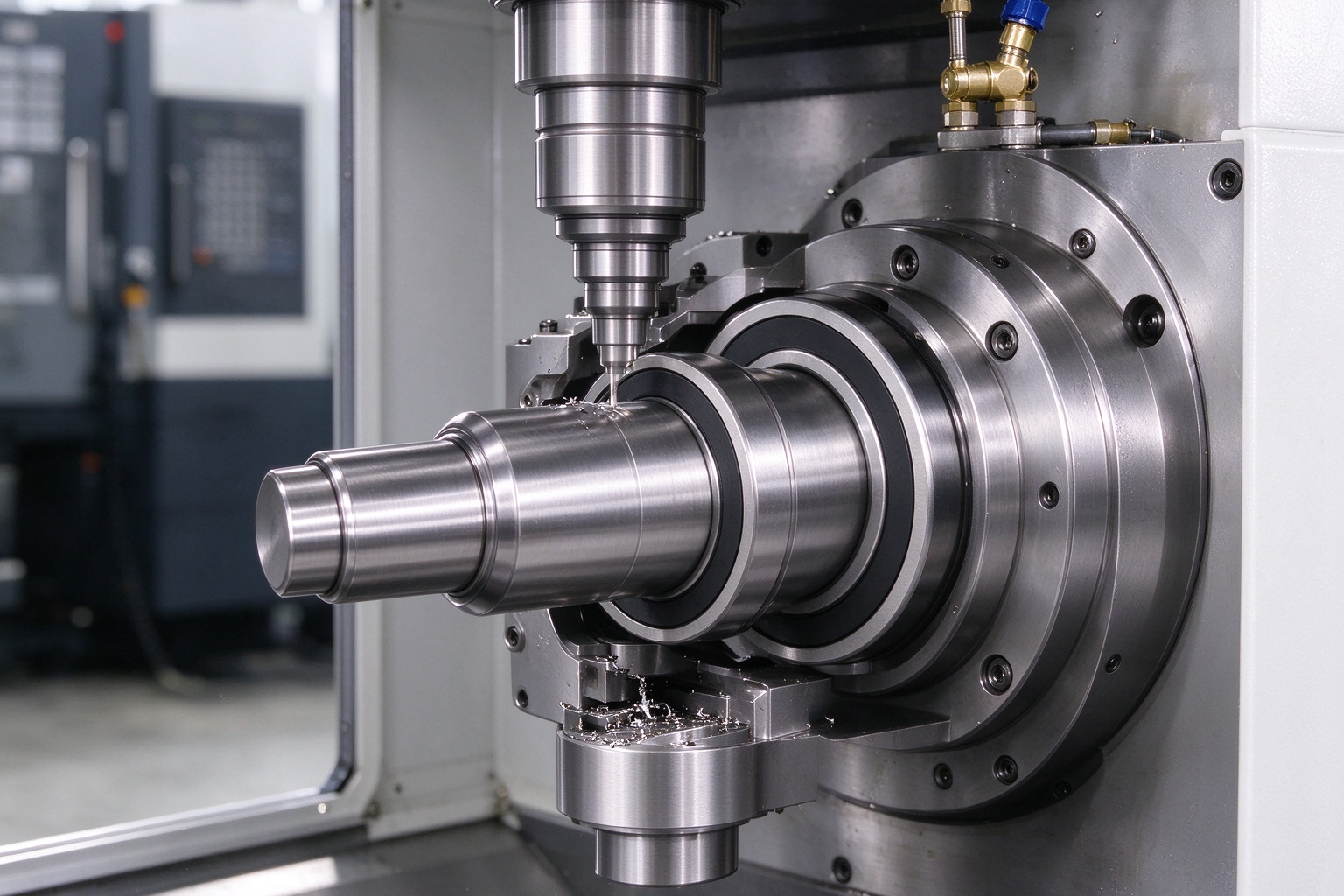
Preload is the internal load applied to a bearing before external forces act on it. Proper preload increases spindle stiffness and reduces vibration, but excessive preload generates additional heat and may shorten bearing life.
In CNC spindle design, preload must be matched to:
- Spindle speed range
- Cutting load characteristics
- Lubrication and cooling conditions
- Bearing arrangement and housing fit
- Required machining accuracy
A common approach is to use matched bearing sets with defined preload levels. This ensures consistent performance and simplifies assembly. For high-speed spindles, lighter preload may be preferred to limit temperature rise. For heavy-cutting applications, higher preload can improve rigidity and reduce deflection.
Lubrication and Speed Limits
Lubrication plays a major role in spindle bearing performance. Incorrect lubrication can cause overheating, cage damage, grease degradation, and premature failure, even when the bearing itself is correctly selected.
| Lubrication Method | Advantages | Best Use Case |
|---|
| Lubrication Method | Advantages | Best Use Case |
|---|---|---|
| Grease | Simple maintenance, good sealing | Moderate-speed spindles |
| Oil mist | Effective cooling, stable film | High-speed continuous operation |
| Oil-air | Precise oil supply, low consumption | Ultra-high-speed precision spindles |
Speed limits are not fixed values. They depend on bearing size, cage type, preload, lubrication, and cooling. A bearing that performs well at moderate speed may overheat if preload or lubrication is not optimized. Therefore, spindle manufacturers should evaluate the complete operating environment rather than relying only on catalog speed ratings.
Installation Practices That Protect Accuracy
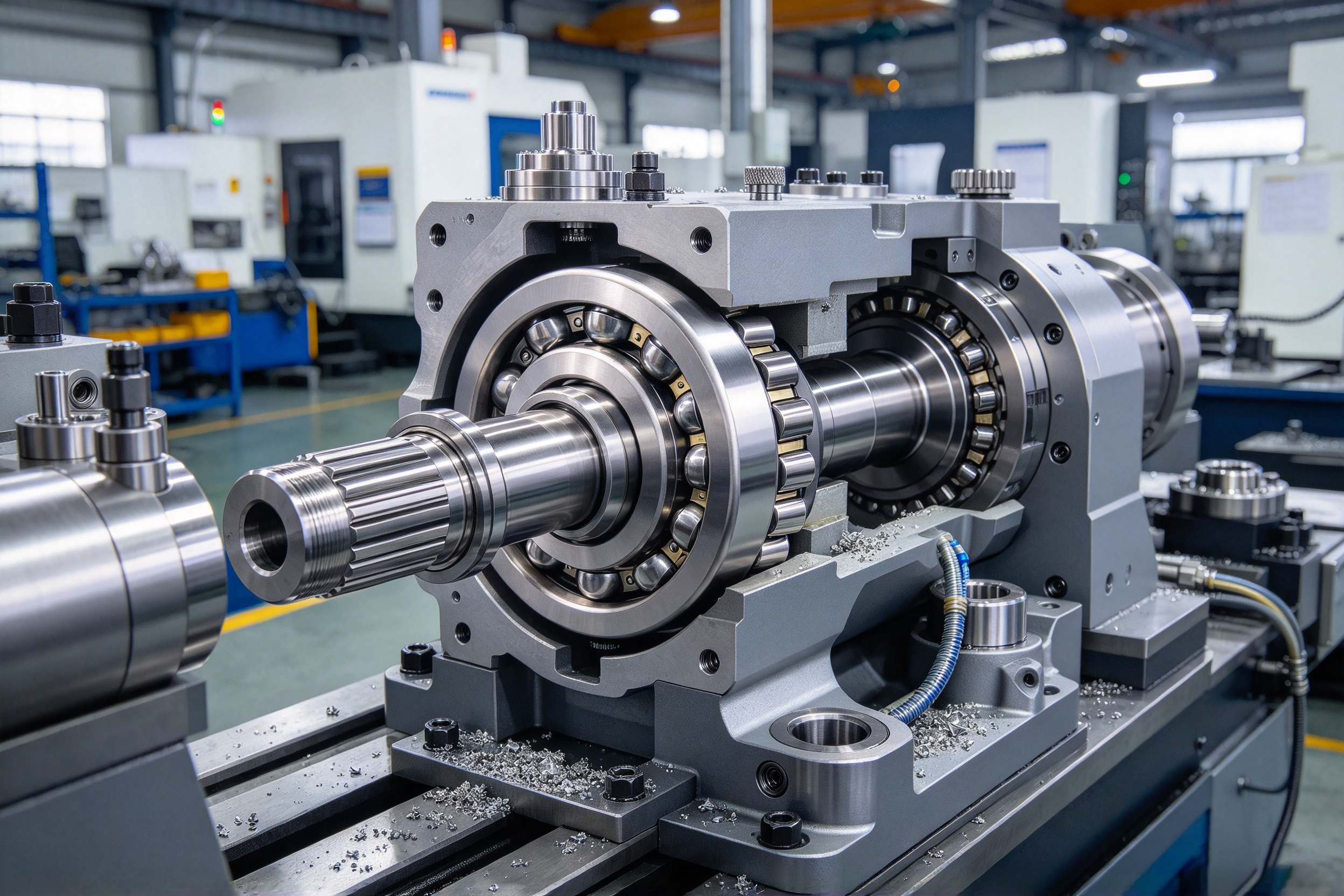
Even the highest-precision bearing cannot deliver nanometer-level performance if it is mounted incorrectly. Installation quality often determines whether theoretical accuracy becomes real machining accuracy.
Key installation requirements include:
- Clean assembly environment to avoid contamination
- Controlled shaft and housing tolerances
- Proper fit selection to prevent creep or excessive preload
- Use of induction heating or hydraulic methods for mounting
- Accurate alignment of bearing seats
- Controlled tightening sequence for locknuts and preload devices
- Verification of runout after assembly
Shaft and housing surfaces should have appropriate geometric accuracy and surface finish. Excessive form errors or rough surfaces can distort bearing rings and increase vibration.
Common Causes of Spindle Bearing Failure
Many spindle problems are not caused by bearing material defects. They are related to contamination, improper preload, poor lubrication, incorrect fits, or thermal overload.
| Failure Symptom | Possible Cause | Recommended Action |
|---|
| Failure Symptom | Possible Cause | Recommended Action |
|---|---|---|
| High temperature rise | Excessive preload or poor lubrication | Check preload, oil supply, and cooling |
| Vibration or noise | Contamination or surface damage | Inspect seals, lubrication, and raceways |
| Poor surface finish | Bearing wear or incorrect preload | Measure runout and review preload setting |
| Short service life | Misalignment or incorrect fit | Verify shaft/housing tolerances and mounting |
| Grease discoloration | Overheating or grease degradation | Improve lubrication method and monitoring |
Regular condition monitoring helps detect early signs of spindle degradation. Temperature sensors, vibration analysis, and runout measurement can prevent unexpected downtime and protect machining accuracy.
Selecting the Right Spindle Bearing for CNC Machines
When selecting precision spindle bearings, CNC machine builders should consider the full application profile rather than isolated specifications. A reliable selection process includes:
- Defining spindle speed range and load conditions.
- Choosing the appropriate accuracy class and bearing type.
- Matching preload to stiffness and thermal requirements.
- Selecting a lubrication method compatible with operating speed.
- Ensuring shaft, housing, and assembly processes meet precision requirements.
- Planning maintenance intervals and condition monitoring.
Precision spindle bearings are not interchangeable components. Their performance depends on careful engineering, correct installation, and consistent maintenance. When these factors are properly managed, they enable CNC machines to achieve stable nanometer-level accuracy, higher productivity, and longer service life.
FAQ: Precision Spindle Bearings for CNC Machining
Q1: What is a precision spindle bearing?
A: It is a high-accuracy bearing designed to support CNC spindles with minimal runout, low vibration, and stable high-speed performance.
A: It is a high-accuracy bearing designed to support CNC spindles with minimal runout, low vibration, and stable high-speed performance.
Q2: Which accuracy class is best for CNC machining?
A: P4 is widely used for high-speed machining centers. P2 is reserved for ultra-precision applications requiring nanometer-level stability.
A: P4 is widely used for high-speed machining centers. P2 is reserved for ultra-precision applications requiring nanometer-level stability.
Q3: How do spindle bearings affect machining accuracy?
A: They control radial and axial runout, reduce vibration, improve surface finish, and help maintain consistent dimensional tolerances.
A: They control radial and axial runout, reduce vibration, improve surface finish, and help maintain consistent dimensional tolerances.
Q4: What is bearing preload?
A: Preload is an internal load applied before external cutting forces act. It increases stiffness but must be balanced to avoid excessive heat.
A: Preload is an internal load applied before external cutting forces act. It increases stiffness but must be balanced to avoid excessive heat.
Q5: Grease or oil lubrication— which is better?
A: Grease suits moderate-speed spindles. Oil mist or oil-air lubrication is better for high-speed and continuous-operation spindles.
A: Grease suits moderate-speed spindles. Oil mist or oil-air lubrication is better for high-speed and continuous-operation spindles.
Q6: Why do spindle bearings overheat?
A: Common causes include excessive preload, poor lubrication, incorrect fits, contamination, or insufficient cooling.
A: Common causes include excessive preload, poor lubrication, incorrect fits, contamination, or insufficient cooling.
Q7: How long do precision spindle bearings last?
A: Service life depends on speed, load, lubrication, installation quality, and operating environment. Regular monitoring helps extend life.
A: Service life depends on speed, load, lubrication, installation quality, and operating environment. Regular monitoring helps extend life.
Post time: Oct-30-2026