


6006 2RS reference bearing — typical C2 / C0 / C3 / C4 clearance options across ABEC 1 / 3 / 5 grades.
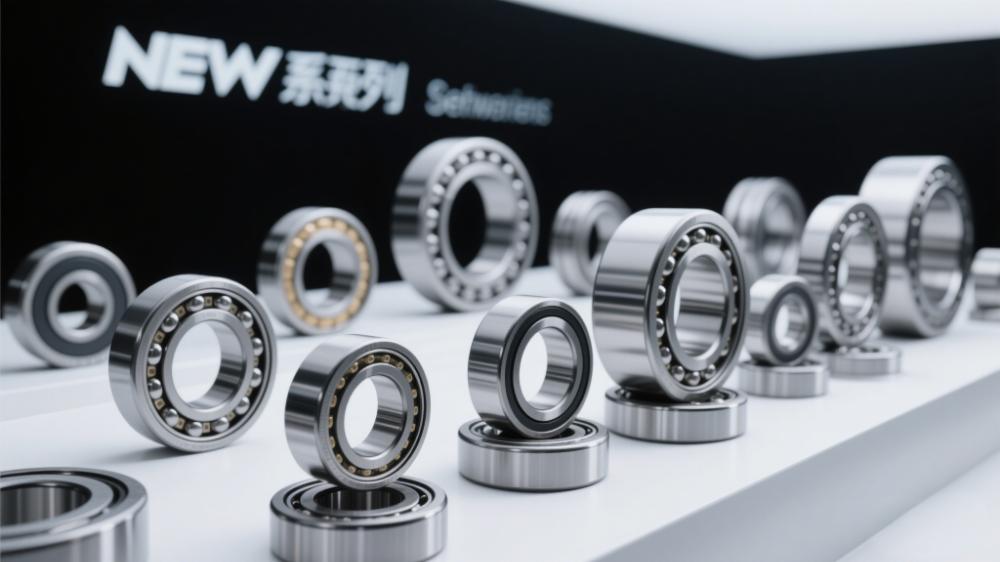
Cross-section of a precision-ground inner raceway — the surface finish is what ABEC grade actually measures.
For most textile machinery (ring spinning, weaving, knitting, dyeing, roving frames, drafting systems below 3,000 RPM), ABEC-3 (ISO P6) is the practical ceiling. ABEC-5 (ISO P5) pays off only on high-speed texturizing, precision winding, and fine-denier spinning above 3,000 RPM. ABEC-1 (ISO P0) is the cost baseline for drafting rollers and roving frames where accuracy is not critical. Choosing ABEC above the requirement is the most common unnecessary spend in textile machinery OEM sourcing.
If you build textile machinery — ring spinning frames, roving frames, winding machines, texturizing equipment, weaving machines, knitting machines, dyeing range machinery — you have to make a precision-grade decision on every deep groove ball bearing in the BOM. The decision looks small per bearing, but multiplied across the bearing count of a single machine and the OEM annual volume, the wrong choice becomes a six-figure line item.
ABEC-1, ABEC-3, and ABEC-5 are three precision tolerance grades that map to three different price points and three different performance envelopes. The decision is not which grade is “best” — it is which grade matches the duty cycle of the specific bearing position. This guide covers the engineering numbers behind the grades, the typical textile application per grade, the cost premium per step, and where the diminishing returns line sits.
What ABEC Actually Measures (and What It Doesn’t)
The ABEC scale was developed by the Annular Bearing Engineering Committee of the American Bearing Manufacturers Association (ABMA) and is now maintained as an ANSI standard. It rates bearings on five geometric parameters under controlled measurement conditions: bore diameter tolerance, outer diameter tolerance, radial runout, axial runout, and side runout (perpendicularity).
What ABEC measures: the dimensional and geometric precision of the bearing as manufactured, under no-load conditions, on a controlled test fixture at room temperature.
What ABEC does not measure: load capacity, fatigue life, grease life, speed rating, operating temperature range, noise level under load, vibration under load, or any application-specific performance characteristic. The ABEC grade is a manufacturing-precision contract, not a performance warranty.
This distinction matters because two ABEC-5 bearings from different manufacturers can have substantially different field performance, depending on the steel cleanliness, the heat treatment, the raceway surface finish, and the cage design — none of which the ABEC grade captures. ABEC-5 is a precision floor, not a quality ceiling.
| ABEC Grade | ISO 492 Equivalent | DIN 620 | JIS B 1514 | Bore Tolerance (small bearings) |
|---|---|---|---|---|
| ABEC-1 | Normal Class (P0) | P0 | Class 0 | 0 to -8 µm |
| ABEC-3 | Class 6 (P6) | P6 | Class 6 | 0 to -6 µm |
| ABEC-5 | Class 5 (P5) | P5 | Class 5 | 0 to -5 µm |
| ABEC-7 | Class 4 (P4) | P4 | Class 4 | 0 to -4 µm |
| ABEC-9 | Class 2 (P2) | P2 | Class 2 | 0 to -2.5 µm |
The bore tolerance column shows the trend: each ABEC step roughly halves the geometric tolerance band. The price premium per step is roughly 30-60%, depending on the bearing series and size. So a 6204 ABEC-1 at USD 1.20 might be USD 1.80 at ABEC-3 and USD 2.80 at ABEC-5 — three steps, 2.3x the unit price, but only a 38% tighter bore tolerance band.
P0/P6/P5/P4 vs. ABEC-1/3/5/7: The ISO-ABEC Translation
The ISO 492 standard (most recently revised as ISO 492:2023) and the ABEC system converge closely enough that for sourcing purposes, they are treated as equivalent. The mapping above is the practical reference. The minor numerical differences come from the way each standard defines the measurement conditions and the way each rounds the tolerance values.
For a textile OEM sourcing from a Chinese bearing manufacturer, the practical situation is that the Chinese catalog will list the precision grade using the ISO notation (P0, P6, P5, P4). The buyer who needs ABEC-5 specifies P5, the buyer who needs ABEC-3 specifies P6, and the buyer who needs ABEC-1 specifies P0. The two notations travel together; the manufactured product is the same.
The OEM has to be careful with one edge case: ISO 492 also defines a P3 grade (between P4 and P2) that has no ABEC counterpart. If a Chinese catalog lists P3, it is tighter than ABEC-7 and is not equivalent to any standard ABEC class. This grade is uncommon in textile machinery but does appear in some high-precision grinding and metrology equipment.
Textile Machinery Tolerances: Which ABEC Grade Matches Which Application
Textile machinery spans a wide range of speeds and accuracy requirements. The ABEC grade decision is per bearing position, not per machine. A typical textile OEM BOM uses two or even three ABEC grades in the same machine, depending on the bearing function.
| Bearing Position | Typical Speed (RPM) | Recommended ABEC | Reason |
|---|---|---|---|
| Spindle bearing (ring spinning) | 15,000 – 25,000 | ABEC-5 (P5) or ABEC-7 (P4) | Yarn quality depends on spindle runout < 5 µm |
| Spindle bearing (texturizing, false-twist) | 20,000 – 400,000 | ABEC-5 (P5) minimum | Speed variation drives yarn denier variation |
| Drafting roller top roller | 200 – 3,000 | ABEC-3 (P6) | Load and concentricity matter more than precision |
| Roving frame top roller | 800 – 2,000 | ABEC-1 (P0) | Cost baseline, accuracy not critical |
| Winding machine drum | 1,500 – 4,000 | ABEC-3 (P6) | Drum runout affects package quality |
| Weaving machine crank / cam | 200 – 600 | ABEC-1 (P0) | Heavy shock load, precision not limiting |
| Knitting machine cylinder | 1,000 – 3,000 | ABEC-3 (P6) | Cylinder runout affects stitch uniformity |
| Dyeing range roller | 50 – 200 | ABEC-1 (P0) | Speed low, chemical resistance the real spec |
The pattern: high-speed, accuracy-critical positions (spindle, texturizing) need ABEC-5 or better. Medium-speed positions where concentricity and runout matter (winding drums, knitting cylinders, top rollers) need ABEC-3. Heavy-load, low-speed, shock-loaded positions (weaving crank, roving frames, dyeing rollers) need ABEC-1.
Cost Premium Per Grade: The Textile OEM Build-vs-Buy Math
The unit-price step between ABEC grades depends on the bearing series and size, but a representative spread for a 6206 ZZ (a typical textile machinery bearing):
- ABEC-1 (P0): baseline price, USD 1.20-1.50 per bearing
- ABEC-3 (P6): ~50-80% premium, USD 1.80-2.65
- ABEC-5 (P5): ~120-180% premium over baseline, USD 2.65-4.20
On a typical ring spinning frame with 400-500 bearing positions (spindles, drafting rollers, drafting bottom rollers, roving bearings, drive train), the wrong ABEC grade decision can swing the bearing-only BOM by USD 800-2,000 per machine. At OEM annual volumes of 5,000-10,000 machines, that becomes USD 4-20 million per year on the line item.
The most common mistake is specifying ABEC-5 across the entire BOM when only 20-30% of the bearing positions actually need ABEC-5. The drafting roller position that runs at 800 RPM does not need ABEC-5; it needs ABEC-1 or ABEC-3 and the OEM pocket the difference. Specifying ABEC-5 everywhere is the easiest way to lose the OEM’s bearing margin to a competitor who specs correctly per position.
Case Study: A Textile OEM Switching ABEC-3 to ABEC-5 on a High-Speed Winder
A precision winding machine builder in Italy ran a 6204 ZZ on the winding drum at 3,800 RPM. The application: winding fine-denier nylon yarn (40 denier and below), where speed variation on the drum translates directly into denier variation in the finished package. The original spec was ABEC-3.
The OEM measured package denier variation at the winder output across multiple machines over a 6-month field trial. The data, summarized from their internal service bulletin:
- ABEC-3 spec (6204 ZZ P6): Mean denier variation across package = 4.8% (CV). Customer rejection rate on 40-denier lots = 3.2%.
- ABEC-5 spec (6204 ZZ P5): Mean denier variation = 3.1% (CV). Customer rejection rate = 1.1%.
- Net on the ABEC-5 trial: denier variation dropped by 35%, rejection rate dropped by 66%.
- Unit cost delta: USD 1.65 per bearing upcharge on 8 bearings per machine = USD 13.20 per machine.
- Net saving on rejection: 2.1 percentage points of rejected production. At 40 denier nylon pricing and the trial volumes, the saving was approximately USD 240 per machine per year in recovered good production.
The payback on the ABEC-5 upcharge was less than 3 weeks of production. This case is representative: on high-speed precision winding above 3,000 RPM with tight denier tolerance, ABEC-5 pays back. Below 3,000 RPM on ring spinning or general winding, the same upcharge does not pay back and ABEC-3 is the correct spec.
When to Spec ABEC-3 and Stop: The Diminishing Returns Line
The general rule for textile machinery: if the bearing position runs below 3,000 RPM and does not have a documented accuracy requirement tighter than the machine’s overall quality spec, ABEC-3 is the practical ceiling. Going to ABEC-5 adds cost without measurable output gain.
Three situations where ABEC-5 is justified despite the cost:
- High-speed texturizing above 3,000 RPM — false-twist, air-jet texturizing. Speed variation on the spindle rolls directly into yarn denier variation. ABEC-5 minimum; ABEC-7 for the higher speed variants.
- Fine-denier precision winding — winding 40 denier and below, where customer rejection on denier variation is a real cost driver. The Italy case above is a representative example.
- Spindle bearing in ring spinning above 18,000 RPM — modern high-speed ring frames. Below 15,000 RPM ring spindle, ABEC-3 is usually adequate; above 18,000 RPM, ABEC-5 starts to pay.
Outside these three situations, the answer for a textile OEM is ABEC-3 on accuracy-critical positions and ABEC-1 on heavy-load or low-accuracy positions. The cost savings of correct per-position ABEC specification are real, and they compound across an OEM’s annual production volume.
How Juding Supplies ABEC-1 / ABEC-3 / ABEC-5 Across 6200 / 6300 / 6400 Series
Ningbo Demy (D&M) Bearings Co., Ltd. — operating as Juding Engineering — supplies deep groove ball bearings across the 6200, 6300, and 6400 series with P0 / P6 / P5 / P4 precision grades (mapped to ABEC 1 / 3 / 5 / 7), in OEM and branded packaging. The reference page at deep groove ball bearings tolerance ABEC shows the 6006 2RS as a typical P0 / P6 / P5 cross-reference bearing.
For OEM buyers specifying by position, the typical engagement covers: the 6203 ZZ for top rollers (17 × 40 × 12 mm, see the ceiling fan ball bearing 6203 P0 P6 P5 precision reference listing) and the 6206 ZZ for winding drums and drafting bottom rollers (30 × 62 × 16 mm, see the 6206 ZZ deep groove ball bearings catalog page). For OEM volume inquiries on ABEC-graded deep groove ball bearings for textile machinery, use the contact form with the bearing series, precision grade, and quantity specified.
Standard catalog part numbers are typically available with 7-15 day sample lead time; custom ABEC grade configurations for high-volume OEM programs are typically 15-30 days. The factory runs ISO 9001:2015 quality systems with batch traceability per shipment.
Frequently Asked Questions
What is the practical difference between ABEC-1, ABEC-3, and ABEC-5?
ABEC-1 is normal precision (ISO P0 equivalent), with bore tolerance 0 to -8 microns on small bearings. ABEC-3 is moderate precision (ISO P6), tolerance 0 to -6 microns. ABEC-5 is high precision (ISO P5), tolerance 0 to -5 microns. For most textile machinery, ABEC-3 gives the right balance of accuracy and cost.
Is ABEC-5 worth the premium over ABEC-3 for a textile machine?
Only on machines that run above 3,000 RPM with tight speed variation requirements — high-speed false-twist texturizing, fine-denier yarn spinning, precision winding. For general ring spinning, weaving, knitting, and dyeing machinery below 3,000 RPM, ABEC-3 is the practical ceiling and ABEC-5 adds cost without measurable output gain.
Does ABEC grade affect bearing life?
Marginally. Tighter tolerances reduce vibration and improve running accuracy, which can extend grease life and reduce wear on adjacent components, but the calculated L10 fatigue life of the bearing itself is dominated by load and lubrication, not ABEC class. Choose ABEC for accuracy, not for life.
What ISO grade maps to ABEC-5?
ABEC-5 maps to ISO 492 Class 5 / DIN 620 P5 / JIS B 1514 Class 5. The two systems are treated as equivalent for engineering and sourcing purposes, though minor numerical differences exist in certain bore ranges.
Can a textile OEM mix ABEC-1 and ABEC-3 in the same machine?
Yes — that is standard practice. Spindle bearings in a ring-spinning frame typically run ABEC-5 or ABEC-3 for accuracy, while drafting roller and roving frame bearings run ABEC-1 for cost. The ABEC grade is selected per bearing position, not per machine.
Where can I source ABEC-1 / ABEC-3 / ABEC-5 deep groove ball bearings in OEM quantities?
Juding Engineering (Ningbo Demy Bearings) supplies deep groove ball bearings across the 6200 / 6300 / 6400 series with P0 / P6 / P5 / P4 precision grades (mapped to ABEC 1 / 3 / 5 / 7), in OEM and branded packaging. The 6006 2RS reference page lists the precision grade options at https://www.juding-engineering.com/deep-groove-ball-bearings-6006-2rs-product/.
Post time: Aug-06-2026