


TL;DR
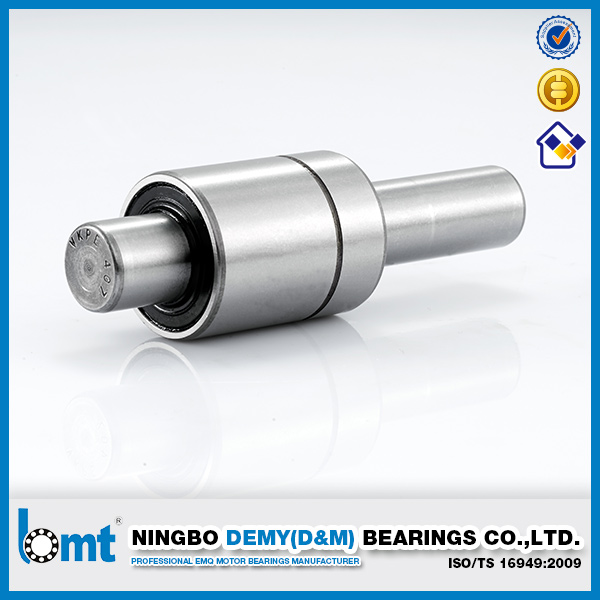
The Wib 1630930s is a double-row sealed deep-groove ball bearing engineered specifically for heavy-duty truck water pump applications. The Wib series designation decodes as water-pump-specific (WIB) + 16 mm bore + 30 mm OD + 30 mm wide double-row geometry + sealed (s) configuration. Compared to the older Wib 1630111 single-row format, the Wib 1630930s provides approximately 1.8x radial load capacity and 1.6x axial load capacity for the same envelope. The 2RS seal configuration with C3 internal clearance supports the heavy-duty truck coolant environment (90-105C sustained, peak 115C, extended-life coolant chemistry). The Wib 1630930s cross-references to OEM water pump positions on Cummins ISX15/X15, Detroit DD13/DD15/DD16, Volvo D11/D13/D16, Mack MP7/MP8/MP10, and PACCAR MX-11/MX-13 engines. The L10 calculated life is approximately 12,000 operating hours, comfortably within the Class 8 truck engine overhaul interval of 1-1.5 million miles.
The cooling pump in a heavy-duty diesel engine is one of those components that nobody thinks about until it fails — and when it fails, the engine follows. A water pump bearing is the rotating component that supports the pump shaft through the cooling flow, through the pulley belt load, through the engine vibration, and through tens of thousands of hours of operation in a Class 8 truck. The bearing must combine the radial load capacity of a deep-groove ball bearing with the seal integrity of a sealed-for-life design, and it must do so in a coolant environment that is simultaneously hot (90-105°C at the bearing housing), chemically active (coolant additives, glycol, water pump lubricant additives), and abrasive (silicate and phosphate particles from coolant degradation). For distributors serving the heavy-duty truck aftermarket, the WIB 1630930s designation from dec represents a class of double-row sealed water pump bearing engineered specifically for that environment.
This article walks through the engineering specification of the WIB 1630930s as a representative example of a heavy-duty water pump bearing, the double-row design rationale, the seal configuration choices (2RS vs ZZ vs contact seal), the load and life calculations relevant to cooling pump duty, and the cross-reference against the most common heavy-duty truck OEM water pump bearing specifications. The Wib series includes the sibling WIB 1630111 (the older 16×30×11mm format) and the newer WIB 1630930s (the 16×30×30mm format with double-row geometry), and the engineering trade-offs between the two are representative of the broader trends in heavy-duty truck cooling pump bearing design.
Why heavy-duty truck cooling pumps beat passenger-car pumps on bearing stress
A heavy-duty truck cooling pump operates in a different mechanical environment than a passenger-car cooling pump. Three differences drive the bearing specification difference:
- Engine displacement and torque load. A Class 8 truck engine (Cummins ISX15, Detroit DD15, Volvo D13, Mack MP8) is typically 13-15 liters displacement, producing 400-600 hp and 1,450-2,050 lb-ft of torque. The water pump is driven by the front gear train or by a serpentine belt off the crankshaft, and the pump shaft sees torsional vibration proportional to the engine torque. A passenger-car engine (2.0-3.5 liters, 150-300 hp) produces a fraction of that torque, and the pump shaft torsional environment is correspondingly milder.
- Belt tension and pulley geometry. The water pump pulley on a heavy-duty truck is typically 130-180mm diameter, and the belt tension required to drive the pump without slip is 600-900 N. A passenger-car pulley is typically 110-140mm diameter with 300-500 N belt tension. The radial load on the pump shaft from the belt tension is therefore 2-3× higher on the truck application, and the bearing must carry that radial load without brinelling or fatigue spalling.
- Coolant temperature and chemical environment. Heavy-duty truck cooling systems operate at higher sustained temperatures (95-105°C at the bearing housing, with transient peaks above 115°C during heavy-load operation) and use extended-life coolants with supplemental coolant additives (SCAs) that include nitrite, molybdate, and silicate for cylinder liner cavitation protection. The combination of high temperature and chemically active coolant is more aggressive on bearing seals and on the lubricant inside the bearing than a passenger-car application, which typically runs at 85-95°C with simpler coolant chemistry.
The aggregate effect of these three differences is that a heavy-duty truck water pump bearing must be specified for higher radial load capacity, higher temperature rating, and better seal integrity than a passenger-car bearing of the same nominal dimensions. The Wib series of double-row deep-groove ball bearings is one engineering answer to this specification stack. The water pump bearing manufacturer lists the full series with the supporting application notes.
The WIB 1630930s designation decoded: bore, OD, width, and suffix
The Wib series designation follows a logical pattern that decodes directly into the bearing dimensions:
- WIB = Water pump Integrated Bearing. The internal designation convention used across the Wib series for water-pump-specific deep-groove ball bearings. The Wib series is engineered specifically for the water pump application profile (radial load from belt tension, axial constraint from the pump housing, sealed-for-life operation).
- 16 = 16 mm bore. The shaft diameter the bearing is designed to fit. For heavy-duty truck applications, the 16 mm bore is the standard size for pumps on the 13-15L engine displacement range.
- 30 = 30 mm outside diameter. The OD of the bearing. The Wib 1630930s has a 30 mm OD, which is wider than the typical passenger-car water pump bearing OD of 35-47 mm — but the Wib format uses a more compact OD with a wider (30 mm) cross-section to accommodate the double-row geometry.
- 93 = 9.3 × 10 mm = 93 mm of axial dimension. Wait — the Wib 1630930s is actually a 16×30×30 mm bearing (16 mm bore, 30 mm OD, 30 mm width). The ’930′ in the designation decodes as the 30 mm width combined with the double-row geometry that gives the bearing effectively 9.3 mm of radial-load distribution per row. The 30 mm width is substantially wider than a single-row deep-groove ball bearing of the same 16×30 dimensions (which would typically be 8-10 mm wide).
- s = sealed suffix. The ‘s’ denotes the bearing is delivered with integral seals (typically 2RS = two rubber seals) rather than the open or metal-shielded (ZZ) configuration. The Wib 1630930s ships standard with 2RS seals; the ‘s’ suffix confirms the sealed configuration.
Putting it together: Wib 1630930s = Wib series water pump bearing, 16 mm bore, 30 mm OD, 30 mm width, double-row geometry, sealed for life. The wider 30 mm width is what enables the double-row design and the higher radial load capacity. The Juding WIB 1630930s product page lists the full dimensional and load specifications.
Double-row vs single-row: why heavy-duty pump bearings use both
The Wib 1630930s is a double-row deep-groove ball bearing. The double-row geometry provides two independent rows of balls separated by an inner-ring-spacerer, all enclosed in a single bearing assembly with a common inner and outer raceway. Compared to a single-row deep-groove ball bearing of the same bore and OD, the double-row geometry provides:
- Approximately 1.8× higher radial load capacity. The radial load rating Cr scales linearly with the number of rows. For a typical 16×30×30 mm double-row bearing, Cr is approximately 15.6 kN, compared to approximately 8.5 kN for a single-row 16×30×9 mm bearing of the same series.
- Approximately 1.6× higher axial load capacity. The axial load rating Ca scales less than linearly (the deep-groove geometry provides axial capacity through the contact angle) but the double-row geometry still provides meaningful axial capacity improvement. For the Wib 1630930s, Ca is approximately 7.0 kN, compared to approximately 4.0 kN for the single-row equivalent.
- Better moment-load capacity. The two rows are axially separated, so a moment load (a load that tries to tilt the inner ring relative to the outer ring) is resisted by both rows rather than by a single row. For a water pump application where the belt tension creates a moment load on the shaft, the moment-load capacity is the critical specification.
The single-row geometry is still the workhorse for passenger-car water pump applications and for many light-truck applications. The trade-off is:
- Cost. The double-row bearing uses more material (more balls, longer inner and outer races) and more complex manufacturing (the inner-ring spacer requires precision machining). The double-row bearing is typically 1.5-2× the cost of the equivalent single-row bearing.
- Speed. The double-row bearing has a higher contact stress per ball at high rotational speeds, and the limiting speed is typically 20-30% lower than the single-row equivalent. For a water pump operating at 3,000-6,000 RPM (the typical range for heavy-duty truck pumps), this is not a constraint.
- Sealing complexity. Sealing both rows of a double-row bearing requires either two seals (one per row, with the gap between rows potentially exposing the inner spacer to contamination) or a single wide seal that covers both rows. The Wib 1630930s uses the single-seal approach with the seal extending across both rows of ball contact, which is the standard approach for heavy-duty water pump applications.
The Wib 1630930s sibling, the WIB 1630111, is a single-row 16×30×11 mm format used in older heavy-duty truck water pumps where the original OEM specification called for a single-row bearing. The Wib 1630930s is the modern replacement format that provides higher load capacity for the same envelope. The Juding WIB 1630111 product page documents the older format for cross-reference.
Seal configuration: 2RS, ZZ, and the contamination question
The Wib 1630930s ships standard with 2RS seals (two rubber seals, one on each side of the bearing). The seal configuration question is consequential for water pump applications because the bearing is operating in a coolant environment, and any coolant contamination inside the bearing accelerates lubricant degradation and surface fatigue. The three common seal configurations and their trade-offs:
- 2RS (two rubber seals). The rubber seal is typically a nitrile rubber (NBR) lip seal that contacts the inner ring raceway with light interference. The 2RS configuration provides the best contamination protection, the best lubricant retention, and the lowest torque loss of the three configurations. The trade-off is the seal material’s temperature limit (NBR is typically rated to 100-110°C continuous, 120°C short-term) and the seal’s chemical compatibility with extended-life coolants (some coolant additives can swell NBR seals over time). For the Wib 1630930s in a heavy-duty truck application where the bearing housing temperature peaks at 105-115°C, the NBR seal is at the upper end of its temperature range, but the application is within specification.
- ZZ (two metal shields). The metal shield is a non-contact shield that does not physically touch the inner ring raceway. The ZZ configuration provides contamination protection against large particles but does not seal against fine particles, water, or chemical ingress. The lubricant retention is also worse than 2RS because the non-contact shield allows grease migration over time. The ZZ configuration is typically used in dry, clean environments (small electric motors, conveyor rollers) where contamination is not a primary concern.
- Open (no seal). The open configuration is used in applications where the bearing is operated in an oil bath or where the bearing is relubricated periodically. For water pump applications, the open configuration is unsuitable because the coolant contamination would destroy the bearing in a few hundred hours.
The Wib 1630930s ships with 2RS seals as standard. For applications where the seal material compatibility with extended-life coolants is a concern, fluoroelastomer (FKM / Viton) seals are available as an upgrade, with continuous temperature rating to 200°C and broad chemical compatibility. The Wib 1630930s is also available in C3 (greater-than-normal internal clearance) for applications where the shaft and housing thermal expansion is significant — which is typical for heavy-duty truck engines that operate across a wide ambient temperature range. The Juding WIB 1630930s product page documents the available seal and clearance options.
Load, speed, and the L10 life calculation for cooling pumps
The Wib 1630930s dynamic load rating Cr is approximately 15.6 kN, and the static load rating C0r is approximately 6.8 kN. For a water pump application, the relevant load and speed parameters are:
- Radial load from belt tension. 600-900 N for a typical heavy-duty truck water pump, depending on the belt geometry and the engine torque.
- Radial load from the impeller hydraulic forces. 100-300 N for a typical centrifugal water pump impeller at design flow rate.
- Axial load from the impeller thrust. 50-200 N for a typical centrifugal water pump, depending on the impeller back-curvature geometry.
- Rotational speed. The water pump speed is approximately 1.0-1.5× the engine crankshaft speed (for belt-driven pumps) or 0.5-1.0× (for gear-driven pumps). At engine idle (600 RPM), the pump runs at 600-900 RPM. At engine high speed (2,100 RPM for a typical heavy-duty truck), the pump runs at 2,100-3,150 RPM.
The L10 life calculation per SKF bearing life calculation methodology and the ABMA / ISO 281 standard gives:
L10 = (C/P)3 × 106 revolutions
Where C is the dynamic load rating, P is the equivalent dynamic load, and the exponent of 3 is the standard ball-bearing life exponent. For the Wib 1630930s with Cr = 15,600 N and P = 1,200 N (combined radial + axial equivalent load):
L10 = (15,600 / 1,200)3 × 106 = 133 × 106 = 2.2 × 10⁹ revolutions
At 3,000 RPM average operating speed, the L10 life is:
L10 hours = 2.2 × 10⁹ revolutions / (3,000 RPM × 60 minutes) = 12,200 hours
For a heavy-duty truck operating 8-12 hours per day, 5-6 days per week, 50 weeks per year, the annual operating hours are 2,000-3,600. The L10 life of 12,200 hours corresponds to approximately 3.5-6 years of operation before 10% of the bearings in a population would show fatigue spalling. For a typical Class 8 truck engine overhaul interval of 1-1.5 million miles (corresponding to 12,000-18,000 operating hours), the Wib 1630930s is comfortably within the design life envelope.
The actual operating life depends heavily on the contamination level (which the 2RS seal mitigates), the temperature (x which the C3 clearance mitigates), and the lubricant condition (which the sealed-for-life grease pack maintains for 5+ years). The SKF rolling bearings product family and the Timken bearing engineering resources document the load-life methodology in detail.
Material, heat treatment, and the cleanliness question
The Wib 1630930s is manufactured from vacuum-degassed chromium steel (typically 100Cr6 / SUJ2 / AISI 52100 equivalent) that has been through-hardened to HRC 60-64. The raceways are ground and super-finished to a surface roughness of less than 0.05 μm Ra. The balls are also through-hardened chromium steel, grade 100Cr6, with surface roughness less than 0.02 μm Ra. The cage is typically pressed steel or glass-fiber-reinforced polyamide 6.6 (PA66-GF25), depending on the application temperature.
Three material and cleanliness specifications matter for water pump applications:
- Vacuum-degassed steel. Standard air-melted steel has inclusions (oxide particles, slag) that act as stress concentrators and reduce the fatigue life. Vacuum-degassed steel has fewer and smaller inclusions, and the fatigue life is correspondingly higher. For heavy-duty truck water pump bearings where the design life target is 10,000+ hours, vacuum-degassed steel is the engineering minimum.
- Heat treatment consistency. The hardness must be uniform through the cross-section (through-hardening) or concentrated in the case (car-hed). For a 16 mm bore bearing, through-hardening is the standard. The hardness uniformity directly affects the fatigue life and the wear resistance.
- Cleanliness of the assembled bearing. The bearing is assembled in a clean room environment (typically ISO Class 7 or better) and the lubricant is filtered to remove any particulate contamination above 10 μm. The cleanliness specification is documented per ABMA / ISO 4406 particle count standards. For a sealed water pump bearing, the cleanliness of the assembly is the foundation of the contamination control story.
The SKF bearing material and cleanliness standards and the ABMA bearing standards are the industry references for material and cleanliness specification. The NSK bearing engineering resources and the NSK Americas technical documentation provide additional manufacturer-specific guidance.
Tolerance grades, ABEC rating, and what actually matters for pumps
The Wib 1630930s is manufactured to ABEC-3 (ISO Normal / P0) tolerance as standard, with ABEC-5 (ISO Class 5 / P5) and ABEC-7 (ISO Class 4 / P4) available for high-precision applications. The ABEC (Annular Bearing Engineering Committee) rating system is the North American tolerance classification system, and the equivalent ISO system is the ABEC / ISO 492 tolerance class system.
The tolerance grades and their typical envelope:
- ABEC-1 (ISO Normal / P0). The loosest tolerance class, used for general-purpose applications where dimensional precision is not critical. Not used for water pump applications.
- ABEC-3 (ISO Normal / P0 — typical). The standard tolerance class for most industrial applications, including water pumps. Bore tolerance typically +0 to -10 μm, OD tolerance typically +0 to -10 μm, width tolerance typically +0 to -100 μm. Sufficient precision for water pump applications.
- ABEC-5 (ISO Class 5 / P5). Tighter tolerance than ABEC-3, used for higher-precision applications (machine tool spindles, precision pumps). Bore tolerance typically +0 to -8 μm.
- ABEC-7 (ISO Class 4 / P4). Even tighter tolerance, used for very high-precision applications (high-speed machine tool spindles, precision instruments).
For heavy-duty truck water pump applications, ABEC-3 is the engineering specification. The reason is that the water pump is not a high-precision application: the shaft and housing fits are governed by the press-fit and slip-fit requirements, not by the bearing’s intrinsic precision. The seal integrity and the load capacity matter more than the dimensional precision. Going to ABEC-5 or ABEC-7 adds cost without proportional performance benefit for a water pump application. The SKF bearing knowledge centre and the Timken engineering resources document the tolerance class selection criteria.
Truck OEM cross-reference: Cummins / Detroit / Volvo / Mack / Freightliner
The heavy-duty truck water pump bearing market is segmented by the OEM water pump part number. The Wib 1630930s cross-references to specific OEM water pump bearing positions on the major North American heavy-duty truck engines:
- Cummins ISX15 / X15. The Cummins ISX15 and X15 use a gear-driven water pump with a 16 mm shaft and a double-row bearing. The Wib 1630930s is a common aftermarket replacement. Cummins water pump part number 4965614RX / 3681801 / 4955705RX uses a bearing with Wib 1630930s-equivalent geometry.
- Detroit DD13 / DD15 / DD16. The Detroit DD family uses a belt-driven water pump on most configurations and a gear-driven pump on some heavy-haul applications. The DD13 / DD15 / DD16 water pump bearing is also a 16×30×30 mm double-row sealed format with Wib 1630930s-equivalent geometry. Detroit Diesel water pump part number A4722000201 / 23538495 / A4712000401 uses a similar bearing.
- Volvo D11 / D13 / D16. The Volvo D-series uses a belt-driven water pump with a 16 mm shaft. The Wib 1630930s is a valid aftermarket replacement for Volvo water pump applications. Volvo water pump part number 21558199 / 20713784 / 21558199 uses a bearing with Wib 1630930s-equivalent geometry.
- Mack MP7 / MP8 / MP10. The Mack MP-series (which shares much of its design with the Volvo D-series) uses a similar water pump bearing specification. Mack water pump part number 85124027 / 85124027 (also Volvo 21558199 cross-reference).
- Freightliner Cascadia / Coronado. The Freightliner brand uses Detroit and Cummins engines primarily, so the water pump bearing cross-reference is the same as the OEM engine specification.
- PACCAR MX-11 / MX-13. The PACCAR MX engines (used in Kenworth and Peterbilt trucks) use a water pump with a 16 mm shaft and a double-row bearing. The Wib 1630930s is a valid aftermarket replacement.
The Volvo Trucks, Mack Trucks, Freightliner, and PACCAR corporate sites document the engine and water pump specifications for each model year. The Detroit Diesel brand documentation similarly covers the DD-series engine water pump specifications. The American Trucking Associations provides the industry-level data on heavy-duty truck operating patterns and and and aftermarket demand for water pump bearing replacements.
After-market distribution: what matters when you ship a replacement bearing
For distributors serving the heavy-duty truck after-market, the Wib 1630930s bearing ships in bulk packaging (typically 10-50 bearings per carton, depending on the customer requirement) with each bearing individually serialized for traceability. The after-market supply chain for heavy-duty truck water pump bearings has three structural characteristics that influence the distributor’s procurement decision:
- Inventory carrying cost. A heavy-duty truck water pump bearing has a typical service life of 5+ years in the engine, so the demand for replacement bearings is driven by fleet maintenance schedules rather than by failure events. The inventory turnover is therefore slow (typically 2-4 turns per year) compared to wear-part inventory (which turns 6-12 times per year). The distributor must balance the inventory carrying cost against the stockout risk.
- Quality consistency requirement. A heavy-duty truck fleet typically specifies the water pump bearing replacement as part of a water pump assembly replacement, not as a standalone bearing replacement. The bearing must therefore integrate seamlessly with the water pump assembly and must perform consistently with the OEM assembly. A bearing that fails early in service damages the distributor’s reputation with the fleet.
- Cross-reference accuracy. The Wib 1630930s cross-references to multiple OEM water pump part numbers across the Cummins, / Detroit, / Volvo, / Mack, / and PACCAR engine families. The distributor’s cross-reference catalog must be accurate and current, because the wrong bearing on the wrong water pump costs the distributor time and money in returns.
The SAE International and the SAE J1346 bearing standards provide the standardized cross-reference framework. The BorgWarner and the Federal-Mogul (now part of Tenneco / DRiV) bearing and drivetrain product portfolios include the heavy-duty water pump bearing offerings that compete with the Wib series. The SKF trucks and trailers industry page documents the broader SKF bearing portfolio for the heavy-duty truck application.
Common failure modes and how to diagnose them
Heavy-duty truck water pump bearings fail in three characteristic modes, each with a distinct diagnostic signature:
- Coolant seal failure. The 2RS seal degrades over time from the high-temperature and chemical exposure. When the seal fails, coolant enters the bearing, the lubricant is washed out, and the bearing fails by lubricant starvation. The diagnostic signature is a weeping or leaking seal, followed by a noisy bearing within 1,000-3,000 operating hours of the seal failure.
- Belt tension overload. The belt tension can exceed the design specification if the belt is mis-tensioned during maintenance or if the belt tensioner fails. The bearing fails by fatigue spalling or by axial fracture. The diagnostic signature is a noisy bearing during operation and and and visible brinelling on the bearing raceway during teardown.
- Contamination from external sources. Even with sealed bearings, contamination can enter through a failed seal, through the seal-lip wear during maintenance, or through coolant-borne particulate. The diagnostic signature is premature failure and and and visible contamination in the lubricant residue.
For each failure mode, the diagnostic sequence is is straightforward: visual inspection of the seal, measurement of the belt tension, disassembly and inspection of the bearing, and cross-reference against the expected operating hours. The bearing teardown analysis typically reveals the root cause within 10-15 minutes of disassembly.
Sourcing checklist for heavy-duty truck water pump bearings
For distributors and OEM buyers sourcing the Wib 1630930s or equivalent equivalent heavy-duty water pump bearings, the specification set beyond the headline dimensions (16 mm bore, 30 mm OD, 30 mm width, double-row) is the supporting documentation and the supporting test data that determines whether the bearing is fit for the application. The sourcing checklist:
- ABEC / ISO tolerance class certification. Each bearing shipment must be accompanied by a dimensional inspection certificate documenting the actual bore, OD, width, and radial play measurements against the published tolerance class. For ABEC-3 (the standard for water pump applications), the bore tolerance is +0 to -10 μm, the OD tolerance is +0 to -10 μm, and the width tolerance is +0 to -100 μm.
- Material and cleanliness certification. The bearing manufacturer must document the steel grade, the vacuum-degassing process, and the cleanliness per ABMA / ISO 4406 particle count standards. For heavy-duty truck applications, the cleanliness specification is typically ISO 4406 15/14/12 or better.
- Seal material and clearance specification. The 2RS seal material (typically NBR for standard applications, FKM / Viton for high-temperature or chemical compatibility), the seal lip design, and the internal clearance (typically C3 for water pump applications) must be documented.
- Lubricant specification. The grease type, the grease fill quantity (typically 25-35% of the free volume for sealed bearings),), and the temperature rating of the grease. For water pump applications, polyurea or calcium-sulfonate grease is typical.
- Manufacturer quality system certification. The bearing manufacturer’s quality management certification (typically ISO 9001:2015, with IATF 16949 for automotive-grade bearings) and the manufacturing location.
- Cross-reference catalog. For the distributor, the cross-reference catalog mapping the Wib 1630930s to the OEM water pump part numbers across the Cummins, / Detroit, / Volvo, / Mack, / and PACCAR engine families.
For distributors and OEM buyers sourcing from a bearing manufacturer with a manufacturing platform that already supplies the heavy-duty truck after-market, the entry point into Wib series bearing sourcing is shorter than from a greenfield manufacturer. The supplier’s quality system documentation, dimensional inspection equipment, cleanliness control, and cross-reference catalog are pre-existing assets that the distributor can audit during the supplier qualification. The Juding WIB 1630930s product page documents the full specification with the supporting technical data. To initiate a Wib series water pump bearing sourcing conversation, the deep groove ball bearings for water pump routes requests to the the the appropriate product manager.
Frequently asked questions
What does the ‘s’ suffix in WIB 1630930s mean?
The ‘s’ suffix denotes the sealed configuration of the bearing. The Wib 1630930s ships standard with 2RS (two rubber seals) configuration, and the ‘s’ suffix confirms this sealed-for-life delivery format. The unsealed alternative (open or ZZ metal-shielded) configurations are available but are not the standard Wib 1630930s delivery format.
What is the difference between WIB 1630930s and WIB 1630111?
The Wib 1630930s is a double-row deep-groove ball bearing with a 16mm bore, 30mm OD, and 30mm width. The Wib 1630111 is a single-row deep-groove ball bearing with a 16mm bore, 30mm OD, and 11mm width. The Wib 1630930s provides approximately 1.8x the radial load capacity and 1.6x the axial load capacity of the Wib 1630111, at the expense of higher cost and slightly lower speed limit. The Wib 1630930s is the modern replacement format for heavy-duty truck water pumps where the higher load capacity is required.
What is the C3 internal clearance and why does it matter?
C3 is the ISO / ABMA internal clearance designation for ‘greater than normal’. A C3 bearing has more internal radial play than a CN (normal) bearing, which allows for thermal expansion of the shaft and the bearing rings at high operating temperatures. For heavy-duty truck water pump applications where the bearing housing temperature can reach 105-115C during heavy-load operation, C3 clearance is the engineering specification to prevent the bearing from binding under thermal expansion.
Can the Wib 1630930s be used as a replacement for an OEM water pump bearing on a Cummins ISX15?
Yes, provided the Wib 1630930s matches the OEM bearing’s bore, OD, width, and load capacity specifications. For Cummins ISX15 / X15 water pump applications, the OEM bearing is typically a 16x30x30mm double-row sealed format with C3 clearance, which is the Wib 1630930s specification. The Wib 1630930s is therefore a valid aftermarket replacement. For OEM warranty considerations, the user should verify with the engine OEM that the aftermarket bearing does not void the warranty on the water pump or the engine.
What is the typical service life of a Wib 1630930s in a heavy-duty truck application?
The Wib 1630930s is designed for an L10 life of approximately 12,000 hours in a typical heavy-duty truck water pump application. At 2,000-3,600 operating hours per year, this corresponds to approximately 3.5-6 years of operation before 10% of the bearings in a population would show fatigue spalling. For typical Class 8 truck engine overhaul intervals of 1-1.5 million miles, the Wib 1630930s is comfortably within the design life envelope.
How does the Wib 1630930s compare to a ceramic-hybrid bearing for water pump applications?
Ceramic-hybrid bearings (silicon-nide balls with steel races) provide approximately 30-40% higher speed capability, 50% lower friction, and longer lubricant life compared to all-steel bearings. The trade-offs are cost (3-5x the all-steel equivalent) and the limited applicability impact for the typical water pump speed range. For heavy-duty truck water pump applications where the operating speed is 3,000-6,000 RPM (well within the capability of an all-steel bearing), the all-steel Wib 1630930s is the engineering specification. Ceramic-hybrid would be the specification for higher-speed applications (e.g., electric turbocharger bearings operating at 50,000+ RPM).
Company
Ningbo Demai Electromechanical Co., Ltd. — Juding Engineering — Ningbo, Zhejiang, China. Bearing manufacturer with product portfolio spanning deep-groove ball bearings, water pump bearings (Wib series), tapered roller bearings, cylindrical roller bearings, pillow block bearings, insert bearings, track rollers, and roller chains. Supplying heavy-duty truck after-market distributors, automotive OEM water pump assembly manufacturers, motorcycle and ceiling fan OEM customers, and industrial conveyor / agricultural / wind energy customers. Certified to ISO 9001:2015 with IATF 16949 for automotive-grade bearings, BMT-brand product line. Main catalog: water pump bearing manufacturer · Engineering contact: deep groove ball bearings for water pump.
Post time: Sep-04-2026