


Non-Conductive Bearings: Solving Electrical Erosion in Motor Applications
Electrical erosion has become one of the most common hidden failure modes in modern motor systems. As variable frequency drives, inverters, and high-speed motors are widely used in industrial production, bearings are no longer damaged only by mechanical load. Shaft voltage, stray current, and high-frequency circulating current can also pass through the bearing raceway, causing pitting, fluting, premature noise, and unexpected downtime.
Non-conductive bearings provide a practical engineering solution to this problem. By adding an insulating layer or using ceramic rolling elements, they block or greatly reduce the current path through the bearing, helping protect motors that operate under electrically stressful conditions.
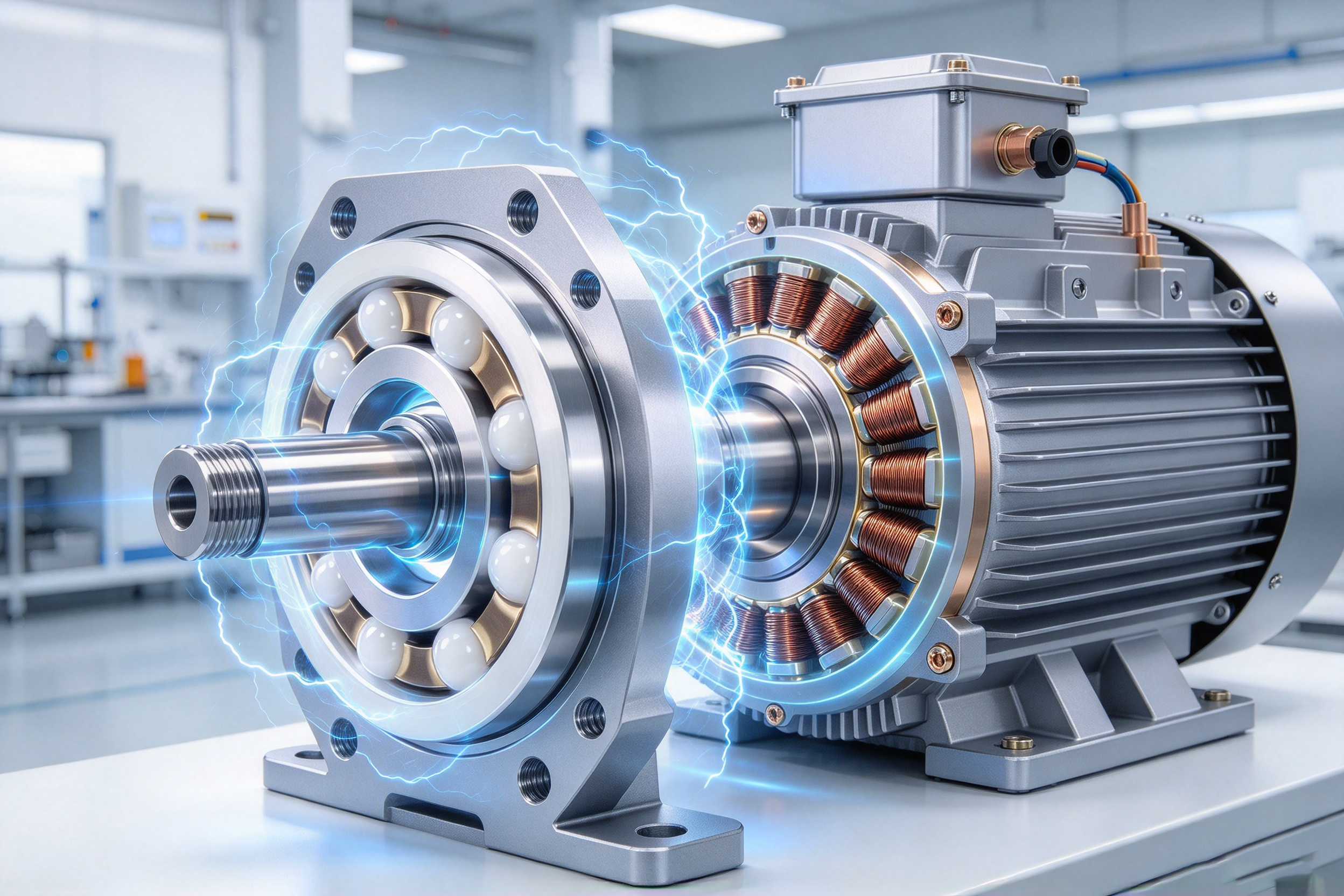
Why electrical erosion occurs in motors
In many inverter-driven motors, the stator and rotor do not form a perfectly balanced electrical field. High-frequency switching from PWM inverters can induce shaft voltage. When this voltage exceeds the dielectric strength of the lubricant film inside the bearing, small discharges occur. These discharges may be invisible during normal operation, but over time they create micro-craters on the raceway surface.
Once the raceway surface is damaged, vibration and noise usually increase. The lubricant may also degrade faster due to localized heating. In severe cases, the bearing fails long before its calculated mechanical life is reached.
| Failure symptom | Typical cause | Common application scenario |
|---|---|---|
| Fine fluting marks on raceway | Repeated micro-discharges | Inverter-driven AC motors |
| Localized pitting | Shaft voltage breakdown | High-speed spindles |
| Early grease degradation | Electrical heating in contact zone | Traction motors, generators |
| Sudden noise increase | Surface fatigue after erosion | Fans, pumps, compressors |
How non-conductive bearings protect motors
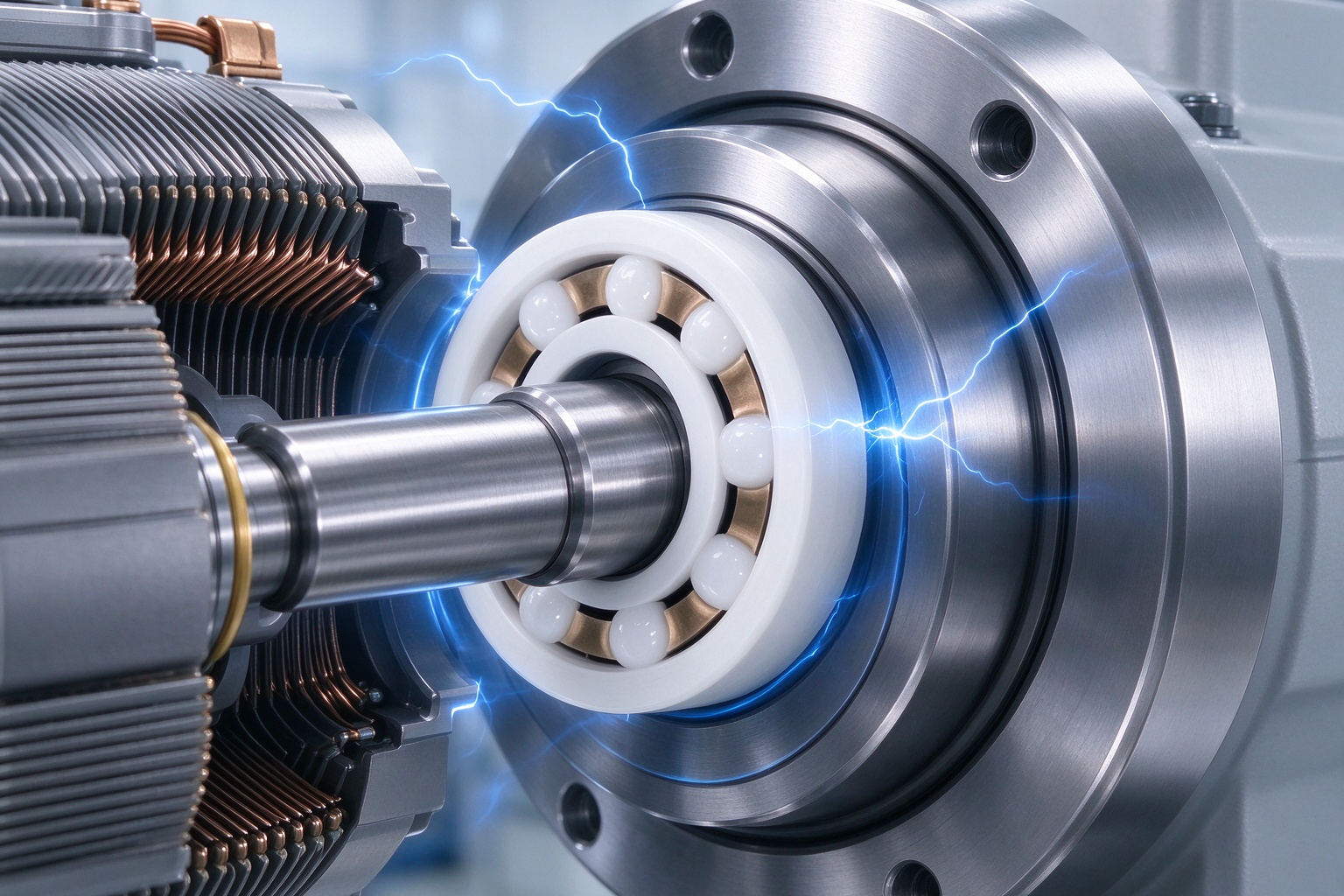
Non-conductive bearings limit electrical current from passing through the bearing by introducing an insulating barrier. The most common design is an insulated outer or inner ring coated with alumina or another ceramic-based layer. Another option is a hybrid bearing, which uses silicon nitride ceramic balls together with steel rings.
The key difference between these solutions is where the insulation is placed and what additional performance requirements the application has. Coated bearings mainly block current at the coated ring surface. Hybrid bearings not only reduce electrical conduction but also offer lower friction, lower density, and better high-speed performance.
| Bearing type | Insulation method | Main advantage | Typical limitation |
|---|---|---|---|
| Insulated outer ring bearing | Ceramic coating on outer ring | Strong insulation, easy integration | Coating must be protected during mounting |
| Insulated inner ring bearing | Ceramic coating on inner ring | Suitable for shaft-side insulation needs | Requires precise fitting control |
| Hybrid ceramic bearing | Silicon nitride balls | High speed, low friction, partial insulation | Higher cost, not always required |
Where non-conductive bearings are most useful
Non-conductive bearings are not required for every motor. For small motors running directly on mains power with low shaft voltage, standard bearings may still be sufficient. However, when motors are driven by inverters, operate at high speed, or are exposed to stray currents, insulated solutions should be considered during the design stage.
Typical applications include:
- Inverter-driven industrial AC motors
- High-speed spindles and machine tool motors
- Traction motors for rail and electric vehicles
- Generators and wind turbine drivetrains
- Compressors and fans with long operating hours
- Servo motors and automation equipment
In these applications, non-conductive bearings help reduce the risk of premature bearing failure and extend maintenance intervals. They are especially valuable when downtime is costly or when maintenance access is limited.
How to select the right insulated bearing
Selecting a non-conductive bearing should not be based only on insulation. The bearing must still meet mechanical load, speed, temperature, lubrication, and housing requirements. A correct selection usually starts with identifying the electrical risk level and then matching it with an appropriate insulation method.
Important selection factors include:
- Motor type and drive method: Inverter-driven motors usually create higher electrical stress.
- Shaft voltage level: Higher voltage requires more reliable insulation.
- Bearing position: Inner ring, outer ring, or both sides may need protection depending on the current path.
- Speed and temperature: Hybrid bearings may be preferred in high-speed or high-precision applications.
- Mounting conditions: Insulated coatings must not be damaged during press fitting or heating.
- Lubrication compatibility: Proper grease selection still affects bearing life even when insulation is used.
| Selection factor | What to check | Design implication |
|---|---|---|
| Drive type | Direct-on-line or inverter | Inverter duty increases erosion risk |
| Motor power and speed | kW rating, RPM | Higher speed may favor hybrid solutions |
| Bearing location | Drive end, non-drive end | Current path determines insulation position |
| Operating temperature | Ambient and internal heat | Coating and grease must remain stable |
| Mounting method | Press fit, heating, pullers | Avoid damaging insulated surfaces |
Installation and maintenance precautions
Non-conductive bearings require careful handling. Insulated coatings are durable under normal operating conditions, but they can be damaged by improper mounting. Press fitting should be applied to the non-coated ring whenever possible. If heating is required, temperature limits must follow the manufacturer’s specification.
Lubrication management remains important. Electrical insulation does not eliminate the need for proper grease selection, correct filling quantity, or regular relubrication. In contaminated or high-temperature environments, grease life may still determine service intervals.
Maintenance teams should also check for secondary current paths. If the motor housing, coupling, or driven equipment creates an alternative conductive path, additional measures such as shaft grounding rings or insulated housings may be necessary.
Conclusion
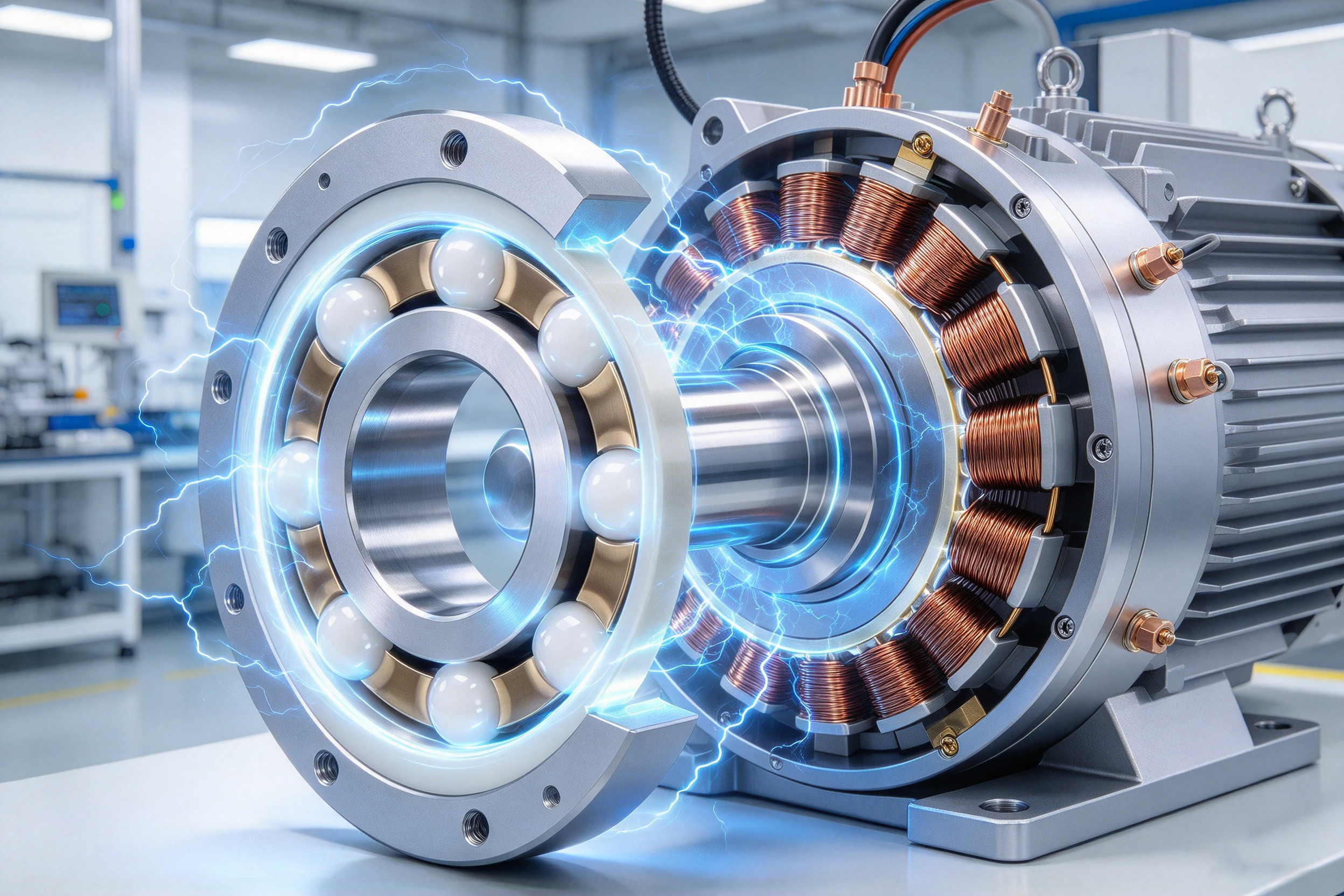
Electrical erosion is not purely a bearing problem. It is a system-level issue caused by modern drive technology, motor design, and operating conditions. Non-conductive bearings address the problem at the component level by interrupting the current path through the bearing.
For motor manufacturers, equipment designers, and maintenance engineers, the value of insulated bearings lies in prevention. Once fluting appears, the damage cannot be reversed. Choosing the right non-conductive bearing early in the design process can reduce failure risk, improve reliability, and lower total cost of ownership in electrically sensitive motor applications.
Frequently Asked Questions (FAQ)
Q: What is the main cause of electrical erosion in bearings?
A: It is primarily caused by shaft voltage induced by Variable Frequency Drives (VFDs). When this voltage exceeds the lubricant’s dielectric strength, it discharges through the bearing, causing pitting and fluting.
A: It is primarily caused by shaft voltage induced by Variable Frequency Drives (VFDs). When this voltage exceeds the lubricant’s dielectric strength, it discharges through the bearing, causing pitting and fluting.
Q: What is the difference between coated bearings and hybrid ceramic bearings?
A: Coated bearings use an insulating layer (usually alumina) on the ring to block current. Hybrid bearings use ceramic balls (Silicon Nitride) which naturally resist current and offer higher speed capabilities, though they are generally more expensive.
A: Coated bearings use an insulating layer (usually alumina) on the ring to block current. Hybrid bearings use ceramic balls (Silicon Nitride) which naturally resist current and offer higher speed capabilities, though they are generally more expensive.
Q: Do I need to insulate both the inner and outer rings?
A: Not always. Insulating one ring is often sufficient to break the circuit. The choice depends on the specific motor design and the path of the stray current. Consult your engineering team for the optimal configuration.
A: Not always. Insulating one ring is often sufficient to break the circuit. The choice depends on the specific motor design and the path of the stray current. Consult your engineering team for the optimal configuration.
Q: Can I use standard grease with insulated bearings?
A: Yes, standard greases are compatible. However, selecting high-quality grease remains critical for mechanical lubrication and heat dissipation, even if the electrical path is blocked.
A: Yes, standard greases are compatible. However, selecting high-quality grease remains critical for mechanical lubrication and heat dissipation, even if the electrical path is blocked.
Q: How should insulated bearings be mounted to avoid damage?
A: Care is required. Always apply press force to the non-coated ring. If heating is necessary for installation, strictly follow the manufacturer’s temperature limits to prevent damaging the insulating coating.
A: Care is required. Always apply press force to the non-coated ring. If heating is necessary for installation, strictly follow the manufacturer’s temperature limits to prevent damaging the insulating coating.
Post time: Oct-19-2026