


In high-vacuum environments—such as semiconductor manufacturing equipment, space mechanisms, and vacuum coating systems—bearing lubrication faces a fundamental challenge: conventional liquid lubricants evaporate, oxidize, or lose film stability when pressure drops. This makes solid lubricants one of the most important technical solutions for extending bearing service life in vacuum applications.
Solid lubricants do not rely on liquid oil films to separate contacting surfaces. Instead, they form thin, low-shear transfer films on raceways, rolling elements, cages, and retainers. These films reduce friction, limit adhesive wear, and help bearings operate more reliably when liquid lubrication is impractical.
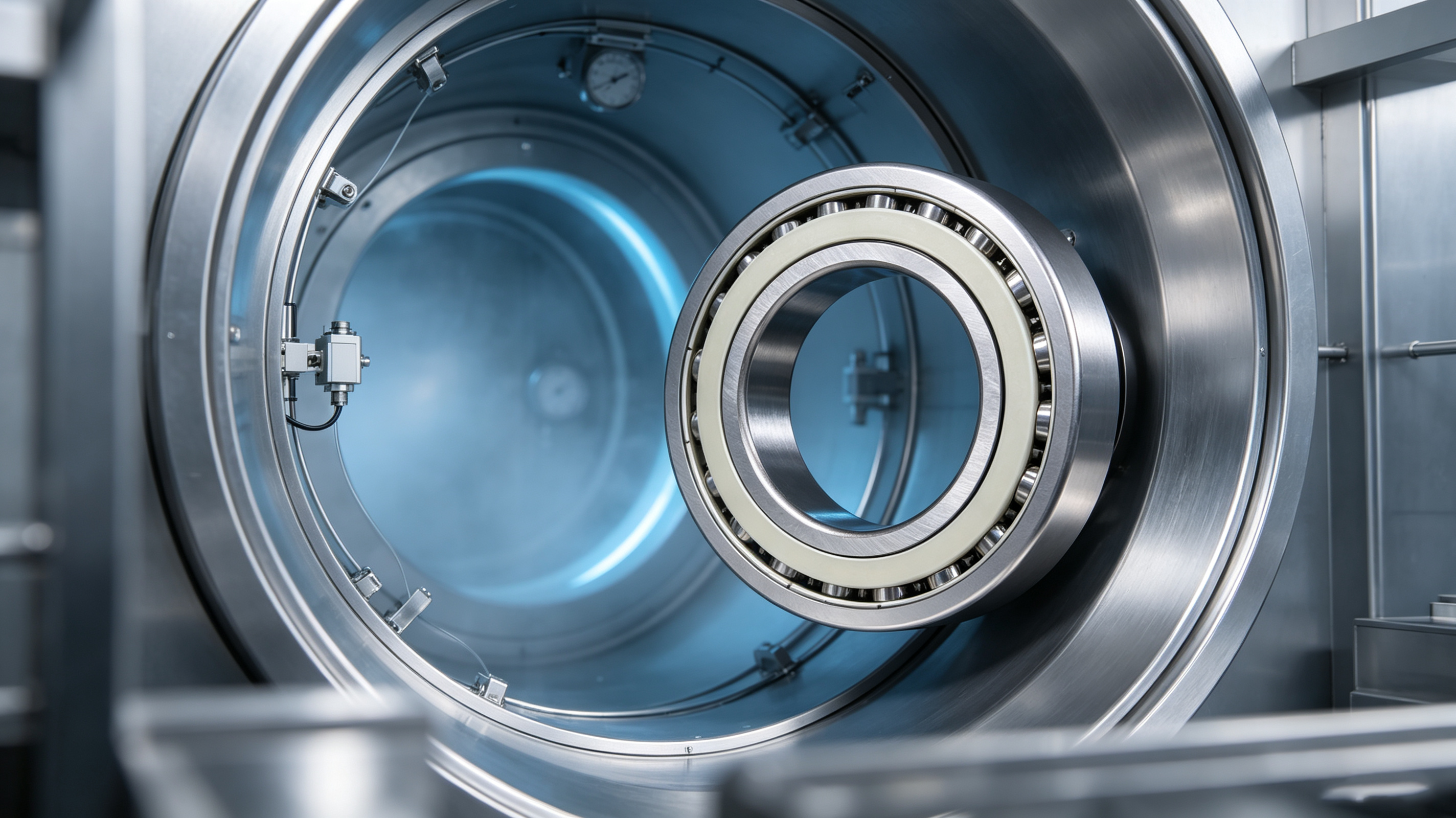
Why Vacuum Environments Are Challenging for Bearings
Vacuum conditions change the way friction and wear behave. In normal atmospheric conditions, many lubricants benefit from surrounding gas, moisture, and pressure that help maintain surface films. In vacuum, these supporting conditions disappear.
The main challenges include:
- Lubricant evaporation: Liquid oils and greases can outgas or evaporate under low pressure.
- Reduced film formation: Without sufficient ambient pressure or fluid supply, conventional lubricating films may break down.
- Increased adhesive wear: Clean metal surfaces in vacuum are more prone to cold welding and surface adhesion.
- Limited heat dissipation: Vacuum environments often provide less convective cooling, increasing the importance of low-friction operation.
- Contamination sensitivity: In processes such as semiconductor fabrication, even small amounts of lubricant outgassing can affect product quality.
For these reasons, vacuum bearings are not simply standard bearings placed into a vacuum chamber. Their materials, surface treatment, cage design, and lubrication method must all be matched to the operating environment.
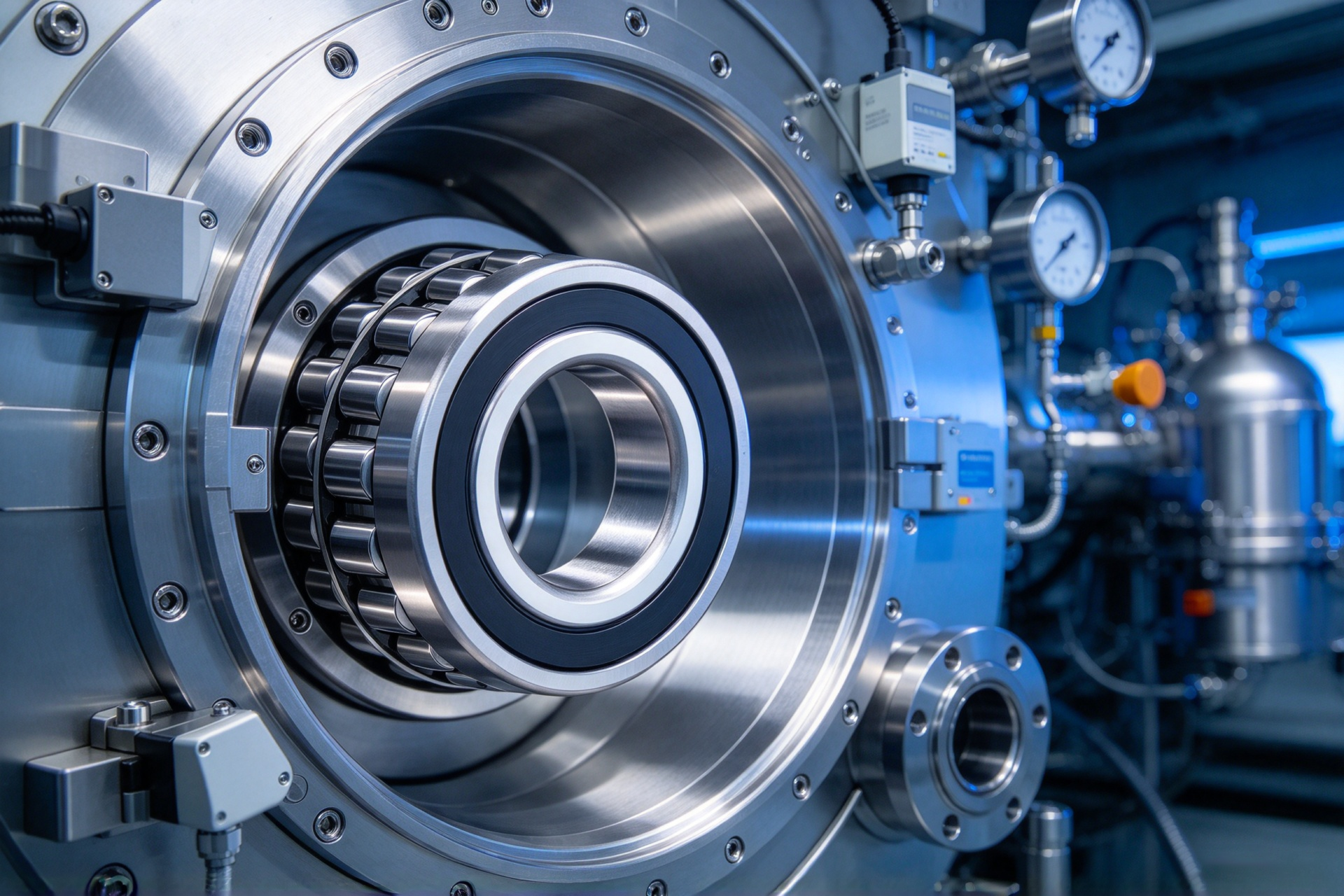
How Solid Lubricants Reduce Friction and Wear
Solid lubricants work by forming a protective layer between moving surfaces. This layer shears more easily than the underlying metal, reducing the force required for motion and limiting direct metal-to-metal contact.
In vacuum bearings, solid lubricants typically function through:
- Transfer film formation: A thin layer of lubricant transfers from the cage, retainer, or coating onto the raceway and rolling elements.
- Low shear strength: The lubricant film allows surfaces to slide with less resistance.
- Surface protection: The film reduces adhesive wear, fretting, and surface damage during start-stop cycles.
- Reduced outgassing: Unlike many liquid lubricants, properly selected solid lubricants can maintain performance without significant vapor release.
The effectiveness of solid lubrication depends on more than the lubricant itself. Bearing load, speed, temperature, vacuum level, surface finish, and cage material all influence how well the lubricant performs.
Common Solid Lubricants for Vacuum Bearings
Different solid lubricants are suitable for different vacuum applications. The most commonly used materials include polytetrafluoroethylene-based compounds, molybdenum disulfide, tungsten disulfide, and certain soft metal films.
| Solid Lubricant | Typical Characteristics | Common Vacuum Considerations |
|---|---|---|
| PTFE-based compounds | Low friction, good chemical stability, widely used in dry-running applications | Suitable for many low-to-moderate load conditions; performance depends on transfer film quality |
| MoS₂ | Very low friction in dry and vacuum environments | Effective where liquid lubricants cannot be used; sensitive to moisture during storage and handling |
| WS₂ | Similar to MoS₂ with strong dry-film lubricity | Used in specialized vacuum and dry-running applications |
| Soft metal films | Can provide lubricity under high contact stress | Applied in specific engineering cases where polymer or sulfide films are unsuitable |
No single solid lubricant is universally optimal. Selection should be based on actual operating conditions rather than general assumptions.
How Solid Lubricants Are Applied to Bearings
Solid lubricants can be introduced into bearing systems in several ways. The application method affects friction behavior, service life, cleanliness, and maintenance requirements.
| Application Method | Description | Typical Advantages |
|---|---|---|
| Cage or retainer impregnation | The cage material contains or carries solid lubricant that transfers during operation | Provides continuous lubricant supply without external grease |
| Surface coating | Raceways, rolling elements, or cages are coated with a solid lubricant layer | Reduces direct metal contact and can improve dry-running capability |
| Composite materials | Lubricant is incorporated into polymer, metal, or ceramic composite structures | Useful where conventional lubrication is restricted |
| Bonded dry films | Solid lubricant is bonded to bearing or component surfaces | Can help maintain lubricity during initial operation and intermittent contact |
In vacuum systems, cage design is especially important. The cage often acts as the primary source of solid lubricant transfer, making material selection and surface engineering critical to long-term performance.
Solid Lubricants vs. Conventional Lubrication in Vacuum
One of the clearest advantages of solid lubricants in vacuum is their ability to operate without relying on liquid oil films. However, they are not simply a direct replacement for grease or oil in every case.
| Factor | Conventional Liquid Lubricants | Solid Lubricants in Vacuum |
|---|---|---|
| Outgassing risk | Can be high unless specially formulated | Generally lower when properly selected |
| Film formation mechanism | Depends on fluid properties and supply | Depends on transfer film and surface interaction |
| Vacuum compatibility | Limited in many high-vacuum applications | Often preferred for dry or high-vacuum service |
| Maintenance | May require replenishment or sealed designs | Typically designed for long-life or maintenance-limited operation |
| Load and speed sensitivity | Influenced by viscosity and film thickness | Influenced by coating quality, material pair, and contact conditions |
In practice, some vacuum bearings still use specialized greases or oils with very low vapor pressure. Solid lubricants are especially valuable when outgassing must be minimized, when liquid lubricants cannot be maintained, or when bearings must tolerate dry or near-dry operating conditions.
Design Factors That Influence Vacuum Bearing Life
Solid lubricants can significantly extend bearing life, but they perform best when the entire bearing system is designed for vacuum service.
Important factors include:
- Material selection: Bearing steel, stainless steel, ceramics, and cage materials must be compatible with vacuum conditions.
- Surface finish: Smooth, controlled surfaces help transfer films form more uniformly.
- Cage type: Polymer, metal, or composite cages influence lubricant supply and friction behavior.
- Load distribution: Excessive contact stress can accelerate wear even with solid lubrication.
- Speed range: Solid lubricants perform differently at low, moderate, and high speeds.
- Temperature stability: Lubricant and bearing materials must remain stable under operating temperature.
- Cleanliness requirements: In semiconductor and optical vacuum systems, contamination control is as important as friction reduction.
Engineers should treat vacuum bearing selection as a system-level decision. The lubricant, bearing geometry, materials, and operating environment must be evaluated together.
Typical Vacuum Applications
Solid-lubricated and vacuum-compatible bearings are used across many advanced industries.
- Semiconductor manufacturing equipment: Wafer handling, transfer mechanisms, and vacuum chambers require low contamination and stable motion.
- Space mechanisms: Satellite actuators, solar array drives, and deployment mechanisms operate in extreme vacuum and temperature conditions.
- Vacuum coating and thin-film systems: Bearings must resist outgassing and maintain performance during long processing cycles.
- Scientific instruments: Vacuum-compatible motion systems require predictable friction and minimal particle generation.
- Industrial vacuum processes: Drying, degassing, and heat treatment systems may use specialized bearings to improve reliability.
In each application, the goal is not only to reduce friction, but to maintain consistent performance over time.
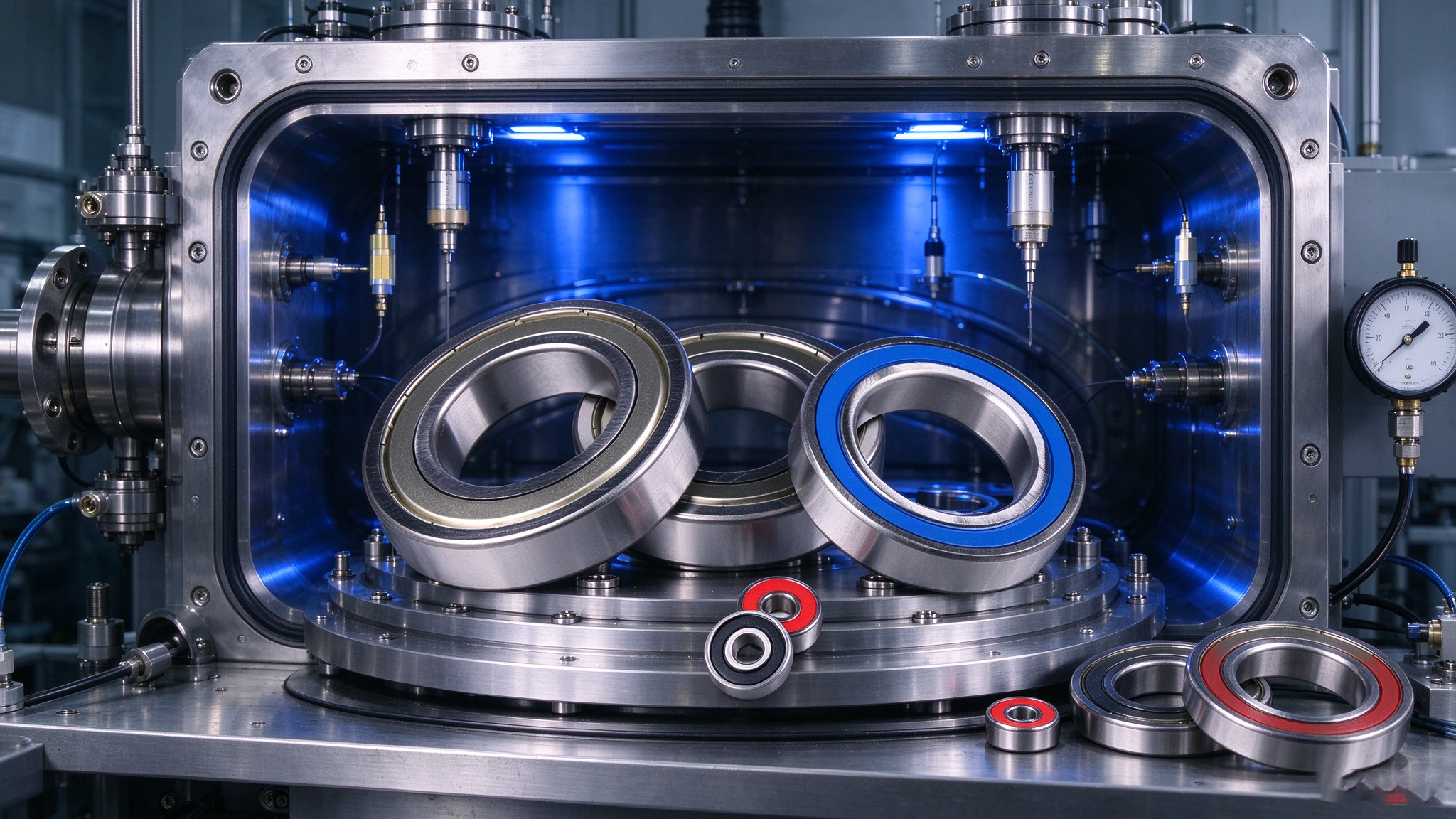
How to Select Vacuum-Ready Bearings
When evaluating bearings for vacuum applications, consider the following:
- Define the vacuum level. Not all vacuum environments are the same. Rough vacuum, high vacuum, and ultra-high vacuum place different demands on materials and lubricants.
- Identify load and speed conditions. Solid lubricants must be matched to contact stress and rotational requirements.
- Assess temperature range. Lubricant stability and thermal expansion affect long-term reliability.
- Evaluate contamination limits. Semiconductor and optical applications often require stricter cleanliness than general industrial vacuum systems.
- Review cage and material compatibility. The cage often plays a central role in solid lubricant transfer.
- Confirm testing requirements. Real-world validation under simulated vacuum conditions provides more reliable data than theoretical comparison alone.
Final Note
Solid lubricants extend bearing life in vacuum by reducing friction, limiting adhesive wear, and enabling operation where liquid lubricants are unsuitable. Their performance depends on proper material selection, surface engineering, cage design, and application-specific testing.
For engineers designing vacuum systems, the key is not choosing a lubricant in isolation, but matching the bearing solution to the actual operating environment. When correctly applied, solid-lubricated bearings can improve reliability, reduce maintenance risk, and support more stable performance in demanding vacuum applications.
FAQ: Solid Lubricants in Vacuum Bearings
Q: Why can’t standard grease be used in high-vacuum environments?
A: Standard greases have high vapor pressure, causing them to evaporate (outgas) in a vacuum. This leads to lubricant failure, contamination of the vacuum chamber, and rapid bearing seizure.
A: Standard greases have high vapor pressure, causing them to evaporate (outgas) in a vacuum. This leads to lubricant failure, contamination of the vacuum chamber, and rapid bearing seizure.
Q: What is the most common solid lubricant for vacuum applications?
A: Molybdenum Disulfide (MoS₂) and Polytetrafluoroethylene (PTFE) are the most widely used. MoS₂ is preferred for high-load space applications, while PTFE is common in semiconductor manufacturing due to its cleanliness.
A: Molybdenum Disulfide (MoS₂) and Polytetrafluoroethylene (PTFE) are the most widely used. MoS₂ is preferred for high-load space applications, while PTFE is common in semiconductor manufacturing due to its cleanliness.
Q: How does a “transfer film” work?
A: During operation, microscopic particles of the solid lubricant transfer from the cage or coating onto the bearing raceways. This creates a thin, low-friction layer that prevents direct metal-to-metal contact.
A: During operation, microscopic particles of the solid lubricant transfer from the cage or coating onto the bearing raceways. This creates a thin, low-friction layer that prevents direct metal-to-metal contact.
Q: Do solid-lubricated bearings last longer than oil-lubricated ones in a vacuum?
A: Yes, significantly. Because they do not evaporate or degrade like oils, solid lubricants can extend service life from a few hundred hours to several years, depending on the load and speed.
A: Yes, significantly. Because they do not evaporate or degrade like oils, solid lubricants can extend service life from a few hundred hours to several years, depending on the load and speed.
Q: Can solid lubricants handle high speeds?
A: They are generally better suited for low-to-medium speeds. At very high speeds, heat generation can degrade the transfer film. Specialized designs or oil-mist systems are often required for high-speed vacuum applications.
A: They are generally better suited for low-to-medium speeds. At very high speeds, heat generation can degrade the transfer film. Specialized designs or oil-mist systems are often required for high-speed vacuum applications.
Q: Is MoS₂ sensitive to humidity?
A: Yes. While MoS₂ performs exceptionally well in a vacuum or dry inert gas, its friction increases in humid air. It requires careful storage and handling to prevent moisture absorption before installation.
A: Yes. While MoS₂ performs exceptionally well in a vacuum or dry inert gas, its friction increases in humid air. It requires careful storage and handling to prevent moisture absorption before installation.
Post time: Sep-24-2026