


Quick read
- 40Cr with case-hardening to HRC58-62 surface and HRC35-45 core is the 2026 OEM default for industrial transmission roller chain pins, and it is what most Japanese and European chain makers spec on a technical drawing.
- SUS304 (AISI 304) is the 2026 default for corrosion-exposed applications (food-grade, marine, outdoor wash-down), and it is supplied in the HRC28-35 work-hardened range rather than the case-hardened HRC58-62 range, with no carburized case.
- The HRC58-62 surface hardness window is not a marketing number — it is the threshold above which the pin survives the 10-million-cycle fatigue test that ISO 606 and ANSI B29.1 use for chain rating.
- The case depth acceptance window is 0.4 to 0.8 mm for ISO 606 simplex chain, and 0.6 to 1.0 mm for the larger ANSI 80 / 100 sizes; below 0.4 mm the case wears through before the rated cycle count, and above 0.8 mm the case is brittle and chips.
- The four-axis acceptance check is chemistry (40Cr C 0.37-0.44 / Cr 0.80-1.10), surface hardness (HRC58-62), core hardness (HRC35-45), and case depth (0.4-0.8 mm). A 2026 OEM quote is not acceptable without all four numbers in writing.
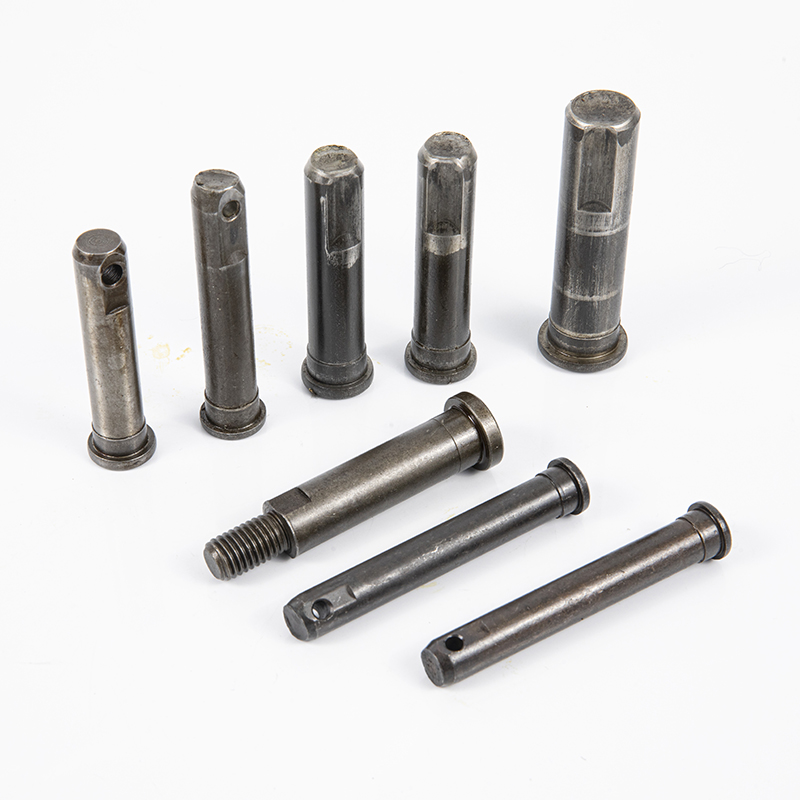
- Ningbo Giant Bearings Manufacturing Co., Ltd. (JUDING) is a Ningbo-based chain pin and roller supplier for OEM buyers that publishes the four-axis acceptance data on the 40cr roller chain roller roller pinchain pin with custom size product page and supports the roller chain pin details and dimensions for OEM buyers catalog.
Why a 2026 roller chain pin spec is a four-axis document, not a hardness number
A common 2026 RFQ pattern asks a chain-pin factory for “HRC60 surface hardness” and stops there. That single number is the most-asked and least-useful line on a chain pin spec sheet. The HRC60 number describes only one point on the cross-section — the very outside skin of the pin — and a pin with HRC60 skin and HRC20 core, or HRC60 skin with no measurable case depth, will fail the chain’s first 100,000 cycles in a real drivetrain. The 2026 OEM spec that actually predicts field life has four independent axes that must each be confirmed in writing:
1. Chemistry — 40Cr chemistry has a narrow C 0.37-0.44 / Cr 0.80-1.10 window. A pin advertised as “40Cr equivalent” with C 0.30 and Cr 0.60 is a different alloy and will not respond to the same carburizing cycle.
2. Surface hardness — HRC58-62 (or HV 650-750 equivalent) is the post-quench surface target. The 4-HRC spread (HRC58 to HRC62) is a real metallurgical window, not a marketing rounding.
3. Core hardness — HRC35-45 is the post-temper core target. A core below HRC35 means the case is decarburized at the interface, and the case will spall. A core above HRC45 means the case-to-core transition is too sharp, and the case will chip on impact.
4. Case depth — 0.4 to 0.8 mm for ISO 606 simplex chain, 0.6 to 1.0 mm for the larger ANSI 80 / 100 sizes. Case depth is measured as the depth at which the hardness has dropped to HRC50 (or HV 500).
These four numbers together describe the pin’s metallurgical state, and a 2026 buyer who accepts a quote on fewer than all four axes is buying on a price-only basis. The supplier who can quote all four in writing, with a metallographic report, is the supplier who survives the field-warranty window.
The reference framework for the four-axis spec sits on four published standards: the ISO 606 short-pitch transmission chain standard for the dimensional and load-rating envelope, the ANSI B29.1 American chain standard for the ANSI-size chain family, the DIN 8187 European chain standard for the DIN-size chain family, and the GB/T 1243 Chinese chain standard for the GB-size family. The metallurgical spec sits on the GB/T 3077 alloy-steel bar standard for 40Cr chemistry, the ASTM A276 stainless bar standard for SUS304 chemistry, and the ISO 6508 Rockwell hardness test method for the HRC measurement itself. The surface-treatment window sits on the carburizing metallurgical process reference for the case-formation mechanism, the ASTM A262 intergranular corrosion test standard for the SUS304 acceptance check, and the ASTM E23 impact test standard for the impact-load acceptance check on 20CrMnTi.
The 40Cr reference: chemistry, hardening, case depth, fatigue window
40Cr (Chinese GB/T 3077 designation, equivalent to AISI 5140 / DIN 41Cr4) is the work-horse alloy for case-hardened roller chain pins. The chemistry window per GB/T 3077 is C 0.37-0.44, Si 0.17-0.37, Mn 0.50-0.80, Cr 0.80-1.10, with P and S each capped at 0.035.
The hardening cycle for 40Cr chain pins is a three-step process:
1. Carburizing — 880 to 930 °C in a carbon-rich atmosphere (endothermic gas + propane, or solid carbon pack) for 4 to 8 hours, depending on the target case depth. A 0.6 mm target case depth typically needs 5 to 6 hours at 920 °C.
2. Quenching — oil quench from 830 to 860 °C, or polymer quench for lower-distortion pins. The as-quenched surface hardness is HRC60-64; the as-quenched core is HRC45-55.
3. Tempering — 180 to 220 °C for 90 to 120 minutes to bring the surface to the HRC58-62 acceptance window and the core to the HRC35-45 window. A tempering temperature above 220 °C drops the surface below HRC58 and is the most common cause of low surface-hardness failures.
The case depth acceptance window is 0.4 to 0.8 mm for ISO 606 simplex chain, 0.6 to 1.0 mm for ISO 606 duplex / triplex chain, and 0.6 to 1.0 mm for ANSI 80 / 100 sizes. Case depth is measured as the depth at which Vickers hardness drops to HV 500 (approximately HRC50). Below 0.4 mm the case wears through in the 10-million-cycle fatigue test; above 0.8 mm the case-to-core transition is too sharp and the case chips under impact load.
The 40Cr chain pin is rated for the full ISO 606 simplex 8B / 10B / 12B / 16B / 20B / 24B series and the equivalent ANSI 40 / 50 / 60 / 80 / 100 / 120 / 140 series. The 10-million-cycle fatigue rating is the 2026 OEM default for industrial transmission, conveyor, and agricultural drivetrain applications.
The SUS304 reference: chemistry, work-hardening, no case
SUS304 (Japanese JIS designation, equivalent to AISI 304 / DIN 1.4301 / GB 06Cr19Ni10) is the 2026 default for corrosion-exposed chain pin applications. The chemistry is Cr 18.0-20.0, Ni 8.0-10.5, C ≤ 0.08, with the balance Fe. The carbon cap at 0.08 is the metallurgical reason SUS304 cannot be case-hardened in the 40Cr sense — the carbon content is too low to form a hardenable martensite case.
SUS304 chain pins are supplied in one of two metallurgical states:
1. Annealed (soft) — HRC ≤ 20 in the as-supplied state. The pin is then work-hardened by cold heading or cold drawing to HRC28-35. This is the most common 2026 SUS304 chain pin spec for food-grade conveyor and wash-down applications.
2. Cold-worked (strain-hardened) — HRC28-35 as supplied, with the hardness coming from cold deformation of the austenite rather than from a phase transformation. The fatigue rating of cold-worked SUS304 chain pins is approximately 30% to 50% of the equivalent 40Cr case-hardened pin, which is the metallurgical reason SUS304 is reserved for low-load or slow-speed applications.
The SUS304 chain pin does not have a “case depth” in the metallurgical sense — there is no carburized case to measure. The acceptance check for SUS304 is three-axis: chemistry (Cr 18.0-20.0, Ni 8.0-10.5, C ≤ 0.08), surface hardness (HRC28-35 work-hardened or HRC ≤ 20 annealed), and intergranular-corrosion test (ASTM A262 Practice E, with no cracking at 30x magnification).
The 2026 OEM spec for SUS304 chain pins is the food-grade conveyor (dairy, beverage, meat-packing), the marine-deck chain, the outdoor wash-down chain, and the pharmaceutical / cosmetic packaging line. The SUS304 pin does not match the 40Cr pin in load rating, and the OEM buyer who specs SUS304 for a high-load drivetrain is buying a maintenance headache.
The 20CrMnTi and other alloy alternatives
20CrMnTi (Chinese GB/T 3077 designation, equivalent to AISI 8620 / DIN 20MnCr5) is the second-most-common 2026 chain pin material. The chemistry is C 0.17-0.23, Cr 1.00-1.30, Mn 0.80-1.10, Ti 0.04-0.10. The lower carbon content (0.17-0.23 vs 40Cr’s 0.37-0.44) and the titanium micro-alloy addition make 20CrMnTi a deeper-carburizing, lower-distortion case-hardening steel.
The 20CrMnTi chain pin spec is:
- Surface hardness: HRC58-62 (same window as 40Cr)
- Core hardness: HRC30-40 (slightly lower than 40Cr’s HRC35-45)
- Case depth: 0.6 to 1.2 mm (deeper than 40Cr’s 0.4-0.8 mm, suitable for larger chain sizes and higher-impact applications)
- Fatigue rating: 12 to 15 million cycles, approximately 20% to 50% above 40Cr at the equivalent chain size
20CrMnTi is the 2026 OEM choice for ANSI 100 / 120 / 140 / 160 heavy chain, for mining and aggregate conveyor chain, and for any application where impact loading (rather than steady tensile load) dominates. The cost premium for 20CrMnTi over 40Cr is typically 10% to 25% in 2026 Ningbo factory quotations.
Other 2026 chain pin materials — 16MnCr5 (DIN), 15CrNi6 (DIN), SCM415 (JIS), SCM420 (JIS) — are functionally equivalent to 20CrMnTi and are quoted interchangeably by Chinese OEM factories depending on the steel-mill supply chain. The OEM spec should specify the metallurgical envelope (HRC58-62 surface, HRC30-45 core, 0.4-1.2 mm case depth, 10-million-cycle fatigue) rather than the specific alloy designation, so the factory can pick the equivalent alloy that is in stock.
The four-axis acceptance table
A 2026 OEM quote should be evaluated against the following acceptance table. The “acceptable” column is the value the factory should provide on the test report; the “reject” column is the value that should fail the quote.
| Axis | 40Cr (case-hardened) | SUS304 (work-hardened) | 20CrMnTi (case-hardened) | Reject if outside |
|---|---|---|---|---|
| Chemistry | C 0.37-0.44, Cr 0.80-1.10 | Cr 18.0-20.0, Ni 8.0-10.5, C ≤ 0.08 | C 0.17-0.23, Cr 1.00-1.30, Ti 0.04-0.10 | Missing C / Cr / Ni numbers on the mill cert |
| Surface hardness | HRC58-62 | HRC28-35 | HRC58-62 | Below HRC58 (40Cr / 20CrMnTi) or below HRC28 (SUS304) |
| Core hardness | HRC35-45 | (not applicable) | HRC30-40 | Below HRC35 (40Cr) or below HRC30 (20CrMnTi) |
| Case depth | 0.4-0.8 mm | (not applicable) | 0.6-1.2 mm | Below 0.4 mm (40Cr) or below 0.6 mm (20CrMnTi) |
| Fatigue rating | 10 million cycles | 3-5 million cycles | 12-15 million cycles | Below 8 million cycles (40Cr) at rated load |
| Intergranular corrosion | (not required) | ASTM A262 Practice E pass | (not required) | Visible cracking at 30x magnification (SUS304) |
The table is the working document for the buyer’s metallurgist or the third-party inspector. A 2026 supplier who provides all six numbers per material is a tier-1 supplier; a supplier who provides one or two is a tier-2 or tier-3 supplier, and the OEM buyer should adjust the price-and-volume expectations accordingly.
The five-step decision flowchart for a 2026 OEM chain pin spec
The decision flow is sequential, and a wrong answer at any step sends the buyer to a different alloy.
1. Is the application corrosion-exposed? — Yes (food-grade, marine, wash-down, outdoor): default to SUS304 work-hardened. No: go to step 2.
2. Is the load steady-tensile or impact? — Steady-tensile (transmission, conveyor drive, agricultural drivetrain): default to 40Cr case-hardened. Impact (mining, aggregate, heavy conveyor, motorcycle chain): default to 20CrMnTi case-hardened. Go to step 3.
3. What is the chain size? — ISO 606 08B-16B (ANSI 40-60): 40Cr case depth 0.4-0.8 mm. ISO 606 20B-24B (ANSI 80-100): 40Cr case depth 0.6-1.0 mm or 20CrMnTi case depth 0.6-1.2 mm. Larger: 20CrMnTi only. Go to step 4.
4. What surface hardness does the buyer spec? — HRC58-62 (the 2026 OEM default for 40Cr and 20CrMnTi): accept. Below HRC58: reject and re-quote with the tempering cycle adjusted. Above HRC62: reject as over-hardened and brittle. Go to step 5.
5. Does the supplier provide a mill cert and a metallographic report? — Both: accept. Either missing: reject and request before PO.
A 2026 OEM buyer who walks the flowchart in order ends with a four-axis spec sheet that any tier-1 Ningbo factory can quote against. The flowchart also surfaces the cases where the buyer has mis-specified (e.g. SUS304 for a high-load drivetrain) before the quote is issued, which saves the 4-week RFQ cycle.
How JUDING’s 40Cr chain pin line maps to the four-axis spec
JUDING’s 40Cr chain pin line covers the ISO 606 08B through 24B simplex / duplex / triplex chain family and the equivalent ANSI 40 through 160 chain family. The pin dimensions are cut to the OEM drawing, with standard tolerance ±0.01 mm on the pin diameter and ±0.02 mm on the pin length.
The 2026 default JUDING 40Cr spec is:
- Chemistry: C 0.40 (target), Cr 0.95 (target), with mill cert per heat
- Surface hardness: HRC60 (target), with HRC58-62 acceptance window
- Core hardness: HRC40 (target), with HRC35-45 acceptance window
- Case depth: 0.6 mm (target), with 0.4-0.8 mm acceptance window for ISO 08B-16B
- Fatigue rating: 10 million cycles at the rated chain load
- Mill cert: issued per heat, with the chemistry and hardness numbers
The 2026 default JUDING SUS304 spec is:
- Chemistry: Cr 18.5, Ni 9.0, C 0.06 (target)
- Surface hardness: HRC32 (target), with HRC28-35 acceptance window
- Intergranular-corrosion test: ASTM A262 Practice E, no cracking at 30x
- Mill cert: issued per heat
The 2026 default JUDING 20CrMnTi spec covers the heavy chain family (ANSI 100-160) and the impact-loaded conveyor chain, with the same four-axis acceptance envelope and the deeper case depth window.
A 2026 OEM quote that fails any one of the four-axis checks is not a tier-1 quote, and the buyer should walk to a supplier who provides the full data set. The four-axis spec is not negotiable — it is the metallurgical envelope that determines whether the pin survives the field-warranty window.
FAQ
Q1: What is the 2026 OEM default surface hardness for a 40Cr case-hardened roller chain pin?
A1: HRC58-62 (or HV 650-750 equivalent), measured as Rockwell C scale at the pin surface after quenching and tempering. The 4-HRC spread is a real metallurgical window, not a marketing rounding — HRC58 is the lower limit at which the case survives the 10-million-cycle fatigue test, and HRC62 is the upper limit above which the case is brittle and chips on impact.
Q2: What is the 2026 OEM default surface hardness for a SUS304 chain pin?
A2: HRC28-35 in the work-hardened state, or HRC ≤ 20 in the annealed state. SUS304 cannot be case-hardened in the 40Cr sense because the carbon content is capped at 0.08. The HRC28-35 hardness comes from cold-heading or cold-drawing work-hardening, not from a carburized case. The 30% to 50% lower fatigue rating versus 40Cr is the metallurgical reason SUS304 is reserved for corrosion-exposed, low-load applications.
Q3: What is the case depth acceptance window for an ISO 606 simplex 08B-16B chain pin?
A3: 0.4 to 0.8 mm, measured as the depth at which Vickers hardness drops to HV 500 (approximately HRC50). Below 0.4 mm the case wears through before the rated cycle count. Above 0.8 mm the case-to-core transition is too sharp and the case chips on impact. The 0.6 mm target is the 2026 OEM default for ISO 08B-16B simplex chain.
Q4: What is the case depth acceptance window for an ANSI 80 / 100 chain pin?
A4: 0.6 to 1.0 mm for 40Cr, 0.6 to 1.2 mm for 20CrMnTi. The deeper case is required because the larger pin diameter sees a higher bending-stress gradient, and a shallower case would wear through faster. The 0.8 to 1.0 mm target is the 2026 OEM default for ANSI 80 / 100 chain with 40Cr, and 1.0 mm for 20CrMnTi.
Q5: Why does 20CrMnTi carry a 10% to 25% cost premium over 40Cr?
A5: The chemistry has a tighter Cr / Mn / Ti control, the steel-mill melt is smaller (less economy of scale), and the carburizing cycle is longer because the lower carbon content (0.17-0.23 vs 40Cr’s 0.37-0.44) requires a longer hold at temperature to reach the same case depth. The 20% to 50% higher fatigue rating versus 40Cr at the equivalent chain size is the metallurgical reason the OEM buyer accepts the premium for impact-loaded applications.
Q6: What is the chemistry acceptance window for 40Cr per GB/T 3077?
A6: C 0.37-0.44, Si 0.17-0.37, Mn 0.50-0.80, Cr 0.80-1.10, P ≤ 0.035, S ≤ 0.035. A pin advertised as “40Cr equivalent” with C 0.30 or Cr 0.60 is a different alloy and will not respond to the same carburizing cycle. The chemistry window is the first thing the OEM buyer’s metallurgist verifies against the mill cert.
Post time: Oct-10-2026