


The rapid expansion of subsea robotics, autonomous underwater vehicles (AUVs), remotely operated vehicles (ROVs), offshore energy systems, and marine exploration equipment has placed new demands on precision components. Among these, underwater bearings play a decisive role. Unlike conventional bearings used in dry industrial environments, underwater bearings must operate under high pressure, continuous water exposure, corrosive seawater, sediment ingress, and limited maintenance access. For marine equipment manufacturers and subsea system designers, bearing selection is not only a matter of load capacity and speed, but also of long-term reliability, material compatibility, sealing performance, and lifecycle cost.
Why Underwater Bearings Are Different
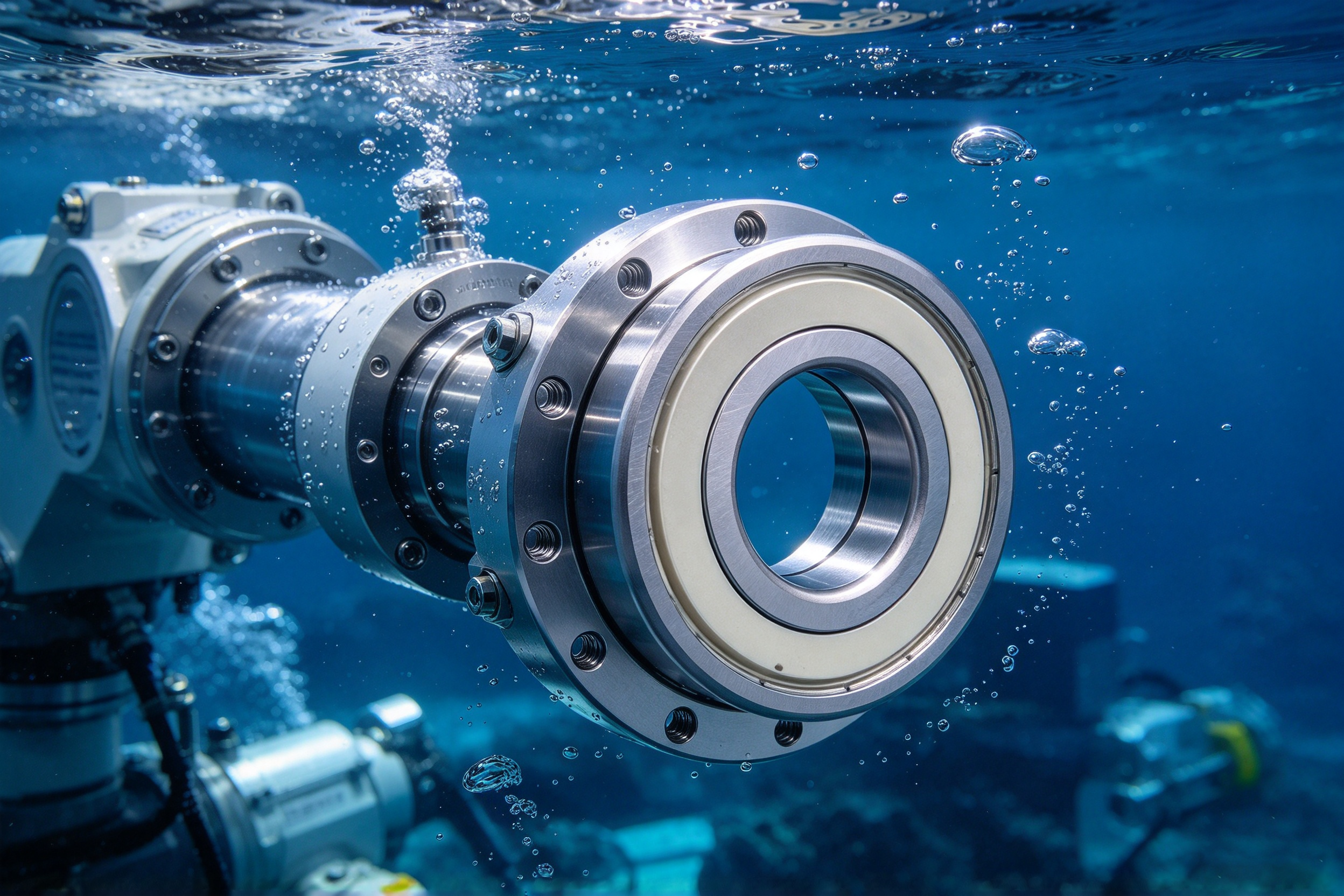
Underwater bearings face conditions that are fundamentally different from those encountered in typical rotating machinery. In subsea applications, water cannot always be fully excluded from the bearing interface. In some designs, it is intentionally present as a lubricant or pressure-compensating medium. This requires materials and surface treatments that can tolerate boundary lubrication, low-viscosity environments, and prolonged immersion.
Seawater corrosion is another major challenge. Chloride ions can accelerate pitting, crevice corrosion, and galvanic attack, especially when dissimilar metals are used in close contact. Bearings installed near propulsion systems, manipulator arms, thrusters, pumps, valves, and sensor housings must also resist abrasive particles such as sand, silt, and biological debris.
Pressure effects further complicate design. At greater depths, external pressure can deform seals, compress internal cavities, and force contaminants into bearing assemblies. A bearing that performs well at shallow depth may fail prematurely in deep-sea conditions if its sealing system, material selection, or pressure-balancing method is not properly engineered.
Key Engineering Requirements for Subsea Bearings
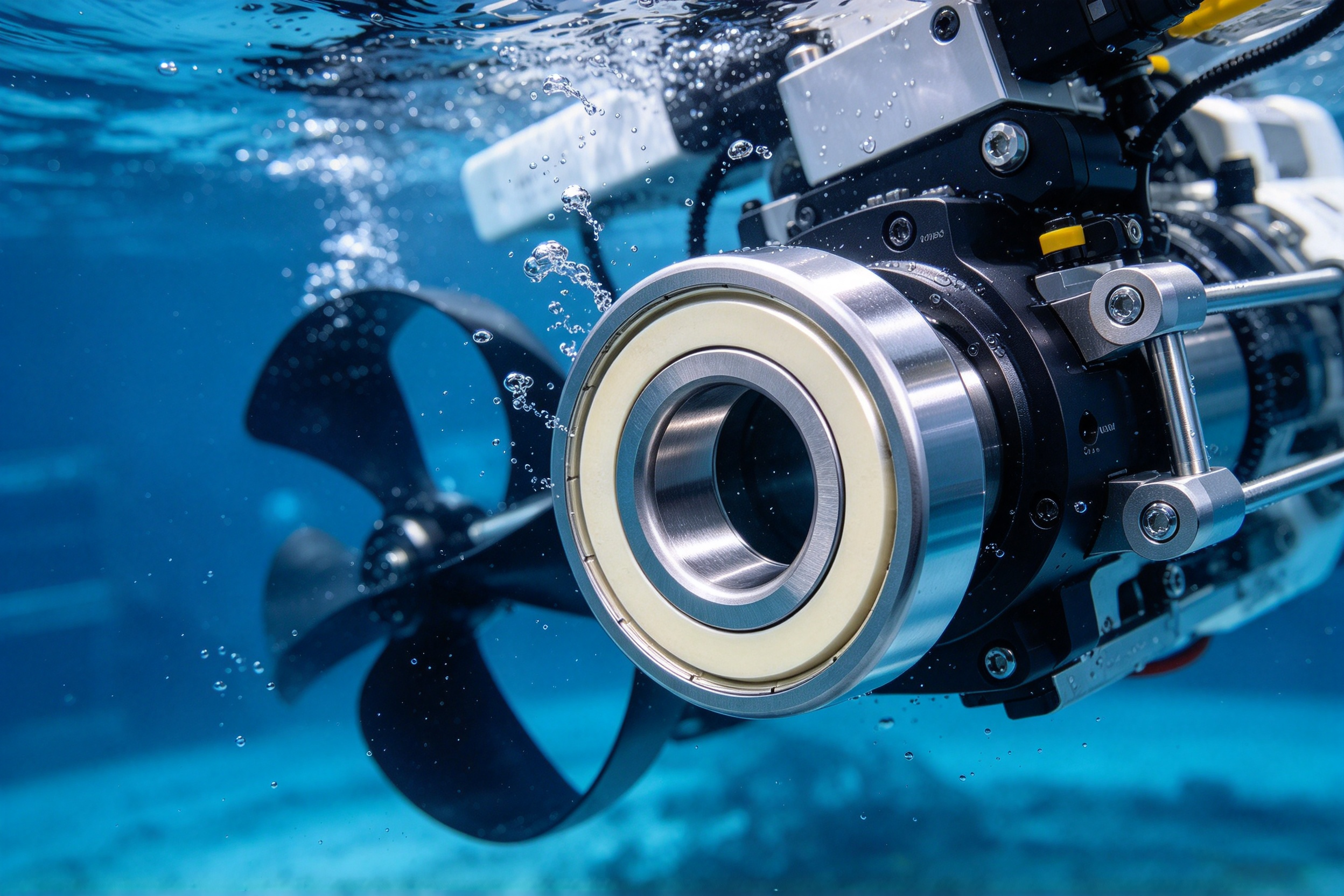
High-performance underwater bearings are typically developed around four engineering priorities: corrosion resistance, sealing and contamination control, load and motion capability, and compatibility with the surrounding marine environment.
Corrosion-resistant materials are essential. Stainless steels, duplex alloys, ceramic hybrids, polymer-based bearings, and specially coated components are commonly considered depending on depth, load, and service life requirements. However, material choice must also account for wear resistance. A material that resists corrosion may still suffer from adhesive wear if it operates without adequate lubrication.
Sealing strategies vary by application. Some subsea bearings rely on multi-lip seals, labyrinth seals, or magnetic seals to keep water and particles out. Others are designed as open or water-lubricated bearings, where seawater or clean water acts as the lubricant. In deep-sea systems, pressure-compensated housings are often used to equalize internal and external pressure, reducing seal stress and improving reliability.
Load capacity remains critical. Subsea bearings may need to support radial loads from thrusters, axial loads from propellers, oscillating motion from robotic joints, or combined loads from manipulator arms. Because maintenance is difficult and costly, designers usually prefer solutions with predictable wear behavior and clearly defined replacement intervals.
Material Selection for Marine and Subsea Applications
Material selection is one of the most important decisions in underwater bearing design. No single material is ideal for every marine application. The correct choice depends on depth, rotational speed, load type, water quality, temperature, required service life, and whether the bearing can be lubricated with grease, oil, polymer liners, or water.
| Material Type | Typical Advantages | Common Subsea Use Cases |
|---|
| Material Type | Typical Advantages | Common Subsea Use Cases |
|---|---|---|
| Stainless steel bearings | Good corrosion resistance, familiar design data | Shallow-water sensors, pumps, light-duty joints |
| Ceramic hybrid bearings | Lower density, reduced friction, good wear performance | High-speed thrusters, precision instruments |
| Polymer or composite bearings | Self-lubricating, resistant to seawater, lightweight | Manipulator arms, valves, low-speed joints |
| Coated or specialized alloy bearings | Enhanced surface protection, tailored performance | Deep-sea ROVs, offshore energy equipment |
In practice, many subsea systems use a combination of materials. For example, a polymer-lined bearing may be chosen for an oscillating joint, while a ceramic hybrid bearing may be more suitable for a high-speed motor shaft. Designers must also consider galvanic compatibility between the bearing, housing, shaft, and fasteners to avoid accelerated corrosion.
Sealing, Lubrication, and Pressure Management
Sealing and lubrication strategies determine how well a bearing can survive prolonged underwater operation. In shallow-water equipment, conventional grease-lubricated bearings with high-quality seals may be sufficient. However, as operating depth increases, the risk of seal failure and grease washout rises significantly.
| Operating Condition | Preferred Bearing Approach | Design Considerations |
|---|
| Operating Condition | Preferred Bearing Approach | Design Considerations |
|---|---|---|
| Shallow water, low contamination | Sealed stainless or hybrid bearings | Lip seals, corrosion-resistant grease |
| Moderate depth, intermittent use | Water-compatible polymer or coated bearings | Low-friction liners, easy inspection |
| Deep sea, continuous operation | Pressure-compensated or water-lubricated systems | Pressure balancing, debris exclusion |
Water-lubricated bearings are increasingly relevant for subsea robotics because they eliminate the need for sealed grease chambers. They can be especially useful when the bearing is already exposed to water and frequent maintenance is impractical. However, water-lubricated designs require careful attention to surface finish, clearance, load distribution, and start-stop friction.
Pressure-compensated bearing housings offer another effective solution. By allowing internal pressure to match external water pressure, these systems reduce differential pressure across seals. This approach is commonly used in ROV thrusters, underwater motors, and deep-sea sensor platforms where long deployment times are expected.
Applications in Subsea Robotics and Marine Equipment
Underwater bearings are used across a wide range of marine systems. In ROVs and AUVs, they support propulsion shafts, steering mechanisms, camera gimbals, and manipulator joints. These components must operate reliably despite vibration, shock loads, and changing flow conditions.
In offshore energy, underwater bearings appear in subsea pumps, valves, winches, mooring systems, and power generation equipment. Renewable marine energy systems, such as tidal and wave energy converters, also depend on bearings that can endure continuous cyclic loading and harsh seawater exposure.
Marine scientific equipment, including underwater cameras, sampling arms, sonar housings, and environmental sensors, often requires compact, low-friction bearings with high positional accuracy. In these applications, smooth motion and minimal particle generation are important to avoid interfering with sensitive measurements.
Design Considerations for Engineers
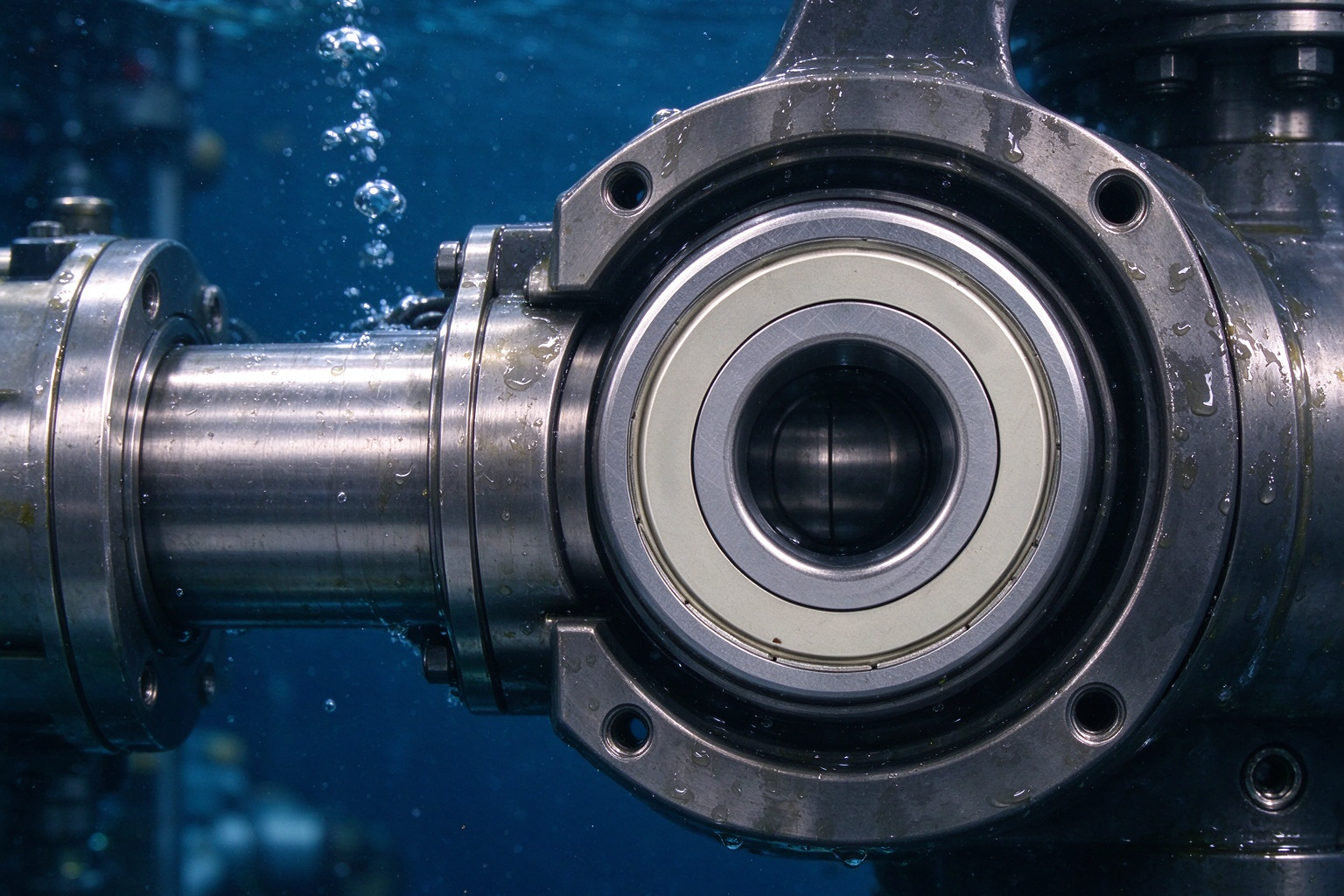
When selecting or specifying underwater bearings, engineers should begin with a clear definition of the operating environment. Depth, temperature range, exposure time, water salinity, rotational speed, load direction, and maintenance accessibility all influence the final design.
It is also important to evaluate the entire assembly rather than the bearing alone. Housing material, shaft hardness, surface finish, seal geometry, and lubrication method must work together. A high-performance bearing can still fail if the shaft corrodes, the seal is mismatched to the pressure range, or the housing allows particulate ingress.
Testing and validation should reflect realistic subsea conditions. Accelerated corrosion tests, pressure cycling, wear trials, and full-system underwater testing can reveal failure modes that are not visible in standard laboratory conditions. For mission-critical equipment, documenting material traceability, manufacturing controls, and performance testing strengthens both engineering confidence and regulatory compliance.
The Path Toward More Reliable Subsea Motion Systems
Underwater bearings are no longer simple mechanical components; they are integrated engineering solutions that connect materials science, tribology, sealing technology, and marine system design. As subsea robotics and offshore equipment become more autonomous and operate at greater depths, bearing reliability will directly affect system uptime, safety, and total cost of ownership.
For marine equipment developers, the most effective approach is to match bearing design to the specific subsea environment rather than relying on generic offshore components. By focusing on corrosion-resistant materials, appropriate sealing or water-lubrication strategies, pressure management, and validated performance data, manufacturers can build more durable and efficient underwater systems.
FAQ: Underwater Bearings for Subsea Robotics and Marine Equipment
Q: What makes underwater bearings different from standard bearings?
A: They are engineered to withstand high pressure, continuous water exposure, seawater corrosion, and abrasive particles, whereas standard bearings typically operate in dry, controlled environments.
A: They are engineered to withstand high pressure, continuous water exposure, seawater corrosion, and abrasive particles, whereas standard bearings typically operate in dry, controlled environments.
Q: Which materials are best for seawater applications?
A: Common choices include stainless steel, ceramic hybrids, polymer composites, and specialized coated alloys. The best option depends on load, speed, and depth requirements.
A: Common choices include stainless steel, ceramic hybrids, polymer composites, and specialized coated alloys. The best option depends on load, speed, and depth requirements.
Q: How are underwater bearings sealed?
A: Sealing methods vary from multi-lip and labyrinth seals for grease-lubricated units to open designs for water-lubricated systems. Deep-sea applications often use pressure-compensated housings to reduce seal stress.
A: Sealing methods vary from multi-lip and labyrinth seals for grease-lubricated units to open designs for water-lubricated systems. Deep-sea applications often use pressure-compensated housings to reduce seal stress.
Q: Can underwater bearings operate without grease?
A: Yes. Water-lubricated and self-lubricating polymer bearings are designed to operate without grease, eliminating the risk of grease washout and reducing maintenance needs.
A: Yes. Water-lubricated and self-lubricating polymer bearings are designed to operate without grease, eliminating the risk of grease washout and reducing maintenance needs.
Q: What are the main failure modes for subsea bearings?
A: The most common causes of failure include corrosion, seal degradation, abrasive wear from sand or silt, and pressure-induced deformation at greater depths.
A: The most common causes of failure include corrosion, seal degradation, abrasive wear from sand or silt, and pressure-induced deformation at greater depths.
Q: How do I choose the right bearing for an ROV or AUV?
A: Define your operating depth, load type, rotational speed, exposure time, and maintenance accessibility first. Then match these parameters with appropriate materials and sealing strategies.
A: Define your operating depth, load type, rotational speed, exposure time, and maintenance accessibility first. Then match these parameters with appropriate materials and sealing strategies.
Q: Are underwater bearings suitable for deep-sea applications?
A: Yes, but deep-sea designs require special attention to pressure balancing, material compatibility, and sealing integrity to prevent premature failure under high external pressure.
A: Yes, but deep-sea designs require special attention to pressure balancing, material compatibility, and sealing integrity to prevent premature failure under high external pressure.
Q: Do underwater bearings require frequent maintenance?
A: Ideally, no. Subsea systems are designed for extended service intervals. Selecting corrosion-resistant materials and reliable sealing or water-lubrication systems helps minimize maintenance requirements.
A: Ideally, no. Subsea systems are designed for extended service intervals. Selecting corrosion-resistant materials and reliable sealing or water-lubrication systems helps minimize maintenance requirements.
Post time: Oct-26-2026