


Cryogenic bearings are specialized rolling bearings designed to operate in extremely low-temperature environments, typically below -150°C. In liquid nitrogen applications, where temperatures reach -196°C, bearing performance depends less on generic “low-temperature capability” and more on material stability, dimensional control, lubrication strategy, and proper clearance management.
For engineers, procurement teams, and plant operators, the main challenge is not simply selecting a cryogenic-grade bearing, but ensuring that the entire bearing system can survive thermal contraction, maintain rotational accuracy, and avoid premature failure caused by lubrication starvation or internal clearance collapse.
Why Liquid Nitrogen Environments Are Different
Liquid nitrogen is widely used in industrial gas processing, cryogenic pumps, vacuum systems, aerospace testing, food freezing, and scientific research. At -196°C, most materials contract, lubricants thicken or solidify, and normal room-temperature bearing behavior no longer applies.
A bearing that performs well at 20°C may fail quickly in liquid nitrogen if:
- The internal clearance becomes negative after cooling.
- The lubricant cannot flow at cryogenic temperatures.
- The cage material becomes brittle.
- Seal materials lose elasticity.
- Thermal shock causes uneven contraction between rings, rolling elements, and housing.
Cryogenic bearings must therefore be treated as engineered components rather than standard replacements.
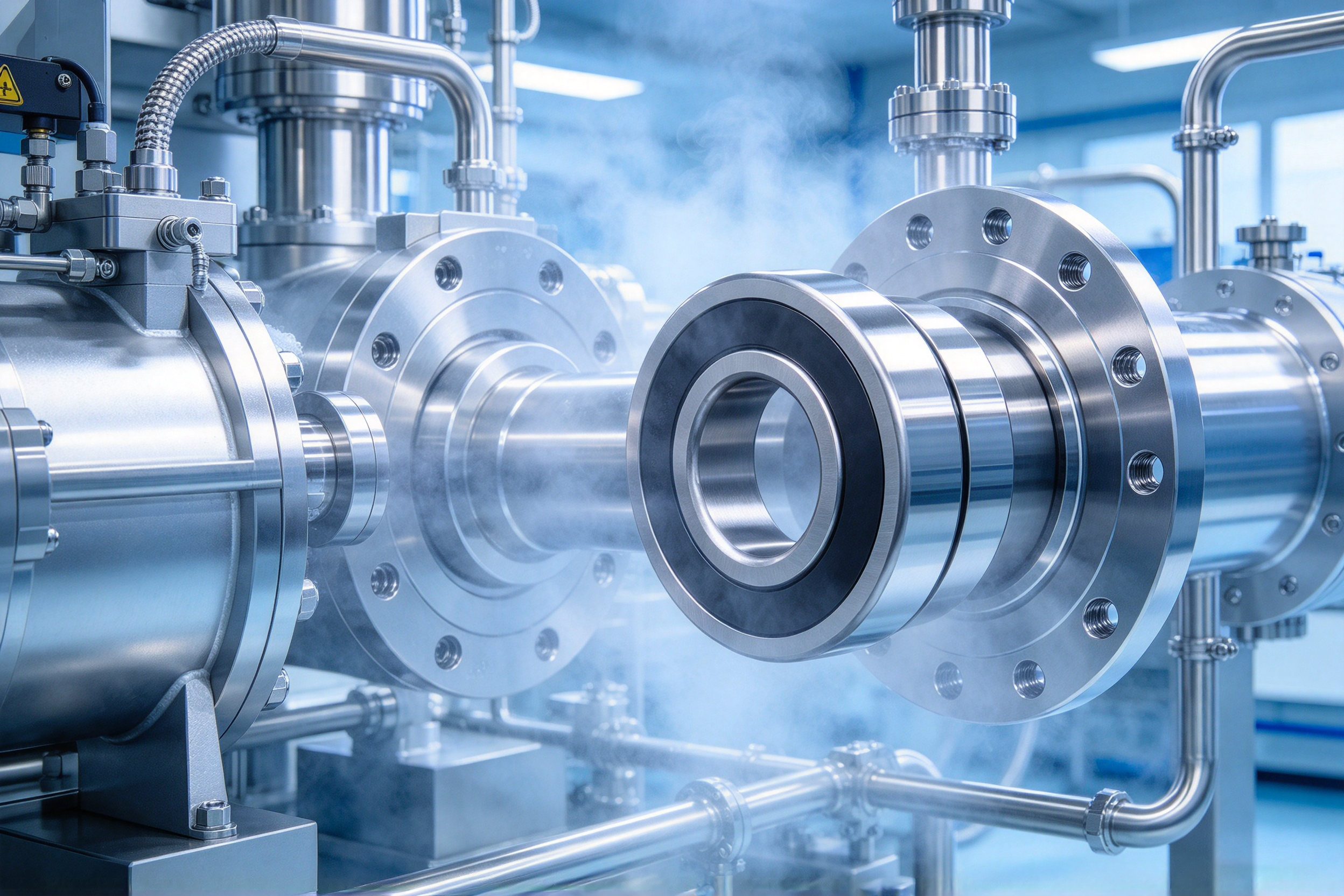
Key Design Factors for Cryogenic Bearing Reliability
1. Material Selection
Bearing rings and rolling elements are commonly made from high-quality martensitic stainless steel or specialty cryogenic steels. The material must maintain adequate hardness, dimensional stability, and fracture resistance at low temperatures.
Cage materials also matter. Polymers that perform well at room temperature may crack or deform under cryogenic conditions. Metal cages, PTFE-based materials, or specially formulated polymers are often preferred depending on speed, load, and lubrication method.
2. Internal Clearance Control
Thermal contraction is one of the most important design considerations. When a bearing cools from room temperature to -196°C, the internal clearance changes significantly. If the initial clearance is too small, it may become negative during operation, leading to excessive preload, heat generation, and early failure.
Clearance selection should consider:
- Bearing size.
- Housing material.
- Shaft material.
- Mounting method.
- Temperature gradient during cooldown.
- Whether the bearing operates submerged or in cold gas.
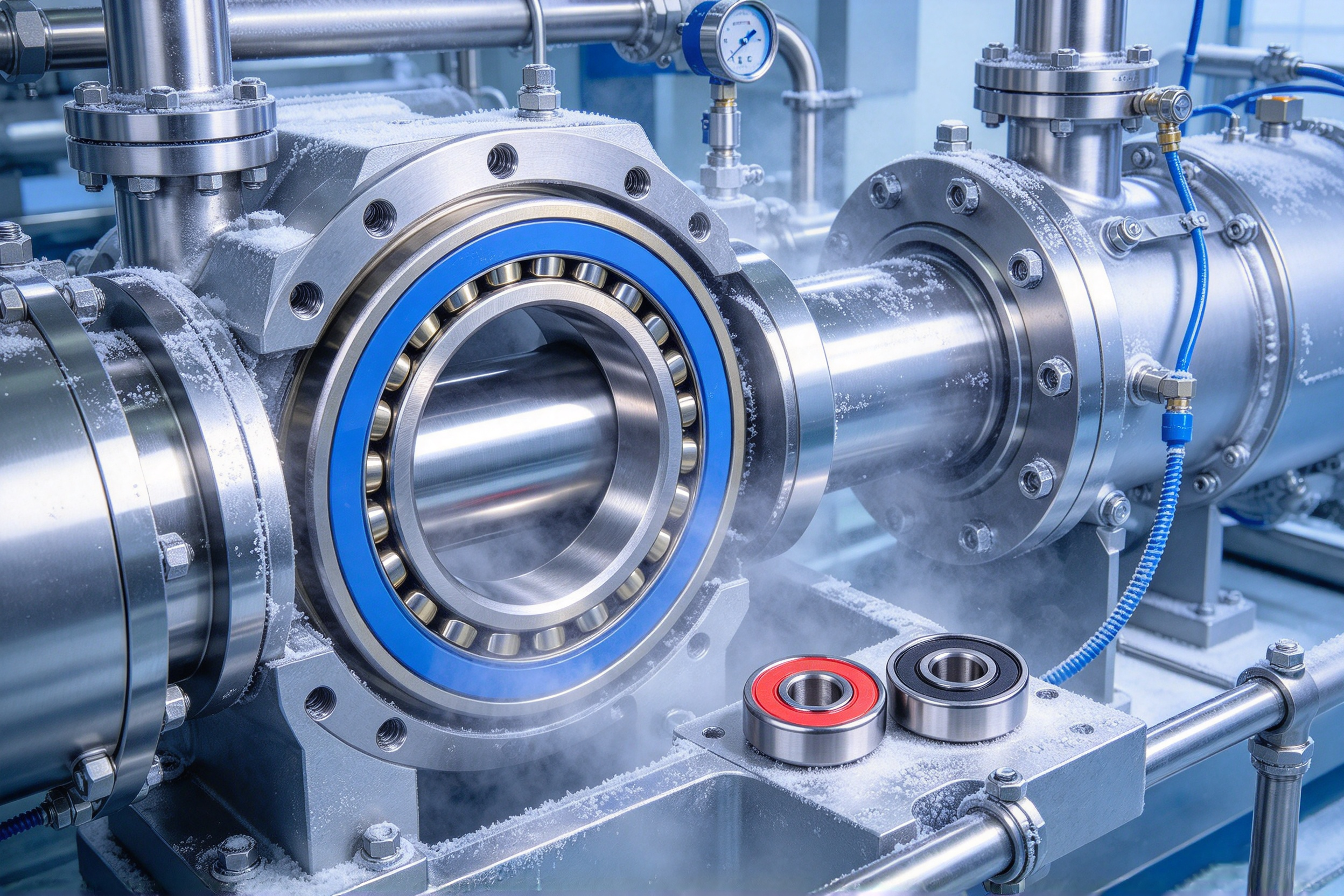
3. Lubrication Strategy
Lubrication in cryogenic environments is not the same as conventional grease lubrication. Many standard greases harden or stop flowing at low temperatures, preventing proper film formation.
Common approaches include:
- Low-temperature synthetic greases for moderate cryogenic service.
- Solid lubricants for dry or gas-lubricated conditions.
- PTFE-based or composite cages that provide limited self-lubrication.
- System-compatible lubricants when the bearing operates in liquid nitrogen or cold gas streams.
The correct choice depends on speed, load, contamination risk, maintenance access, and whether the bearing is sealed.
4. Sealing and Contamination Control
Seals must remain flexible and dimensionally stable at low temperatures. Standard rubber seals may harden and lose sealing effectiveness. In some cryogenic systems, non-contact seals, metal shields, or open bearings with external system sealing are more suitable.
Contamination control is critical. Ice, condensed moisture, or particulate debris can cause abrasive wear and accelerate failure.
Common Applications of Cryogenic Bearings
| Application Area | Typical Operating Condition | Main Bearing Requirement |
|---|
| Application Area | Typical Operating Condition | Main Bearing Requirement |
|---|---|---|
| Cryogenic pumps | Submerged or cold gas environment | Dimensional stability, reliable lubrication |
| Liquid nitrogen valves | Intermittent motion, low to moderate speed | Low torque, corrosion resistance |
| Vacuum and space simulation | Dry, low-temperature environment | Solid lubrication, low outgassing |
| Aerospace test rigs | Rapid temperature changes | Thermal shock resistance |
| Industrial gas processing | Continuous low-temperature operation | Long service life, stable clearance |
Material and Lubrication Considerations
| Component | Typical Options | Function in Cryogenic Service |
|---|
| Component | Typical Options | Function in Cryogenic Service |
|---|---|---|
| Rings and balls | Martensitic stainless steel, cryogenic steel | Maintain hardness and dimensional stability |
| Cage | Metal, PTFE-based, or special polymer | Reduce friction and avoid brittle failure |
| Lubrication | Low-temperature grease, solid film, dry running | Prevent seizure when conventional grease fails |
| Seals | Low-temperature elastomers, metal shields, open design | Control contamination without excessive torque |
Not every combination suits every application. A bearing used in a sealed cryogenic valve may require a different design from one used in a high-speed cryogenic pump.
How to Select a Cryogenic Bearing
Selecting a cryogenic bearing requires more than matching bore size and outer diameter. The following parameters should be defined early:
- Minimum and maximum operating temperature.
- Whether the bearing is submerged, exposed to cold gas, or in vacuum.
- Rotational speed and load direction.
- Required service life and maintenance interval.
- Shaft and housing materials.
- Lubrication compatibility with the process medium.
- Need for seals, shields, or open bearings.
- Acceptable torque and noise level.
Suppliers should be able to explain how clearance, material, cage, and lubrication interact under the intended operating conditions. Documentation, test data, and application experience help reduce selection risk.
Installation and Maintenance Best Practices
Even a well-designed cryogenic bearing can fail if installation is incorrect. Bearings should be handled with clean tools and stored in dry conditions to avoid moisture absorption and surface contamination.
During installation, avoid excessive force that may damage rings or cages. Fit tolerances should be checked at room temperature while considering how components will contract during cooldown. Rapid thermal shock should be avoided unless the system is specifically designed for it.
Maintenance planning should include:
- Monitoring torque changes.
- Checking for abnormal vibration or noise.
- Verifying lubricant condition where applicable.
- Inspecting seals for hardening or cracking.
- Replacing bearings before catastrophic failure in critical systems.
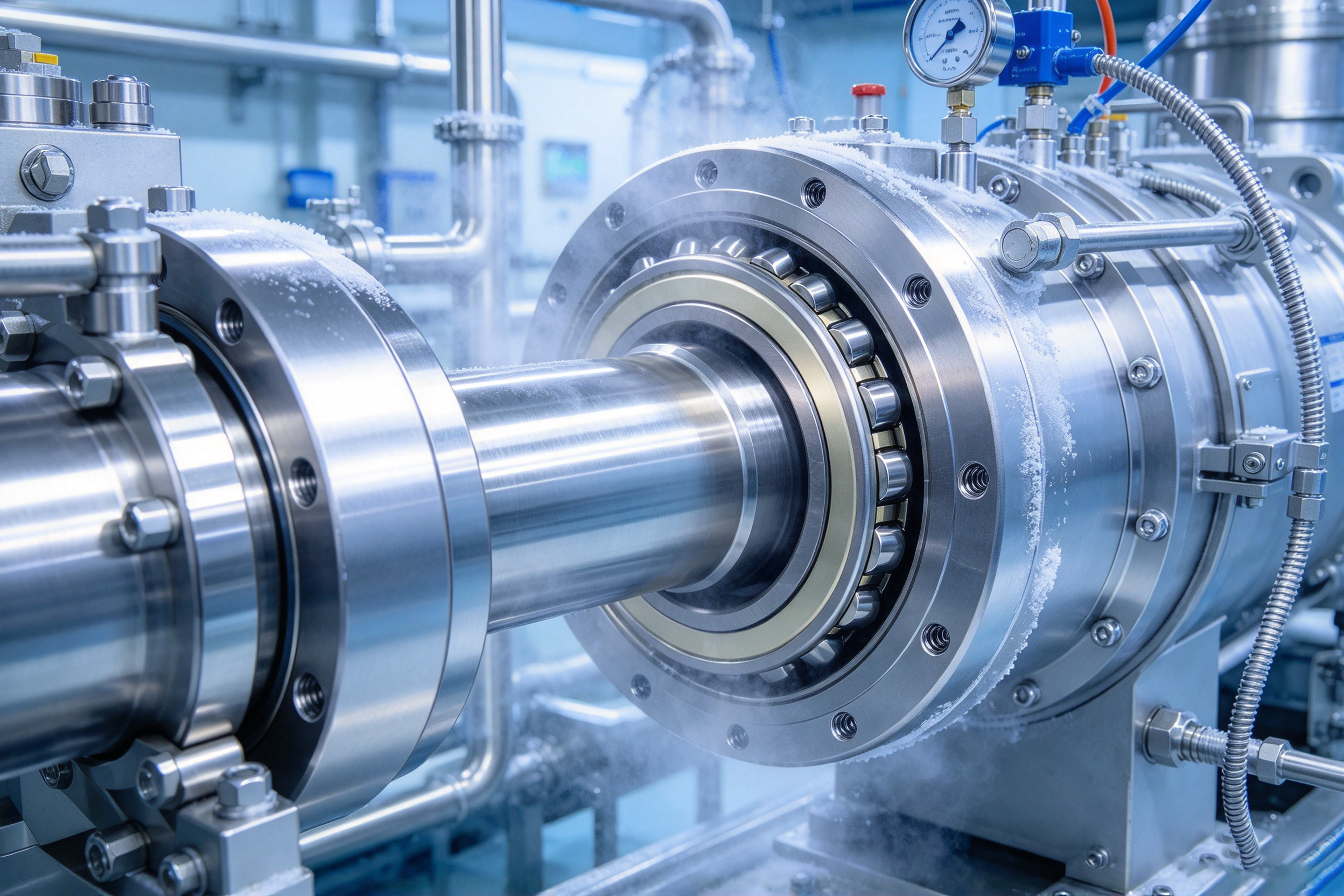
Reliability Starts With System-Level Thinking
Cryogenic bearings do not operate in isolation. Their reliability depends on the interaction between material selection, internal clearance, lubrication, housing design, and operating environment. In liquid nitrogen service at -196°C, small design errors can produce large performance differences.
Engineers should treat cryogenic bearings as part of a complete low-temperature system. Clear operating requirements, verified material choices, and realistic lubrication assumptions are essential for stable long-term performance.
When specified correctly, cryogenic bearings can deliver reliable rotation, low torque, and extended service life even in some of the most demanding industrial environments.
FAQ: Cryogenic Bearings in Liquid Nitrogen
What is a cryogenic bearing?
A cryogenic bearing is a rolling bearing designed to operate reliably at extremely low temperatures, typically below -150°C, including in liquid nitrogen environments at -196°C.
A cryogenic bearing is a rolling bearing designed to operate reliably at extremely low temperatures, typically below -150°C, including in liquid nitrogen environments at -196°C.
Can standard bearings be used in liquid nitrogen?
No. Standard bearings often fail in liquid nitrogen due to lubricant solidification, clearance collapse, cage embrittlement, and seal hardening.
No. Standard bearings often fail in liquid nitrogen due to lubricant solidification, clearance collapse, cage embrittlement, and seal hardening.
What materials are used for cryogenic bearings?
Rings and rolling elements are usually made from martensitic stainless steel or specialty cryogenic steel. Cages may use metal, PTFE-based materials, or specially formulated polymers.
Rings and rolling elements are usually made from martensitic stainless steel or specialty cryogenic steel. Cages may use metal, PTFE-based materials, or specially formulated polymers.
How does -196°C affect internal clearance?
Low temperatures cause thermal contraction, which reduces internal clearance. If the initial clearance is too small, it may become negative and cause excessive preload or seizure.
Low temperatures cause thermal contraction, which reduces internal clearance. If the initial clearance is too small, it may become negative and cause excessive preload or seizure.
What lubrication methods work at -196°C?
Common options include low-temperature synthetic greases, solid lubricants, PTFE-based cages, or system-compatible dry-running designs. Standard greases are usually unsuitable.
Common options include low-temperature synthetic greases, solid lubricants, PTFE-based cages, or system-compatible dry-running designs. Standard greases are usually unsuitable.
Are seals necessary for cryogenic bearings?
Not always. Seals must remain flexible at low temperatures. In some systems, metal shields or open bearings with external sealing are more reliable.
Not always. Seals must remain flexible at low temperatures. In some systems, metal shields or open bearings with external sealing are more reliable.
Where are cryogenic bearings commonly used?
They are used in cryogenic pumps, liquid nitrogen valves, vacuum systems, aerospace test rigs, industrial gas processing, and scientific research equipment.
They are used in cryogenic pumps, liquid nitrogen valves, vacuum systems, aerospace test rigs, industrial gas processing, and scientific research equipment.
How should cryogenic bearings be installed?
They should be installed with clean tools, correct fits, and controlled handling. Rapid thermal shock should be avoided unless the system is designed for it.
They should be installed with clean tools, correct fits, and controlled handling. Rapid thermal shock should be avoided unless the system is designed for it.
How long do cryogenic bearings last?
Service life depends on temperature stability, load, speed, lubrication, clearance selection, and contamination control. There is no universal lifetime value.
Service life depends on temperature stability, load, speed, lubrication, clearance selection, and contamination control. There is no universal lifetime value.
What causes cryogenic bearing failure?
Common causes include lubrication starvation, negative internal clearance, cage cracking, seal failure, thermal shock, and particulate contamination.
Common causes include lubrication starvation, negative internal clearance, cage cracking, seal failure, thermal shock, and particulate contamination.
Post time: Oct-28-2026