


In modern industrial manufacturing, the reliability of production lines depends not only on the performance of the bearings themselves but also on how they are protected, stored, and delivered. Precision packaging plays a critical role in preserving bearing accuracy, preventing contamination, and ensuring that every component arrives in optimal condition. For manufacturers, distributors, and maintenance teams, high-quality packaging is not an afterthought—it is an essential part of bearing quality.
Why Packaging Matters in Bearing Performance
Bearings are precision-engineered components with tight tolerances, smooth raceways, and carefully controlled surface finishes. Even minor exposure to moisture, dust, vibration, or improper handling can affect their performance before installation. Poor packaging may lead to corrosion, brinelling, contamination, or dimensional instability, all of which can shorten service life and increase maintenance costs.
Effective packaging helps maintain bearing integrity from the factory floor to the end user. It protects against environmental risks during transportation, reduces the chance of handling damage, and supports efficient inventory management. When bearings are packaged correctly, production lines can operate with greater confidence, fewer interruptions, and more predictable maintenance schedules.
Common Risks During Storage and Transportation
Bearings face several risks before they are put into service. Understanding these risks helps explain why professional packaging standards are necessary.
| Risk Factor | Possible Impact | Packaging Solution |
|---|---|---|
| Moisture and humidity | Surface corrosion, rust formation | Vapor-corrosion inhibitors, sealed barriers |
| Dust and debris | Raceway contamination, noise increase | Clean inner wrapping and outer cartons |
| Vibration during transit | False brinelling, surface marks | Proper internal fixation and cushioning |
| Temperature changes | Condensation, lubricant instability | Moisture-resistant materials and stable storage |
| Rough handling | Deformation, seal damage | Reinforced cartons and clear labeling |
These risks are especially important for high-precision bearings used in motors, gearboxes, conveyors, pumps, agricultural machinery, and automated production equipment. In such applications, even small defects can cause vibration, overheating, or premature failure.
Key Elements of Professional Bearing Packaging
High-quality bearing packaging usually includes multiple protective layers. Each layer serves a specific function, from preventing corrosion to improving identification and handling efficiency.
Anti-Corrosion Protection
Anti-corrosion treatment is one of the most important steps. Bearings are often wrapped with anti-rust paper, VCI film, or other moisture-resistant materials. These materials help reduce the risk of oxidation during storage and long-distance shipping. For bearings stored in humid environments or shipped across different climate zones, corrosion protection becomes even more valuable.
Clean Inner Wrapping
Inner wrapping keeps dust, metal particles, and other contaminants away from bearing surfaces. Clean packaging helps ensure that bearings remain ready for installation without unnecessary cleaning. This is particularly important for sealed or shielded bearings, where internal contamination cannot be easily removed.
Structural Support and Fixation
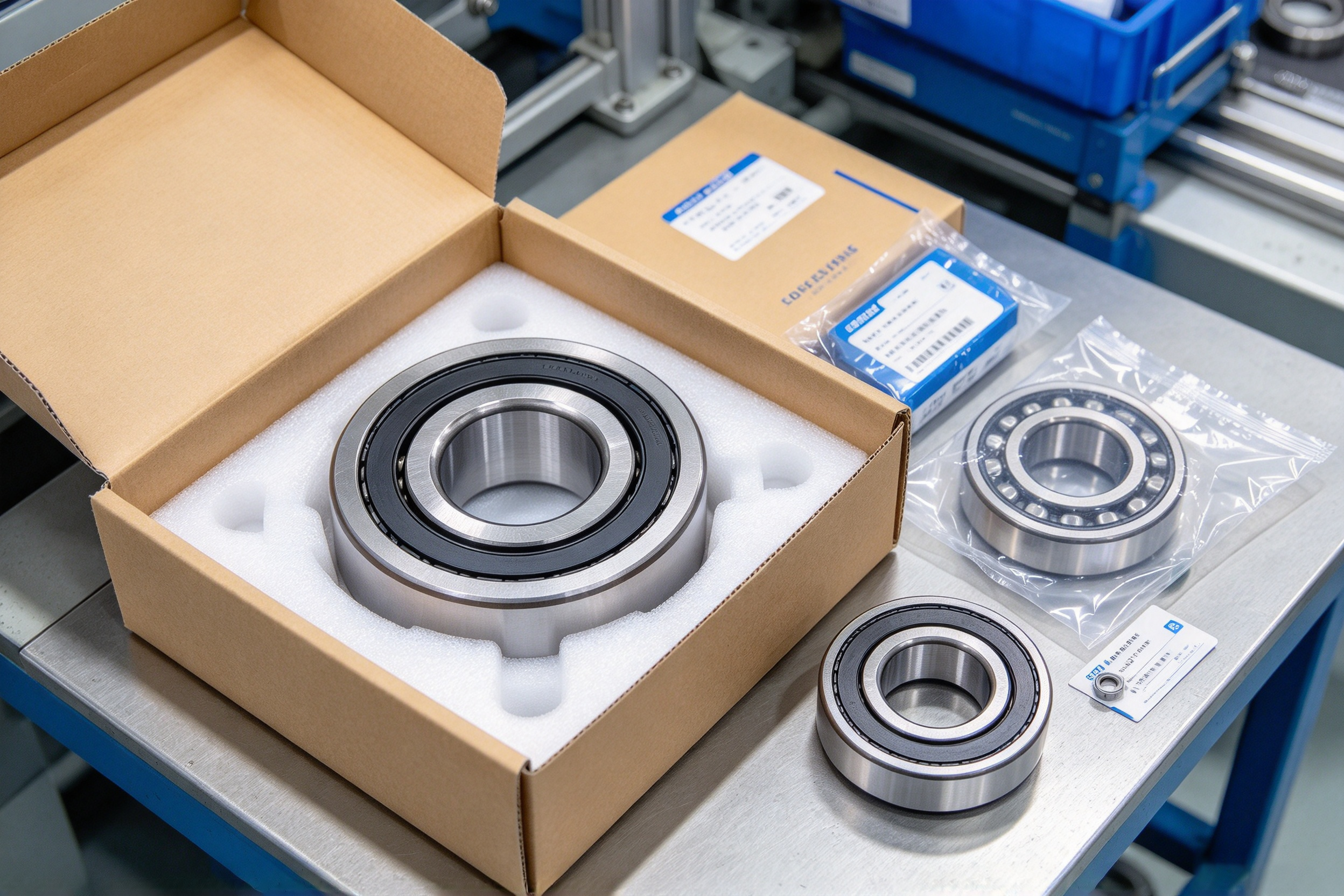
Bearings should be fixed securely inside cartons to prevent movement during transportation. Loose components may collide with each other or with packaging walls, causing surface damage. Proper fixation also helps maintain alignment and prevents deformation of thin-section or large-diameter bearings.
Clear Identification and Traceability
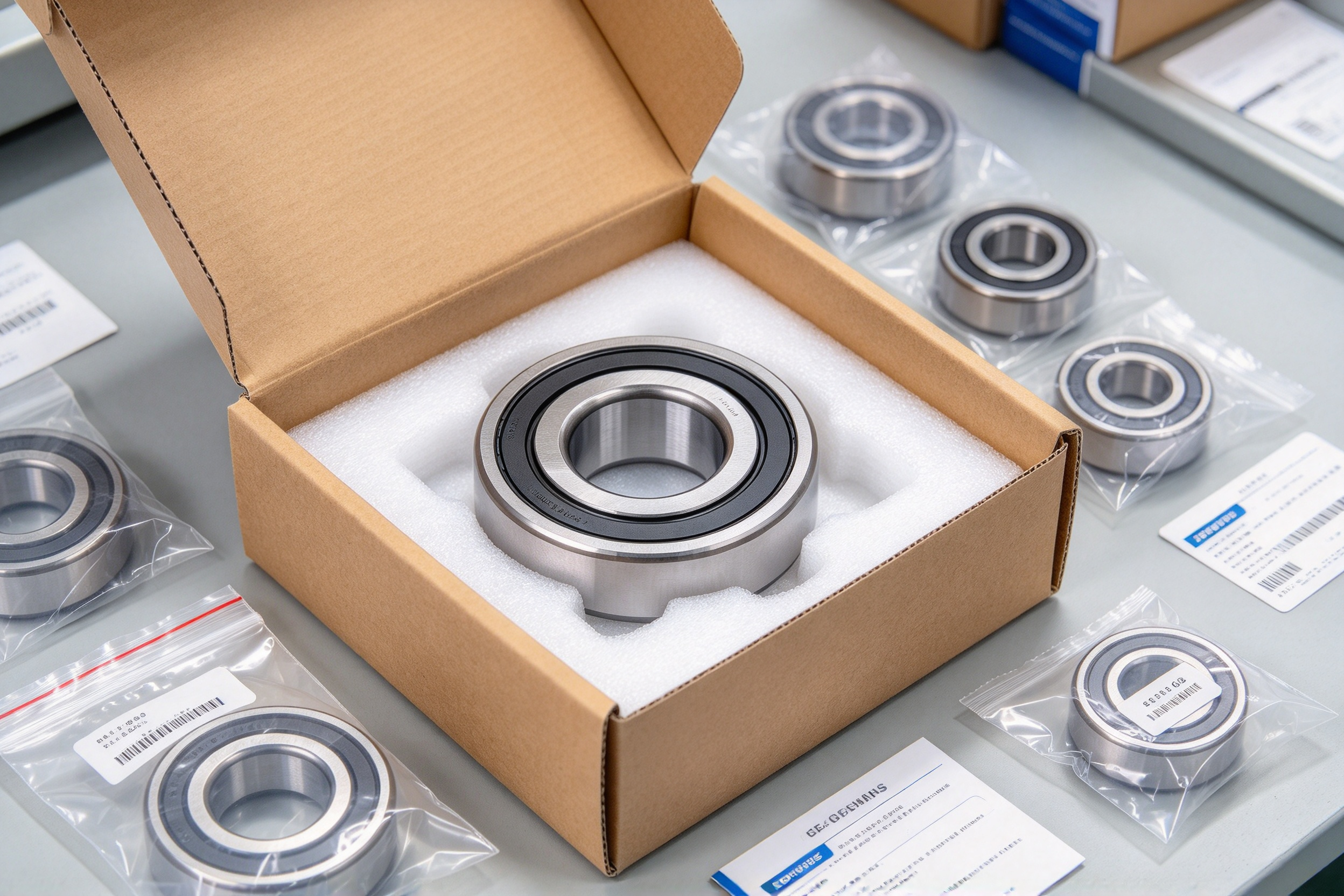
Professional packaging includes clear product labels, batch information, size specifications, and traceability codes. Accurate labeling reduces the risk of wrong installation and supports warehouse management. For industrial buyers, traceability is an important part of quality control and after-sales service.
How Packaging Supports Production Line Efficiency
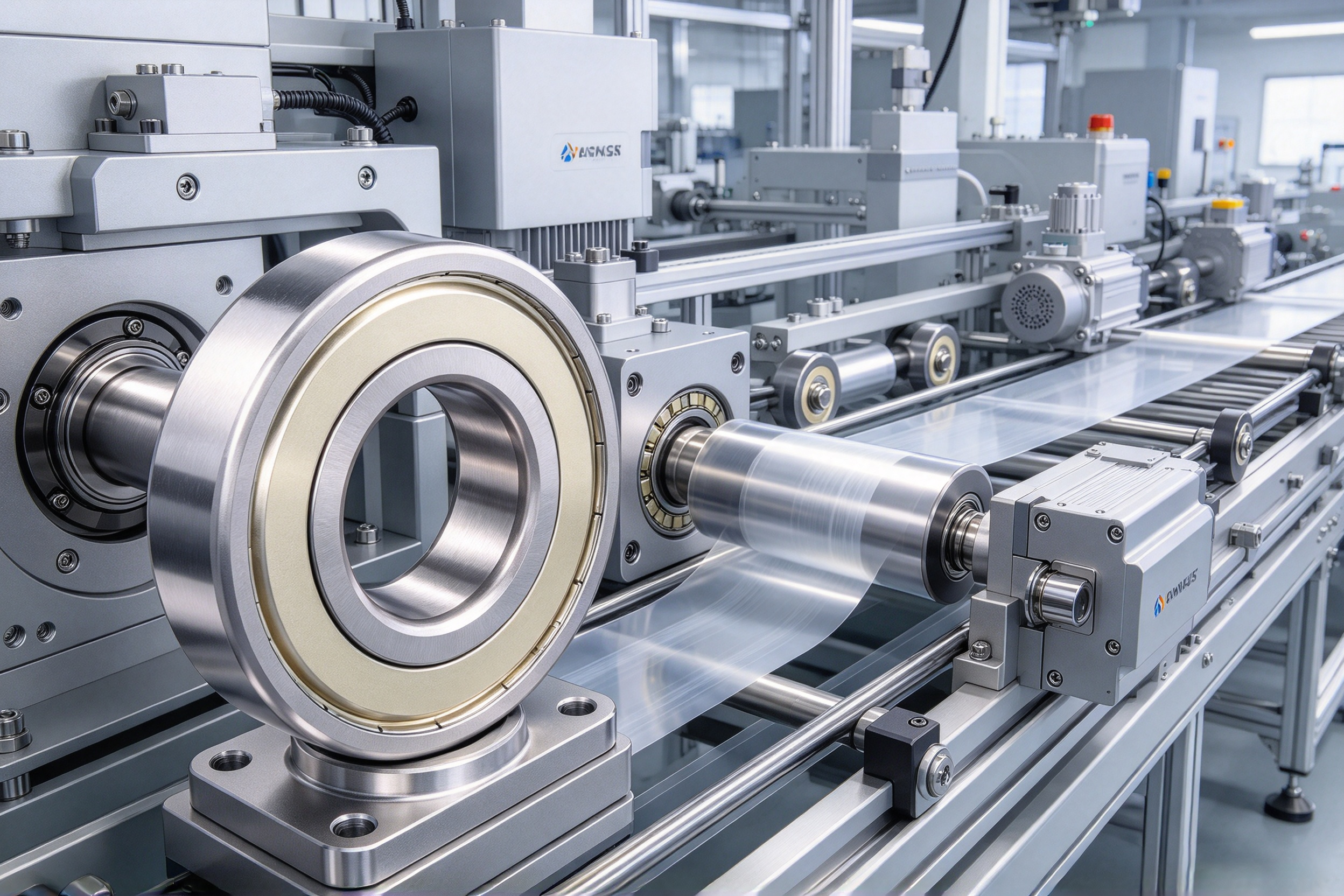
For end users, packaging quality directly affects operational efficiency. Well-packaged bearings are easier to store, identify, and install. Maintenance teams can reduce preparation time because components arrive clean, protected, and correctly labeled.
Good packaging also helps prevent unexpected failures. When bearings are protected from moisture and contamination, they are more likely to perform as designed after installation. This leads to fewer unplanned shutdowns, lower replacement frequency, and more stable production output.
| Packaging Feature | Benefit for Users | Impact on Production |
|---|---|---|
| Moisture-resistant wrapping | Reduces corrosion risk | Extends bearing service life |
| Fixed internal structure | Prevents transit damage | Lowers installation defects |
| Clear product labels | Improves identification accuracy | Reduces wrong-part errors |
| Reinforced outer carton | Improves handling safety | Protects bulk shipments |
| Batch traceability | Supports quality control | Simplifies after-sales support |
Choosing the Right Packaging for Different Applications
Not all bearings require the same packaging solution. Light-duty bearings used in clean indoor environments may need standard protective packaging, while bearings used in harsh conditions or exported overseas may require enhanced protection.
For marine, agricultural, food processing, and chemical environments, additional moisture and contamination protection may be necessary. For high-speed spindles and precision machinery, packaging must also prevent micro-movement and surface marks. For large industrial bearings, packaging design should consider weight distribution, lifting safety, and storage stability.
Manufacturers should evaluate packaging based on bearing type, storage conditions, transportation distance, and customer requirements. A reliable supplier will match packaging standards to the intended application rather than applying a single solution to all products.
Best Practices for Receiving and Storing Packaged Bearings
Even the best packaging cannot fully compensate for poor storage practices. End users should follow basic handling principles to maintain bearing quality.
Bearings should be stored in dry, clean, and temperature-stable areas. Original packaging should remain sealed until installation. Cartons should not be placed directly on wet floors, and heavy items should not be stacked on top of precision bearing packages. When removing bearings from packaging, operators should use clean tools and avoid touching raceways with bare hands whenever possible.
Regular inventory checks also help prevent long-term storage issues. Older stock should be used according to first-in, first-out principles, and any damaged packaging should be inspected before installation. These simple practices can significantly reduce the risk of premature bearing failure.
Packaging as Part of Bearing Quality Assurance
Precision packaging is not separate from bearing quality; it is part of it. A well-manufactured bearing can lose performance if it is poorly protected during storage or transportation. Conversely, professional packaging helps preserve dimensional accuracy, surface finish, lubrication condition, and contamination control.
For industrial buyers, packaging quality reflects a supplier’s attention to detail. Consistent packaging standards, clear labeling, and reliable protection indicate a mature quality management system. These factors contribute to customer trust, smoother logistics, and more reliable production operations.
Building More Reliable Industrial Supply Chains
As industrial equipment becomes more automated and production cycles become more demanding, every component in the supply chain must contribute to stability. Bearings support rotating equipment across countless industries, and their performance depends on careful handling from manufacturing to installation.
Precision packaging ensures that bearings arrive in the condition intended by the manufacturer. It reduces waste, lowers maintenance risks, and helps production lines run more smoothly. By treating packaging as an integral part of bearing quality, manufacturers and suppliers can deliver more consistent value to end users and support long-term operational reliability.
FAQ: Bearing Packaging and Storage
Why is packaging important for bearings?
Packaging protects bearings from moisture, dust, vibration, and handling damage, helping them arrive in proper condition for installation.
Packaging protects bearings from moisture, dust, vibration, and handling damage, helping them arrive in proper condition for installation.
What materials are commonly used in bearing packaging?
Common materials include anti-rust paper, VCI film, clean inner wrapping, sealed bags, and reinforced outer cartons.
Common materials include anti-rust paper, VCI film, clean inner wrapping, sealed bags, and reinforced outer cartons.
How does packaging prevent corrosion?
Moisture-resistant wrapping and vapor-corrosion inhibitors reduce exposure to humidity and help prevent surface rust during storage and transport.
Moisture-resistant wrapping and vapor-corrosion inhibitors reduce exposure to humidity and help prevent surface rust during storage and transport.
Can poor packaging cause bearing failure?
Yes. Inadequate packaging may lead to corrosion, contamination, false brinelling, or seal damage, which can shorten service life.
Yes. Inadequate packaging may lead to corrosion, contamination, false brinelling, or seal damage, which can shorten service life.
Should bearings be removed from packaging before installation?
No. Bearings should remain in their original packaging until they are ready to be installed to avoid contamination and damage.
No. Bearings should remain in their original packaging until they are ready to be installed to avoid contamination and damage.
How should packaged bearings be stored?
Store them in a dry, clean, and temperature-stable area, keep packages sealed, and avoid placing heavy items on top.
Store them in a dry, clean, and temperature-stable area, keep packages sealed, and avoid placing heavy items on top.
What is VCI packaging?
VCI, or vapor corrosion inhibitor packaging, releases protective vapors that help reduce corrosion on metal surfaces during storage and shipping.
VCI, or vapor corrosion inhibitor packaging, releases protective vapors that help reduce corrosion on metal surfaces during storage and shipping.
Why do bearings need internal fixation in cartons?
Internal fixation prevents movement during transit, reducing the risk of collision, surface marks, and deformation.
Internal fixation prevents movement during transit, reducing the risk of collision, surface marks, and deformation.
How does packaging improve production efficiency?
Clear labels, clean protection, and secure packaging reduce inspection time, installation errors, and unexpected bearing failures.
Clear labels, clean protection, and secure packaging reduce inspection time, installation errors, and unexpected bearing failures.
What is the best practice for managing bearing inventory?
Use a first-in, first-out system, check packaging condition regularly, and replace any damaged packages before installation.
Use a first-in, first-out system, check packaging condition regularly, and replace any damaged packages before installation.
Post time: Oct-14-2026