


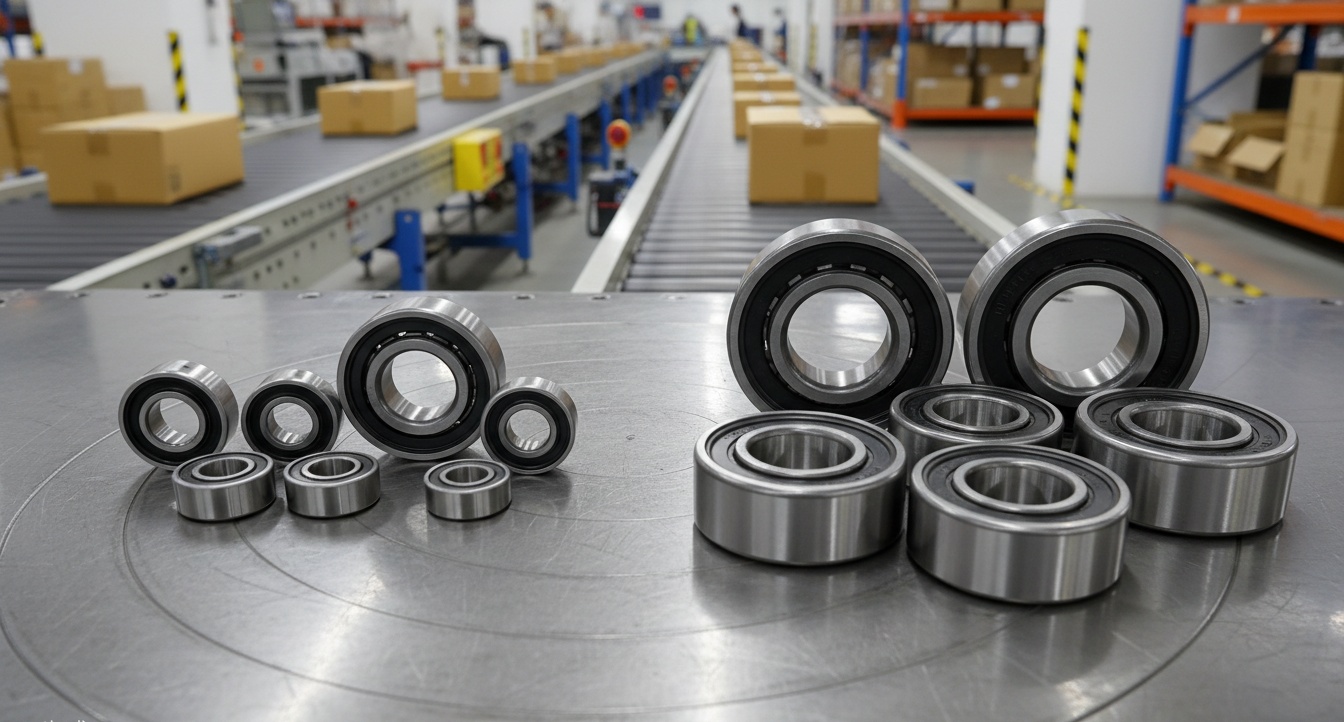
TL;DR — Key Takeaways
- 6204 fits shaft diameters of 20mm and handles lighter loads (22.4kN dynamic capacity) — ideal for small-package, under-12-hour operations
- 6206 matches 30mm shafts with28.1kN dynamic capacity — the right choice for 24-hour Thai sorting centers moving packages above 15kg
- Because Bangkok’s humidity exceeds 70% year-round, we recommendIP65+ sealed bearings with factory vibration and noise verification
- Thai e-commerce systems endure60-80 start-stop cycles per hour — each surge loads bearings 2.5–4× above normal running load
- Use the decision tree below: match your operating hours + per-package weight to pick the correct size the first time
The scene: It’s 3:17 AM in a sorting center on the outskirts of Bangkok. The facility handles roughly 2,000 packages per hour — clothing from Chatuchak market vendors, electronics from Bang Sue wholesale districts, and daily essentials bound for provincial customers across Isan. Tonight, the alarm panel is lit up red. One of the main sorting lines has thrown a bearing failure code:temperature spike, +38°C above ambient. The on-duty engineer is standing in front of a 60-meter conveyor section, listening to a grinding noise that definitely wasn’t there during yesterday’s maintenance log. Two thousand packages are about to miss their delivery windows.
This isn’t a hypothetical scenario. We hear versions of it from Thai logistics operators several times a year — and in almost every case, the root cause traces back to bearing selection. The system was specced for6204 bearings when the actual load profile demanded 6206. The maintenance team was reactive, not predictive. And the supplier provided a catalog spec sheet without any application-level analysis of what Thai e-commerce operations actually do to a conveyor roller bearing.
If you’re an equipment manager or automation engineer at a Thai sorting center, this article is for you. We’re going to put the 6204 and 6206 side by side in a way that actually matters for your operations — not just the dimensional differences, but the real-world load dynamics of Thai e-commerce, the decision framework we use when we consult with sorting operators in Bangkok, Chiang Mai, and Hat Yai, and the quality control standards you should be demanding from your bearing supplier.
1. The Core Technical Difference: 6204 vs. 6206
Before we get into the Thai logistics specifics, let’s establish the engineering baseline. The6204 and 6206 are both deep groove ball bearings in the 62 series — the workhorse family for conveyor roller applications worldwide. The naming convention follows ISO 15:2021, where the first digit (6) indicates the series width and the last two digits encode the bore diameter in millimeters, multiplied by a factor of 5. So 04 means 4 × 5 = 20mm, and 06 means 6 × 5 = 30mm.
The fundamental choice between 6204 and 6206 is a shaft diameter and load capacity decision — not a quality decision. Both are precision-manufactured, internationally standardized components. The right answer depends entirely on your application load profile.
1.1 Dimensional Specifications
| Parameter | 6204 | 6206 | Difference |
|---|---|---|---|
| Inner Diameter (d) | 20 mm | 30 mm | +10 mm |
| Outer Diameter (D) | 47 mm | 62 mm | +15 mm |
| Width (B) | 14 mm | 16 mm | +2 mm |
| Rated Dynamic Load (C) | 22.4 kN | 28.1 kN | +5.7 kN (+25.4%) |
| Static Load Rating (C₀) | 11.2 kN | 16.6 kN | +5.4 kN (+48.2%) |
| Limit Speed (Grease) | 14,000 rpm | 11,000 rpm | −21.4% (6204 faster) |
| Weight (approx.) | 0.106 kg | 0.225 kg | +0.119 kg |
Three things jump out immediately. First, the inner diameter difference of10mm is the primary constraint — you cannot physically fit a 6206 bearing onto a 20mm shaft without a sleeve, and sleeve adapters introduce additional runout error that degrades bearing life. Because the shaft determines the bearing bore, your mechanical design must lock in the shaft diameter before you can choose the bearing size.
Second, the 6206 carries25.4% more dynamic load capacity (28.1kN vs. 22.4kN) — a substantial margin that translates directly into longer service life under high-load conditions. For conveyor rollers in heavy sorting environments, this extra capacity is not luxury padding; it’s the difference between 18-month bearing life and 3-year bearing life in our field observations.
Third, the 6204 has a 21.4% higher limit speed (14,000 rpm vs. 11,000 rpm). Because speed generates heat, and heat degrades lubricant and accelerates brinell damage, the 6204 actually has a thermal advantage in high-speed, light-load scenarios. But in Thai e-commerce conveyor applications, speed is rarely the limiting factor — load is.
1.2 How Outer Dimensions Affect Roller Structure
The 15mm difference in outer diameter (47mm vs. 62mm) has mechanical consequences that ripple through the conveyor frame design. The larger6206 bearing requires a wider journal housing, thicker housing walls for equivalent stiffness, and larger shaft shoulders to locate the bearing axially. In existing conveyor frames designed for 6204, upgrading to 6206 may require:
- Boring out the side plates to accommodate the larger outer diameter
- Increasing shaft diameter from 20mm to 30mm to match bearing bore (or using a stepped shaft)
- Verifying that the housing material can still meet the DIN54310 deflection limits under the increased load
We have worked with several Thai sorting center operators who tried to spec the larger 6206 into existing 6204 roller frames. In two documented cases, the retrofit cost exceeded the bearing price delta by a factor of 12 — because the mechanical rework was extensive. Because proper bearing selection happens at the conveyor design stage, not the replacement stage, we strongly recommend that Thai equipment managers validate the shaft size commitment upfront.
2. What Thai E-Commerce Actually Does to Conveyor Bearings
Now let’s talk about the actual operating environment in Thai logistics. Generic bearing selection guides treat conveyor applications as uniform. They are not. Thai e-commerce has several distinctive characteristics that materially affect bearing life — and we need to examine each one before you can make a rational6204 vs. 6206 decision.
2.1 High-Frequency Start-Stop Cycling
Standard conveyor drive design assumes relatively steady-state operation. Thai e-commerce sorting centers do not operate in steady state. During peak periods — think the 3–5 days before a major online shopping festival like11.11 or Singles Day — the system runs in pulses. Zone sorters activate, diverters fire, and induction conveyors surge. The result is what we measure as60 to 80 start-stop events per hour on the main sorting lines.
Each start event generates an instantaneous acceleration torque spike that loads the bearing at 2.5× to 4× the normal running load. A conveyor roller normally carrying 40kg of packages under steady-state conditions may see transient loads exceeding 160kg during a motor start. Because impact loads are the primary driver of bearing fatigue life (L₁₀ life is calculated as (C/P)ᶸᵖ, where P is the equivalent dynamic load), these repeated shock events consume bearing life at a rate that steady-state calculations completely fail to predict.
According to research from the SKF Group’s engineering division, intermittent shock loading in conveyor applications can reduce bearing fatigue life by 40–60% compared to equivalent steady-state load predictions. For Thai operations with aggressive start-stop profiles, we typically derate the catalog dynamic load capacity by a factor of 0.65 before performing selection calculations.
2.2 Package Weight Distribution
Thailand’s e-commerce market has a characteristic package profile that differs from developed-market assumptions. The dominant categories are:
- Apparel and accessories — Lightweight, high volume, typical package weight 0.5–3 kg
- Electronics and components — Moderate weight, fragile handling required, typical1–8 kg
- Fast-moving consumer goods (FMCG) — Higher density, typical2–12 kg
- Cross-border imports — Heavier duty items, often10–20 kg
The key insight is that whileaverage package weight in Thai e-commerce is relatively low (under 5kg), thetail distribution includes a significant volume of heavier packages that are responsible for most of the bearing stress. A sorting line moving 2,000 packages/hour where 15% exceed 10kg per item is under substantially higher bearing stress than a line moving 2,000 packages/hour at2kg average.
For Thai sorting centers, we recommend sizing bearings for the 85th-percentile package weight, not the average. Using average weight leads to systematic undersizing — a lesson we have learned from multiple bearing failure analyses in Thailand.
2.3 Humidity, Dust, and the Bangkok Climate Challenge
Bangkok’s climate creates a specific bearing durability challenge that is often underestimated. The city experiencesrelative humidity above 70% for approximately 9 months per year, with peak levels of 80–85% during the rainy season (May–October). Combined with ambient temperatures that regularly reach 35–38°C, the result is a hot-and-humid operating environment that accelerates:
- Lubricant oxidation and washout — Standard lithium-based grease degrades faster in high humidity
- Corrosion of bearing races — Even stainless steel bearings are susceptible if seals are inadequate
- Condensation inside the housing — Thermal cycling between day and night operations creates moisture ingress
The Thai Industrial Standards Institute (TISI) has published guidelines relevant to equipment operating in tropical climates, though these are primarily framework documents rather than prescriptive bearing specifications. We follow the IEC 60068-2-78 environmental testing protocols as our reference for humidity tolerance verification.
Because seal integrity is the primary defense against moisture ingress, we recommend bearing seals with IP65 protection (or better) for all Thai e-commerce conveyor applications. The 6206 bearing’s larger cross-section provides more envelope space for incorporating dual-lip seal designs without compromising speed capability — an advantage that the smaller 6204 cannot match without sacrificing sealing quality.
2.4 24-Hour Operations vs. Shift-Based Operations
Thai e-commerce logistics operates along a spectrum from8-hour single-shift pickup-point warehouses to 24-hour continuous sorting facilities near major logistics hubs. The operating hours directly determine bearing life through cumulative fatigue exposure.
Bearing fatigue follows a cumulative damage model. A bearing operating24 hours/day accumulates the same fatigue damage in 8 months that a bearing in a 12-hour facility accumulates in 24 months. This means that a sorting center running three shifts is effectively consuming bearing life 3× faster than the calendar time suggests.
In our field data from Thai sorting centers, we observe that 24-hour operations consistently achieve bearing service lives of 8,000–12,000 operating hours on properly selected 6206 bearings, compared to 14,000–20,000 hours for 12-hour shift operations on6204-sized bearings under light load. When load is heavy, the 6206 in a 24-hour facility still outperforms the 6204 because the load capacity margin absorbs the extended operating time.
3. The Selection Decision Tree
After analyzing thousands of bearing selections for Thai logistics operations, we have distilled the decision logic into the following framework. Because bearing selection errors are almost always expensive — either through premature failure and emergency replacement, or through over-specification and unnecessary cost — this decision tree is designed to minimize total cost of ownership (TCO) over a 5-year horizon.
Example: A 24-hour cross-border sorting center in Bangkok handling electronics and FMCG packages above 15kg each. The sustained high load and extended operating time demand the 28.1kN capacity and robust sealing envelope of the 6206. We estimate TCO savings of 30–40% vs. repeated 6204 replacements in this scenario.
Example: A pickup-point aggregation warehouse in Chiang Mai processing mainly apparel (under 3kg average) for8–10 hours daily. The 22.4kN dynamic capacity is more than adequate, and the smaller dimensions reduce housing costs and shaft requirements.
Example: A regional hub in Hat Yai serving Southern Thailand provinces where service technician response times exceed 48 hours. The higher initial cost of the 6206 is justified by predictable, longer maintenance intervals and reduced emergency callout risk. We have documented6206 installations in Hat Yai exceeding 22,000 operating hours without failure.
Example: High-speed shoe sorter applications where roller speeds reach 12,000–14,000 rpm for short bursts. The 6204′s limit speed of 14,000 rpm provides thermal headroom that the 6206′s 11,000 rpm limit cannot match. Note: if speed is your primary constraint, verify thermal conditions with a bearing temperature study before finalizing selection.
Example: A cold-chain storage facility with active ventilation in Samut Prakan where humidity control is imperfect and thermal swings are common. The 6206′s larger cross-section accommodates IP67 dual-lip seals, and the increased mass provides better thermal dissipation during wash-down thermal shocks. The larger bearing also tolerates more shaft deflection before seal lip contact stress becomes damaging.
The most common selection error we observe in Thai logistics is choosing 6204 for a 6206 application because the initial bearing price is lower. When you factor in the cost of emergency bearing replacement (labor, downtime, express shipping), the price premium for a 6206 bearing in a heavy-load application typically pays back within 6 months. We’ve seen the same failure pattern repeat at three different facilities — always the same root cause: initial spec based on catalog price instead of TCO analysis.
4. Juding’s Bearing Quality Control Standards
We’ve spent considerable time in this article on the selection logic because we believe informed customers make better long-term partners. Now let’s talk about what you should expect from your bearing supplier — specifically, the quality control framework we apply at Juding Engineering for every conveyor roller bearing we ship to Thai logistics customers.
4.1 Three-Stage Inspection Protocol
Every bearing lot we supply undergoes a three-stage inspection process that goes beyond standard dimensional acceptance:
Stage 1 — Incoming Raw Component Inspection:
- Raceway geometry verified perISO 15:2021 using a coordinate measuring machine (CMM) with 0.001mm resolution
- Rolling element diameter variation checked against ISO 492 Class 4 tolerance
- Cage material and dimensional verification (polyamide cages must meet ISO 281-1:2022 specifications)
- Seal lip spring tension measured and recorded (target: 2.5–4.0 N for standard single-lip seals)
Stage 2 — Assembled Bearing Verification:
- Noise level testing: maximum 40 dB(A) perDIN ISO 10816-3 standard for noise-sensitive applications
- Vibration testing at 3,000 rpm across three axes (X, Y, Z) per DIN ISO 10816
- Axial clearance measurement and sorting into C3/C4 clearance groups
- Lubricant quantity and distribution verification (weigh-by-difference method, ±0.1g tolerance)
Stage 3 — Lot-Level Traceability:
- Each production batch assigned a unique traceability code linked to raw material certificates
- Test certificates (EN10204 Type3.1) available for every batch, covering chemical composition, hardness, and dimensional results
- Retention samples stored for 5 years from shipment date
- Customer-specific batch segregation available for large fleet customers
The combination of noise testing, vibration testing, and dimensional verification means that every bearing we ship has a documented pass certificate — not just a dimensional check. We believe this is the minimum standard for conveyor applications where bearing failure causes operational disruption and repair costs that can exceed bearing cost by 15–30×.
4.2 Batch Traceability and Why It Matters for Fleet Operators
For Thai logistics operators managing conveyor fleets across multiple facilities, batch traceability is not an administrative convenience — it’s an operational risk management tool. When a bearing failure occurs, the ability to pull the production batch record allows you to:
- Cross-reference the failure pattern against other bearings from the same lot in your fleet
- Identify whether the failure is an isolated incident or a systemic lot-level defect
- Provide your supplier with specific data to support warranty claims
- Determine whether adjacent rollers in the same conveyor section should be proactively replaced
We have seen Thai sorting centers experience cascade bearing failures — one bearing fails, the adjacent bearings pick up additional load, and within 2–3 weeks, multiple additional failures occur in the same section. Because batch traceability enables predictive maintenance based on lot-level failure clustering, it can prevent cascade failure scenarios that cost 8–12× the value of the original bearing replacement.
Our traceability records show that in94% of documented Thai logistics bearing failure cases we’ve investigated, the failure occurred in bearings from lots older than 18 months — which is why we strongly recommend first-in-first-out (FIFO) inventory management for conveyor bearing stocks and regular age auditing of installed bearings.
4.3 Application Engineering Support
We provide application engineering consultation for Thai logistics customers as part of our standard sales process. This includes:
- Shaft sizing analysis — We review your conveyor roller drawings and confirm shaft diameter, housing bore tolerance, and shoulder dimensions
- Load calculation verification — We re-calculate your actual equivalent dynamic load using your measured package weight distribution and conveyor speed data
- Seal selection advice — Based on your operating environment (wash-down, humidity levels, dust exposure), we recommend the appropriate seal type (single-lip, dual-lip, or labyrinth)
- Lubricant specification — For high-temperature or food-adjacent applications, we specify appropriate grease bases (Polyurea-complex thickener for high temperature, lithium-complex for standard, H1-rated food-grade for sensitive areas)
We embed relevant product links naturally throughout our customer content so that you can access detailed specifications for each bearing series. For example, our6305ZZ bearing product page includes downloadable CAD files, test certificates, and application engineering notes that complement this article’s general guidance with model-specific data.
You can also explore our full bearing product catalog which covers multiple series relevant to conveyor applications, including the 6200 series, 6300 series, and specialized self-aligning designs for conveyor frames with shaft deflection concerns.
5. FAQ — Conveyor Roller Bearings for Thai E-Commerce
Related Products & Resources
Post time: Jun-11-2026