


Semiconductor manufacturing relies on extreme precision. From wafer handling and lithography to thin-film deposition and etching, modern chip fabrication takes place in environments where even microscopic contamination can reduce yield. Vacuum-compatible bearings play a quiet but critical role in these systems. They allow robotic arms, transfer modules, spindles, and positioning stages to move reliably under high vacuum, low pressure, and stringent cleanliness requirements.
For equipment makers and fabrication facilities, selecting the right vacuum-compatible bearing is not only a mechanical decision. It affects process stability, maintenance intervals, particle generation, lubricant management, and total cost of ownership. As semiconductor processes continue to shrink and throughput demands increase, bearing performance under vacuum has become an important engineering consideration.
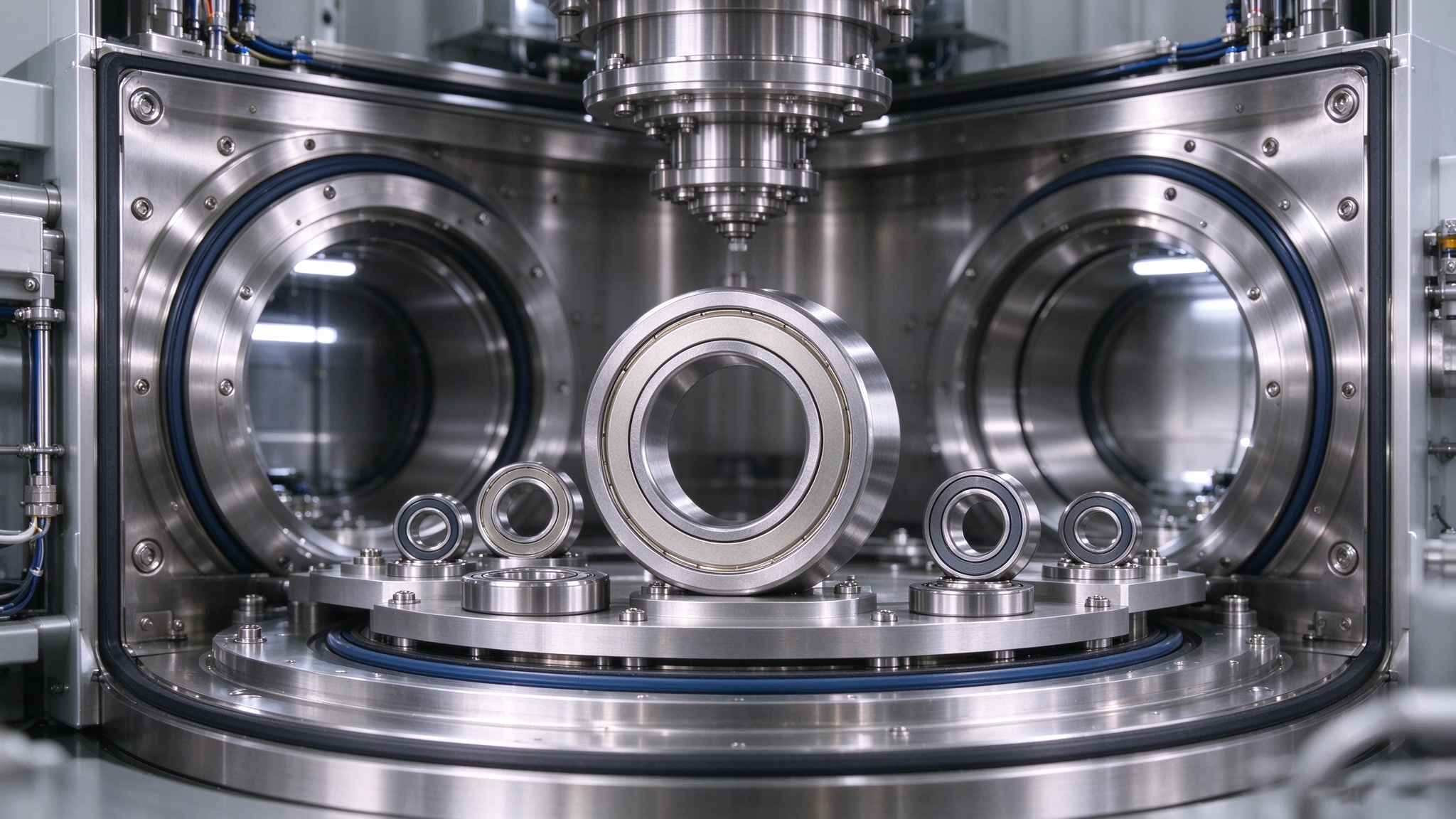
Why vacuum environments create special bearing challenges
Vacuum-compatible bearings are designed to operate where conventional lubricants, seals, and materials may fail. In high-vacuum or ultra-high-vacuum systems, ordinary grease can evaporate, oxidize, or release volatile compounds. These outgassing products may deposit on wafers, optical components, sensors, and chamber walls, creating defects or requiring more frequent cleaning.
Standard bearings can also generate particles through wear, inadequate lubrication, or surface degradation. In semiconductor equipment, particles are a major source of yield loss. Vacuum-compatible bearings must therefore balance low friction, dimensional stability, material cleanliness, and long service life without relying on lubricants that compromise the process environment.
Temperature control adds another layer of complexity. Some vacuum processes involve heat cycling, radiant heating, or localized thermal gradients. Bearings must maintain performance without excessive expansion, seizure, or lubricant breakdown. In many cases, the bearing solution must also support high rotational accuracy, low vibration, and repeatable positioning.
Key requirements for semiconductor vacuum bearings
| Requirement | Why it matters | Typical engineering response |
|---|
| Requirement | Why it matters | Typical engineering response |
|---|---|---|
| Low outgassing | Prevents contamination of wafers and optics | Use of vacuum-stable lubricants, dry films, or solid lubricants |
| Low particle generation | Protects yield and reduces chamber cleaning | Precision manufacturing, controlled preload, clean assembly |
| Vacuum stability | Maintains performance under low pressure | Materials and lubricants qualified for vacuum service |
| Thermal compatibility | Avoids seizure or dimensional drift | Matched ring materials, controlled clearances, stable cages |
| Corrosion resistance | Reduces contamination risk and extends life | Stainless steel or specialized coatings where appropriate |
| Precision and rigidity | Supports accurate wafer handling and positioning | ABEC-style precision classes, optimized internal geometry |
These requirements do not exist in isolation. A bearing that performs well in atmospheric conditions may still fail in vacuum if its lubricant releases volatiles. Conversely, a bearing with excellent vacuum compatibility may not meet accuracy needs if its internal clearance or preload is unsuitable for the application.
Common bearing types used in vacuum semiconductor equipment
Different stages of chip fabrication place different demands on bearings. Robot arms inside vacuum load locks need smooth motion and low particle generation. Spindles used for wafer processing may require higher rotational accuracy. Linear stages and indexing modules depend on repeatable travel and stable friction.
| Bearing type | Typical vacuum applications | Main advantages |
|---|
| Bearing type | Typical vacuum applications | Main advantages |
|---|---|---|
| Deep groove ball bearings | Vacuum robots, transfer modules, light-load spindles | Versatile, available in precision grades, suitable for many vacuum layouts |
| Angular contact ball bearings | High-speed spindles, precision stages | Higher rigidity, better axial load capacity, improved rotational accuracy |
| Thin-section bearings | Compact robotic joints, wafer handlers | Space-saving design, reduced weight, suitable for constrained envelopes |
| Ceramic hybrid bearings | High-speed or thermally sensitive systems | Lower density, reduced centrifugal load, improved thermal behavior |
| Coated or surface-treated bearings | Corrosive or high-cleanliness environments | Improved wear resistance, reduced adhesion, better contamination control |
Material selection is equally important. Stainless steel rings are commonly used because they offer good corrosion resistance and can be manufactured to high precision. Ceramic rolling elements, such as silicon nitride, are often selected for high-speed or low-lubrication conditions. They are lighter than steel and can reduce heat generation, which helps maintain stability in sensitive vacuum systems.
Cage design also influences performance. Polymer cages may be suitable for certain low-outgassing applications, but they must be evaluated against process temperature, radiation exposure, and vacuum level. Metal cages can offer better thermal stability in demanding environments, though they may require careful surface treatment to control friction and wear.
Lubrication strategies for vacuum-compatible operation
Lubrication is one of the most critical design decisions for vacuum bearings. In atmospheric applications, grease can replenish the contact zone and protect against wear. In vacuum, however, many conventional lubricants evaporate or break down, releasing gases that contaminate the chamber.
Engineers typically evaluate several approaches:
- Perfluoropolyether-based lubricants: Often selected for vacuum service due to low vapor pressure and good chemical stability.
- Solid lubricant coatings: Used when liquid or grease lubricants cannot be tolerated, especially in ultra-high-vacuum systems.
- Dry-film lubrication: Applied to cages, rings, or rolling elements to reduce friction without traditional grease.
- Minimal-lubrication designs: Engineered to reduce lubricant volume while maintaining acceptable bearing life.
- Sealed or shielded configurations: Used selectively to retain lubricant and block external contamination, provided the seal materials are compatible with vacuum and process conditions.
The best lubrication strategy depends on vacuum level, speed, load, temperature, cleanliness class, and maintenance access. A bearing used in a load-lock transfer module may have different requirements from one installed inside a deposition chamber or near a lithography stage.
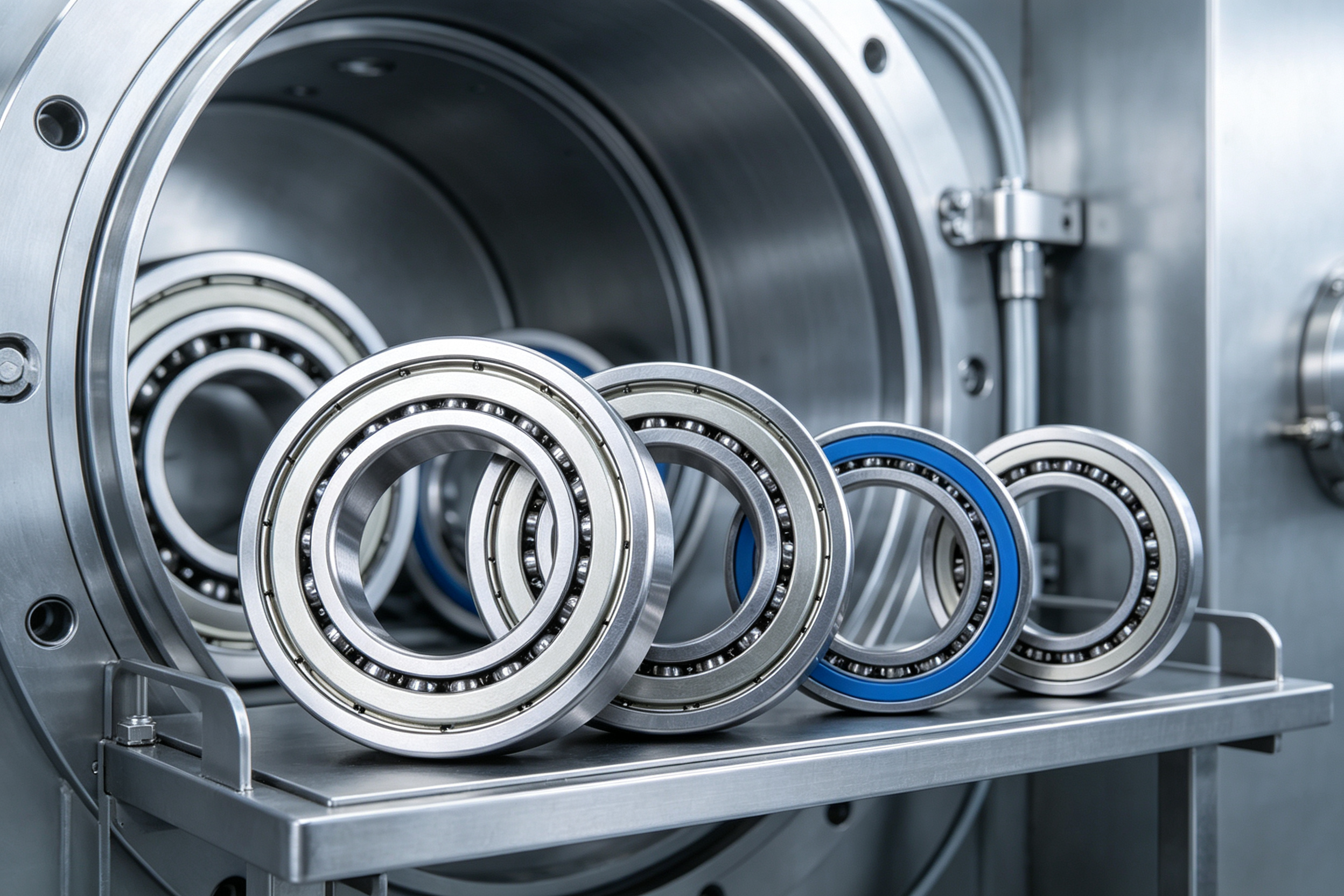
How vacuum bearings affect chip fabrication yield
Yield loss in semiconductor manufacturing is expensive. A single contaminated wafer can represent significant material, energy, and processing cost. Vacuum-compatible bearings help protect yield by reducing sources of particulate and chemical contamination.
They also improve equipment uptime. Bearings that maintain stable friction and precision under vacuum reduce the risk of unexpected stops, positioning errors, or premature maintenance. In high-throughput fabs, even small improvements in bearing reliability can translate into meaningful productivity gains.
Precision motion is another factor. As device structures become smaller, equipment must position wafers with tighter tolerances. Bearings with controlled internal geometry and stable lubrication help robotic arms and stages achieve repeatable movement. This supports accurate alignment, consistent handling, and reduced defect rates.
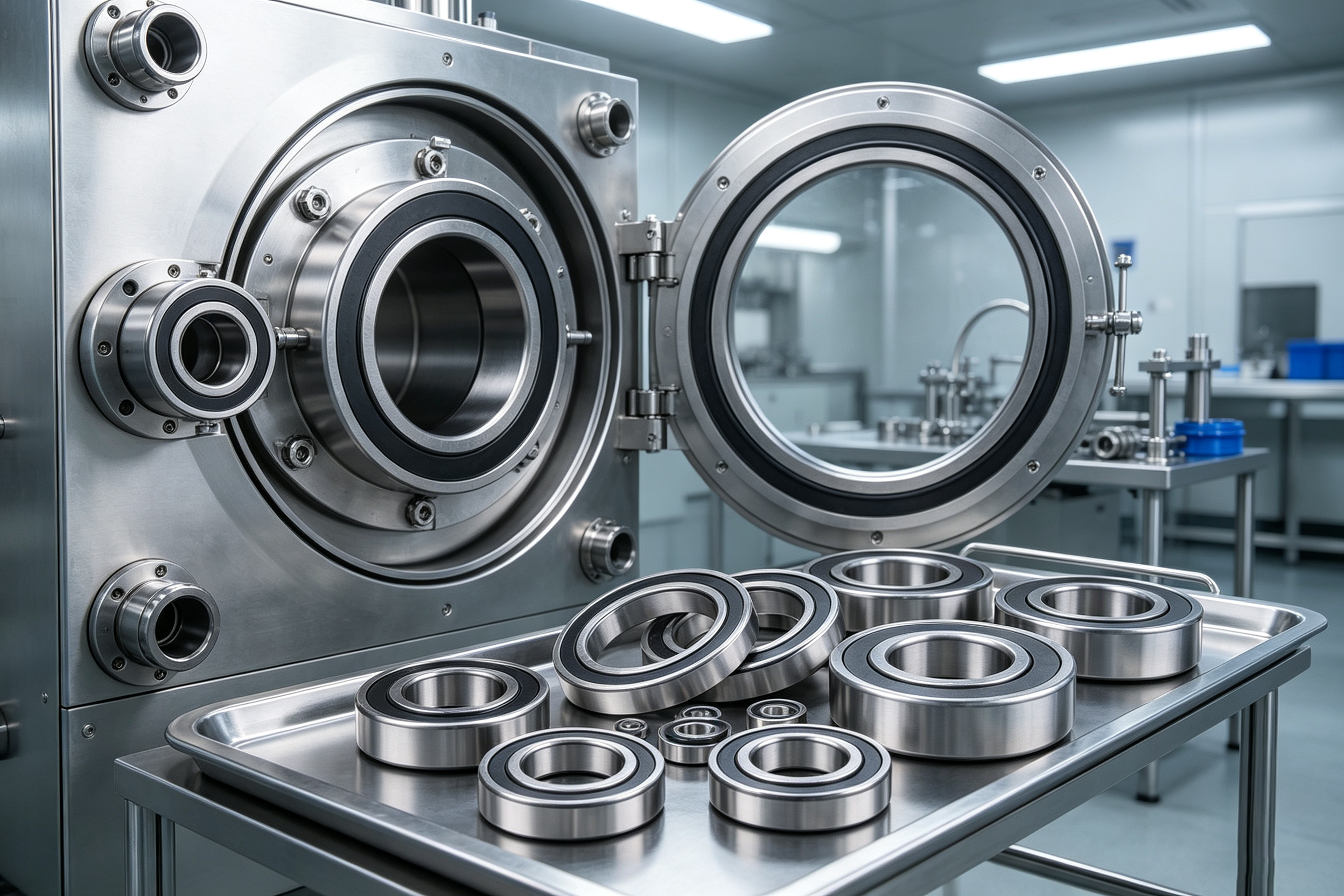
Design and selection considerations
Choosing vacuum-compatible bearings requires more than comparing dimensions and load ratings. Engineers should consider the full operating environment and the interaction between bearing, lubricant, housing, and process gas.
Important selection factors include:
- Vacuum level: High vacuum and ultra-high-vacuum systems place stricter demands on outgassing and lubrication.
- Speed and load: Higher speeds increase heat generation and lubricant stress.
- Temperature range: Bearings must remain stable during process heating, cooling, or ambient cycling.
- Cleanliness class: Semiconductor equipment often requires bearings assembled and packaged under clean conditions.
- Maintenance accessibility: Some chambers are difficult to service, making long bearing life especially valuable.
- Regulatory and customer requirements: Fabrication equipment suppliers may require documented material traceability, cleaning procedures, and performance validation.
Bearing suppliers with experience in semiconductor applications can help match internal clearance, preload, cage type, and lubrication to the intended use. Early collaboration between mechanical engineers, process engineers, and bearing specialists often reduces development risk and shortens qualification cycles.
FAQ
What makes a bearing vacuum-compatible?
A vacuum-compatible bearing is designed to operate under low pressure without releasing excessive gases, generating particles, or relying on lubricants that evaporate or degrade. Material selection, lubrication, cage design, and manufacturing cleanliness all matter.
A vacuum-compatible bearing is designed to operate under low pressure without releasing excessive gases, generating particles, or relying on lubricants that evaporate or degrade. Material selection, lubrication, cage design, and manufacturing cleanliness all matter.
Can ordinary bearings be used in semiconductor vacuum systems?
Ordinary bearings may work temporarily, but they often carry lubricants and surface residues that outgas in vacuum. This can contaminate chambers and reduce bearing life. Purpose-designed vacuum-compatible bearings are preferred for reliable operation.
Ordinary bearings may work temporarily, but they often carry lubricants and surface residues that outgas in vacuum. This can contaminate chambers and reduce bearing life. Purpose-designed vacuum-compatible bearings are preferred for reliable operation.
Do vacuum bearings always run without grease?
Not always. Some vacuum applications use specialized low-vapor-pressure lubricants. Others rely on solid lubricants or dry-film coatings. The choice depends on vacuum level, speed, temperature, and contamination sensitivity.
Not always. Some vacuum applications use specialized low-vapor-pressure lubricants. Others rely on solid lubricants or dry-film coatings. The choice depends on vacuum level, speed, temperature, and contamination sensitivity.
Why are ceramic hybrid bearings used in vacuum applications?
Ceramic rolling elements are lighter and can reduce centrifugal forces at high speed. They also offer good thermal stability and wear resistance, which can help in low-lubrication or thermally demanding vacuum environments.
Ceramic rolling elements are lighter and can reduce centrifugal forces at high speed. They also offer good thermal stability and wear resistance, which can help in low-lubrication or thermally demanding vacuum environments.
How do vacuum bearings support semiconductor yield?
They reduce particle generation and outgassing while maintaining precise, stable motion. This helps protect wafers, extend maintenance intervals, and improve equipment reliability in critical fabrication processes.
They reduce particle generation and outgassing while maintaining precise, stable motion. This helps protect wafers, extend maintenance intervals, and improve equipment reliability in critical fabrication processes.
Vacuum-compatible bearings are not visible to the final chip, but their performance influences nearly every stage of semiconductor manufacturing. As equipment becomes faster, cleaner, and more precise, bearing design will remain an essential part of enabling high-yield chip fabrication.
FAQ
What is a vacuum-compatible bearing?
A bearing designed to operate in low-pressure environments without excessive outgassing, particle generation, or lubricant failure.
A bearing designed to operate in low-pressure environments without excessive outgassing, particle generation, or lubricant failure.
Why can’t standard bearings be used in vacuum systems?
Standard lubricants and surface residues can evaporate in vacuum, causing contamination, wear, and shorter service life.
Standard lubricants and surface residues can evaporate in vacuum, causing contamination, wear, and shorter service life.
Which lubricants are used for vacuum bearings?
Common options include perfluoropolyether-based lubricants, solid lubricant coatings, and dry-film treatments, depending on vacuum level and operating conditions.
Common options include perfluoropolyether-based lubricants, solid lubricant coatings, and dry-film treatments, depending on vacuum level and operating conditions.
Are ceramic hybrid bearings better for vacuum applications?
They can be advantageous in high-speed or thermally sensitive systems because ceramic rolling elements are lighter and generate less heat.
They can be advantageous in high-speed or thermally sensitive systems because ceramic rolling elements are lighter and generate less heat.
How do vacuum bearings affect semiconductor yield?
They help reduce particle and chemical contamination while maintaining precise motion, supporting higher yield and longer equipment uptime.
They help reduce particle and chemical contamination while maintaining precise motion, supporting higher yield and longer equipment uptime.
How should I select a vacuum-compatible bearing?
Consider vacuum level, speed, load, temperature range, cleanliness requirements, maintenance access, and compatibility with the process environment.
Consider vacuum level, speed, load, temperature range, cleanliness requirements, maintenance access, and compatibility with the process environment.
Post time: Nov-16-2026