


Semiconductor manufacturing has become one of the most demanding environments for mechanical components. As wafer sizes increase, process nodes shrink, and cleanroom standards tighten, even microscopic contamination can affect yield. Bearings used in wafer handling equipment must therefore go beyond basic rotational performance. They must minimize particle generation, resist aggressive cleaning processes, and maintain stable motion under repeated start-stop cycles.
Ultra-clean bearings are designed specifically for these conditions. They are not simply “cleaner” versions of standard bearings. Instead, they integrate low-particle materials, specialized sealing or shielding, controlled lubrication, and precision manufacturing to reduce the risk of contamination in semiconductor handling systems.
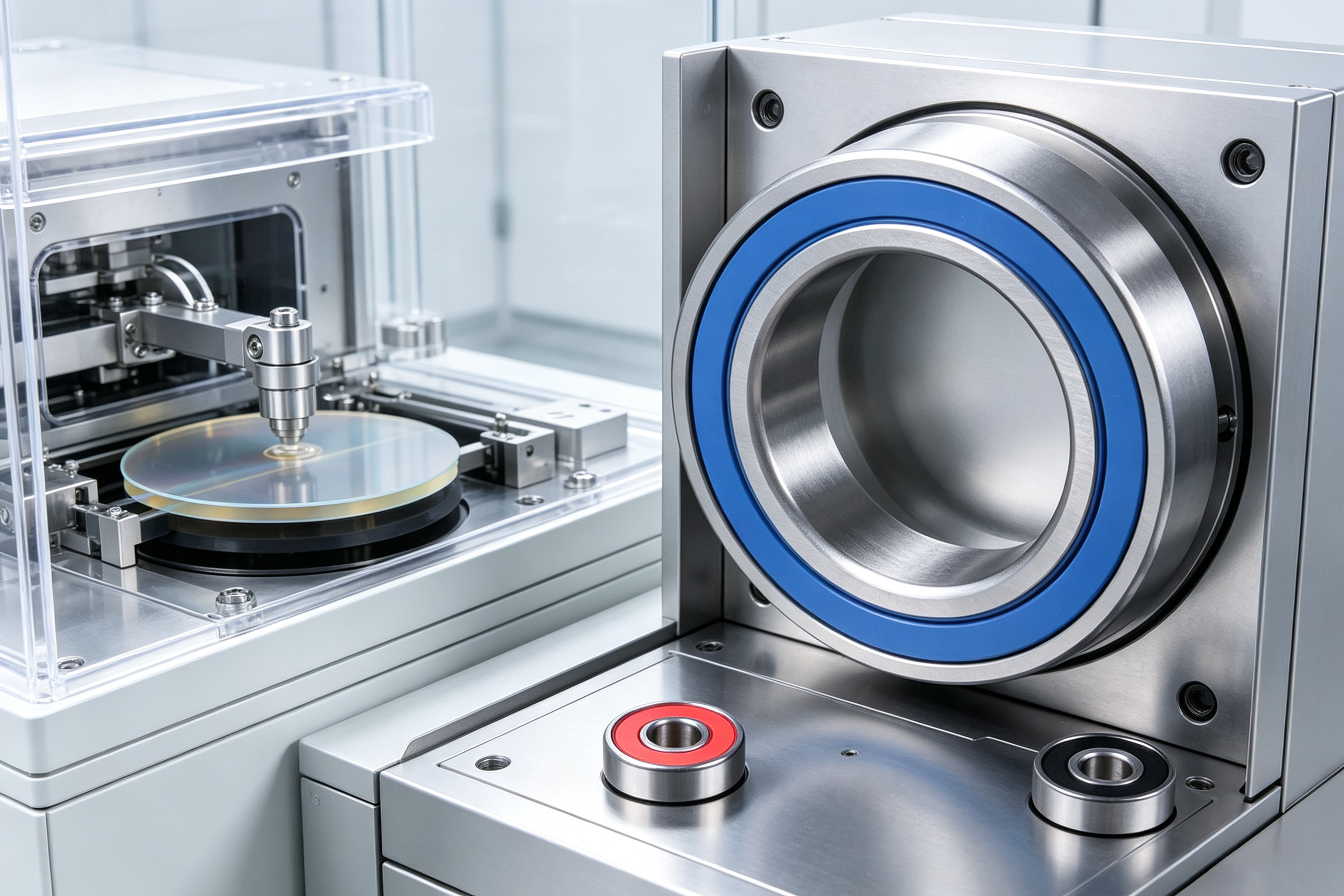
Why Wafer Handling Requires Ultra-Clean Bearings
Wafer handling equipment moves silicon wafers between process chambers, storage modules, inspection stations, and transport systems. These movements must be smooth, accurate, and repeatable. At the same time, the bearing system must avoid introducing particles, metal ions, or lubricant residues into the cleanroom environment.
The main risks from conventional bearings include:
| Contamination Risk | Possible Source | Impact on Semiconductor Process |
|---|
| Contamination Risk | Possible Source | Impact on Semiconductor Process |
|---|---|---|
| Particulate contamination | Wear debris, dust, damaged seals | Surface defects, reduced yield |
| Lubricant outgassing | Volatile compounds from grease or oil | Film deposition on wafers or optics |
| Metallic ion contamination | Corrosion or wear of steel components | Electrical defects in devices |
| Micro-vibration | Poor raceway finish or preload control | Positioning errors during transfer |
In modern fabs, cleanliness is measured at ISO Class 1 to ISO Class 5 levels, depending on the process area. Bearings used in these environments must be compatible with strict particle control, low-outgassing materials, and frequent maintenance or cleaning cycles.
Key Design Features of Ultra-Clean Bearings
Ultra-clean bearings are engineered to reduce contamination at every stage of operation. Their design focuses on material selection, surface quality, lubrication control, and sealing performance.
Low-particle materials
Stainless steel grades with improved corrosion resistance are commonly used to reduce the risk of rust-related contamination. In more advanced applications, ceramic balls or full ceramic bearings may be selected to lower density, reduce wear, and improve chemical resistance.
Stainless steel grades with improved corrosion resistance are commonly used to reduce the risk of rust-related contamination. In more advanced applications, ceramic balls or full ceramic bearings may be selected to lower density, reduce wear, and improve chemical resistance.
Controlled lubrication
Lubricant selection is critical. Ultra-clean bearings often use low-outgassing, cleanroom-grade greases applied in controlled quantities. Excess grease can trap particles or release volatile compounds, while insufficient lubrication increases wear. The goal is stable film formation with minimal migration.
Lubricant selection is critical. Ultra-clean bearings often use low-outgassing, cleanroom-grade greases applied in controlled quantities. Excess grease can trap particles or release volatile compounds, while insufficient lubrication increases wear. The goal is stable film formation with minimal migration.
Sealing and shielding
Non-contact seals, low-friction shields, or specialized labyrinth designs help prevent external particles from entering the bearing while limiting internal lubricant escape. The sealing solution must balance cleanliness, torque, and heat generation.
Non-contact seals, low-friction shields, or specialized labyrinth designs help prevent external particles from entering the bearing while limiting internal lubricant escape. The sealing solution must balance cleanliness, torque, and heat generation.
Precision manufacturing
Raceway roughness, ball roundness, cage accuracy, and internal clearance all influence particle generation. Ultra-clean bearings typically require tighter dimensional control and smoother surfaces than general-purpose bearings to maintain quiet, stable motion.
Raceway roughness, ball roundness, cage accuracy, and internal clearance all influence particle generation. Ultra-clean bearings typically require tighter dimensional control and smoother surfaces than general-purpose bearings to maintain quiet, stable motion.
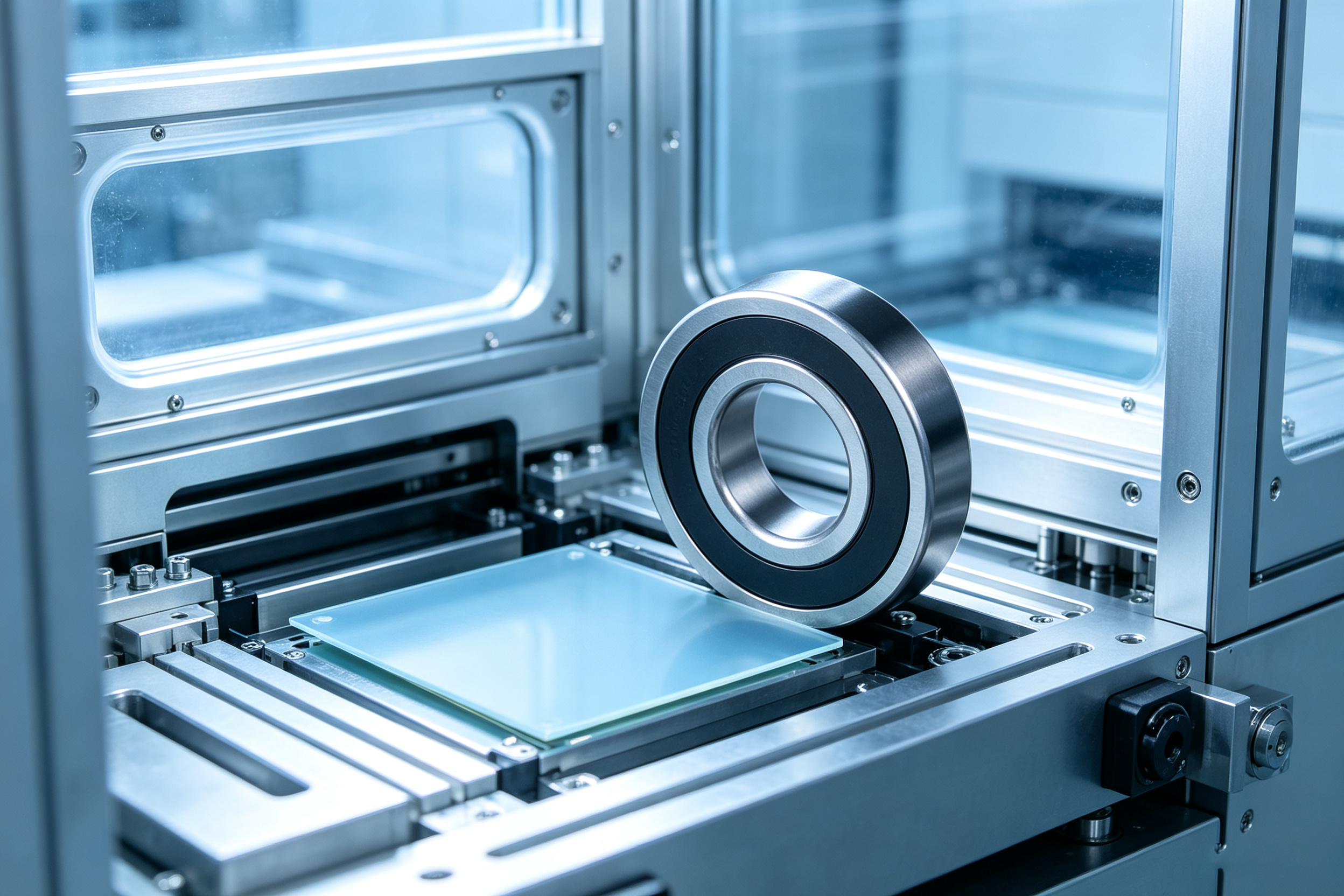
Performance Requirements in Semiconductor Equipment
Bearings in wafer handling systems are not only judged by cleanliness. They must also meet mechanical and operational requirements that directly affect equipment reliability.
| Requirement | Why It Matters | Typical Design Response |
|---|
| Requirement | Why It Matters | Typical Design Response |
|---|---|---|
| Low particle generation | Protects wafer surface and cleanroom class | Smooth raceways, controlled lubrication, ceramic options |
| Low outgassing | Prevents chemical contamination | Cleanroom-grade grease, compatible polymers |
| Corrosion resistance | Withstands cleaning agents and humid environments | Stainless steel, ceramic, protective coatings |
| High positional accuracy | Ensures precise wafer transfer | Precision tolerances, stable preload |
| Long service life | Reduces maintenance and downtime | Optimized materials, sealed designs |
These requirements vary by equipment type. A robotic wafer handler may prioritize low torque and high repeatability, while a vacuum transfer module may place more emphasis on outgassing control and thermal stability.
Common Applications in Wafer Handling
Ultra-clean bearings are used across many stages of semiconductor manufacturing. Typical applications include:
- Wafer transfer robots
- EFEM and load port modules
- Vacuum transport chambers
- Wafer inspection and metrology systems
- Sorting and indexing mechanisms
- Cleanroom conveyor and guide systems
In robotic arms, bearings must support precise angular movement while maintaining low particle emission. In vacuum environments, lubricant behavior and material outgassing become more critical. In atmospheric cleanrooms, particle control and corrosion resistance often take priority.
Selection Guidelines for Engineers
Choosing the right ultra-clean bearing requires matching bearing design to the actual operating environment. Engineers should consider vacuum level, temperature range, speed, load, cleaning frequency, and cleanliness class before finalizing a specification.
| Selection Factor | What to Evaluate | Preferred Bearing Approach |
|---|
| Selection Factor | What to Evaluate | Preferred Bearing Approach |
|---|---|---|
| Cleanroom class | ISO 1–5 requirements | Sealed or shielded ultra-clean designs |
| Vacuum environment | Outgassing and lubricant migration | Low-outgassing grease, ceramic balls |
| Corrosive exposure | Cleaning chemicals, humidity | Stainless steel or ceramic materials |
| Motion profile | Start-stop cycles, reversing motion | Stable preload, smooth raceways |
| Maintenance access | Limited servicing intervals | Long-life lubrication, robust seals |
It is also important to validate bearings under realistic conditions. Laboratory cleanliness ratings provide useful guidance, but actual performance depends on installation quality, lubrication control, mating components, and equipment maintenance practices.
Maintenance and Handling Best Practices
Even the most advanced ultra-clean bearing can underperform if it is handled improperly. Cleanroom-compatible bearings should be stored in sealed packaging until installation. Personnel should use clean gloves and controlled assembly procedures to avoid introducing particles.
Lubrication should never be treated as a generic afterthought. Re-greasing must follow equipment manufacturer recommendations, and incompatible greases should never be mixed. During maintenance, bearings should be inspected for seal damage, corrosion, discoloration, or abnormal noise, as these may indicate contamination or lubrication breakdown.
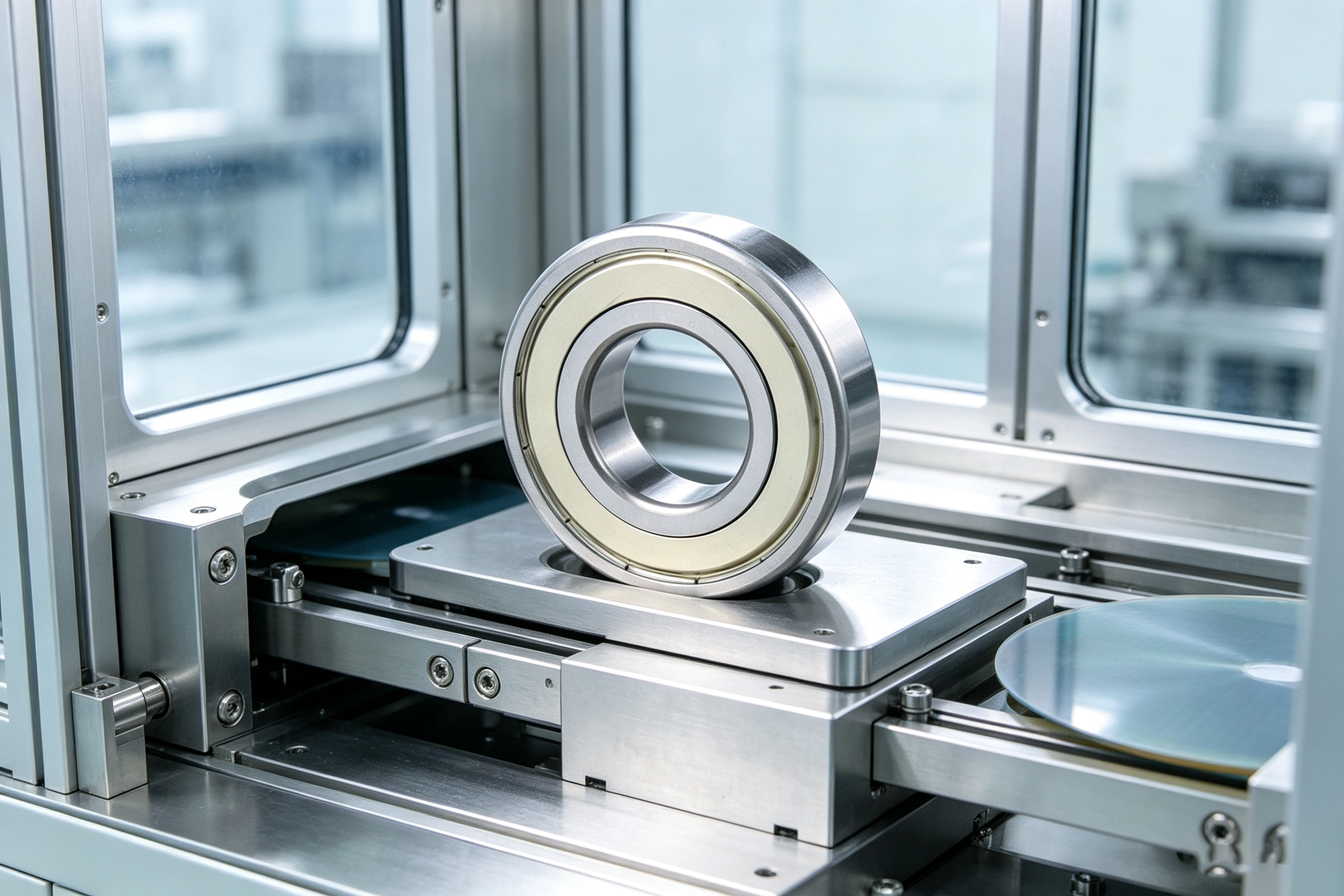
The Role of Ultra-Clean Bearings in Yield Protection
Semiconductor manufacturing tolerances continue to shrink, making contamination control more difficult and more valuable. Ultra-clean bearings help protect yield by reducing one of the least visible but most persistent sources of risk: mechanical particle generation.
For equipment designers, the value of these bearings lies in their ability to combine cleanliness with mechanical reliability. For fab operators, they contribute to longer maintenance intervals, more stable process conditions, and lower contamination risk. As wafer handling systems become faster, more compact, and more automated, ultra-clean bearings will remain an essential component in maintaining high-performance semiconductor production.
FAQ
Q: What is an ultra-clean bearing?
A: An ultra-clean bearing is designed to minimize particle generation, lubricant outgassing, and contamination in cleanroom or semiconductor environments.
A: An ultra-clean bearing is designed to minimize particle generation, lubricant outgassing, and contamination in cleanroom or semiconductor environments.
Q: Why are standard bearings unsuitable for wafer handling?
A: Standard bearings may release particles, metal ions, or volatile lubricant compounds that can reduce wafer yield.
A: Standard bearings may release particles, metal ions, or volatile lubricant compounds that can reduce wafer yield.
Q: Which materials are commonly used?
A: Stainless steel and ceramic materials are commonly used for improved corrosion resistance and lower particle generation.
A: Stainless steel and ceramic materials are commonly used for improved corrosion resistance and lower particle generation.
Q: Do ultra-clean bearings require special lubrication?
A: Yes. They typically use low-outgassing, cleanroom-grade grease applied in controlled quantities.
A: Yes. They typically use low-outgassing, cleanroom-grade grease applied in controlled quantities.
Q: Can ultra-clean bearings operate in vacuum environments?
A: Yes, but vacuum-compatible designs must control outgassing, lubricant migration, and thermal behavior.
A: Yes, but vacuum-compatible designs must control outgassing, lubricant migration, and thermal behavior.
Q: How do these bearings help protect yield?
A: They reduce mechanical contamination sources during wafer transfer, inspection, sorting, and transport.
A: They reduce mechanical contamination sources during wafer transfer, inspection, sorting, and transport.
Q: What applications use ultra-clean bearings?
A: Common applications include wafer robots, EFEM modules, load ports, vacuum chambers, and metrology systems.
A: Common applications include wafer robots, EFEM modules, load ports, vacuum chambers, and metrology systems.
Post time: Nov-13-2026