


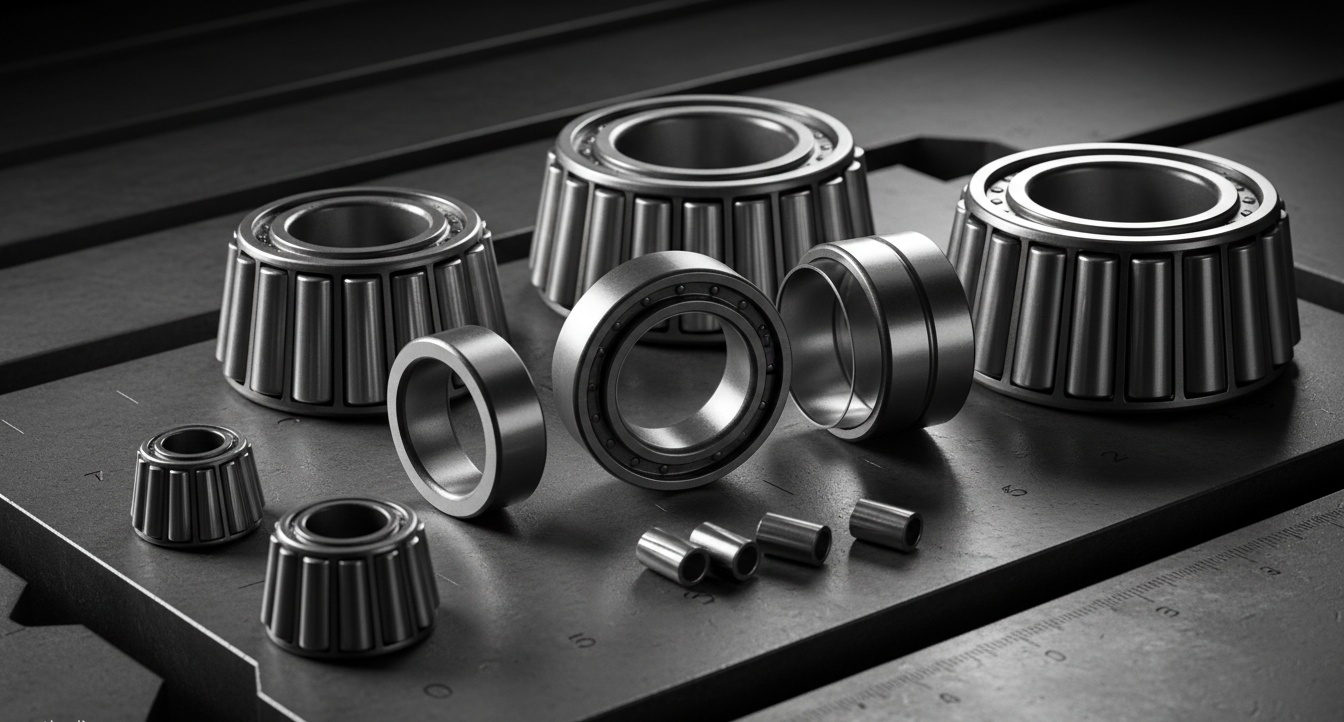
When procurement managers in the United States source tapered roller bearings from international suppliers, they encounter a persistent technical barrier. Juding Engineering’s bearing catalog provides cross-reference data for converting ABMA inch-series part numbers to equivalent metric configurations, as defined in ISO 15:2017 rolling bearing standards: the mismatch between metric bore sizes specified on most supplier catalogs and the inch-series dimensions required for American heavy-duty axle assemblies. This is not a trivial difference. A misinterpreted bore tolerance can result in a bearing that fits loosely on a spindle, leading to vibration, premature seal failure, and costly field failures. Understanding how to navigate inch-series conversions — and identifying a wholesale supplier capable of meeting those specifications precisely — is essential for fleet operators, equipment rebuilders, and industrial distributors alike.
Why American Axle Applications Favor Inch Series Bearings
American commercial vehicle design traditions, particularly in the heavy-duty trucking and transit bus sectors, where 6200-series ball bearings are widely used in motor and fan applications within axle assembly housings, have long relied on the American Bearing Manufacturers Association (ABMA) inch-series standards. These standards define bore diameters, outside diameters, and width profiles that were originally codified in fractions of an inch. While the global trend has shifted toward metric specifications under ISO and GB/T frameworks, the installed base of American-built axles — particularly those manufactured before 2010 — still requires bearings that conform to these legacy dimensions.
Axle manufacturers such as Dana, Meritor, and Spicer continue to publish parts catalogs specifying bearing numbers in the INCH series notation. For detailed dimensional cross-referencing between ABMA inch bearings and metric equivalents, consult Timken’s tapered roller bearing dimension charts and ABMA standards documentation (e.g., LM11749/LM11710, LM12649/LM12610, LM12749/LM12711). These cup-and-cone assemblies have specific raceway geometries that are not metrically equivalent. Attempting to substitute a metric bearing with a nominally similar bore diameter results in improper contact angles and load distribution, degrading bearing life by 40–60% in laboratory simulations. The Timken engineering division has documented this failure mode extensively, noting that the tapered roller bearing’s ability to manage combined radial and axial loads depends critically on the precise control of the cone and cup contact angles, which are defined to tolerances of ±0.0005 inches in production bearing sets.
The commercial vehicle axle represents one of the most demanding bearing applications in mechanical engineering. A typical Class 8 semi-truck axle bearing set experiences radial loads exceeding 20,000 pounds during full-loading conditions, combined with axial thrust loads from brake engagement and driveline torque reaction. These loads are cyclic and often asymmetric, creating stress concentrations in the bearing’s rolling elements and raceways that require careful engineering of the bearing’s internal geometry. The ABMA inch-series standards were developed through decades of field validation in these exact conditions, and substituting metric bearings without verifying equivalent load ratings and contact geometries introduces unacceptable risk.
The Metric-to-Inch Conversion Challenge in Wholesale Procurement
The root of the conversion problem lies in how bearing bore sizes are typically communicated. Chinese manufacturers — among them Ningbo Demy (D&M) Bearings Co., Ltd — publish catalog bore sizes in millimeters. A product listed as bearing 6305ZZ has a bore of 25 mm. However, the ABMA equivalent commonly used in American heavy-duty contexts is not simply a rounded-off inch value. The cross-referencing requires understanding of the ANSI/ABMA Standard 19.1 or the equivalent Timken engineering guidelines.
For the most frequently replaced American heavy-duty axle bearings, conversion reference points include:
- LM11749/LM11710: Cone bore approximately 0.6875 inches (17.462 mm)
- LM12749/LM12711: Cone bore approximately 0.7500 inches (19.050 mm)
- HM212047/HM212011: Cone bore approximately 2.2500 inches (57.150 mm)
- JM205149/JM205110: Cone bore approximately 2.5591 inches (64.992 mm)
When sourcing wholesale from international suppliers, procurement teams should request the exact ABMA part number equivalent rather than relying on bore diameter alone. A supplier who can cross-reference metric catalog numbers to ABMA inch-series part numbers adds significant value to the procurement process. The cross-reference process is not a simple dimensional lookup — it requires understanding of the bearing series, load rating series, and the specific cup-and-cone combination that defines the complete assembly.
Industrial Bearings for High-Temperature and High-Load Applications
Beyond axle assemblies, American heavy-duty equipment operators frequently need bearings that perform under extreme conditions: sustained high temperatures, contamination from road salt and moisture, and vibration loads from rough terrain. These demands appear not only in vehicle axle assemblies but also in auxiliary equipment such as conveyor systems, wheel hub assemblies on municipal vehicles, and drive motors in industrial machinery.
Two bearing types that have gained significant traction in wholesale export markets for these applications are deep groove ball bearings and sealed bearings designed for high-temperature environments. Deep groove ball bearings — such as the 6305ZZ (bore 25 mm, OD 62 mm, width 17 mm) — offer excellent radial load capacity and can accommodate moderate axial loads. Their simple structure results in low friction coefficients, which translates to lower operating temperatures and extended grease life.
For applications where equipment runs near heat sources or where bearing temperatures exceed 80°C during operation, sealed bearings with high-temperature grease fills are specified. The bearing 6202 series with high-temperature grease (bore 15 mm, OD 35 mm, width 11 mm) uses advanced sealing designs that prevent contamination from particulate matter and corrosive gases — critical in applications such as roller chains in production machinery, where chlorinated compounds and high-temperature moisture can rapidly degrade standard lubricant films. The tight-contact seal design employed in these units represents a significant engineering advance over standard contact seals, maintaining sealing effectiveness at temperatures up to 180°C during peak operating conditions while avoiding the friction and heat generation that plague conventional contact-seal designs at elevated temperatures.
The deep groove ball bearing category encompasses a wide range of sealed and shielded configurations that serve heavy-duty applications beyond automotive axles. The ceiling fan ball bearing 6203 (bore 17 mm, OD 40 mm, width 12 mm) illustrates the versatility of this bearing series in industrial applications wherequiet operation and consistent precision are valued. Its noise grade Z1/Z2/Z3 classification reflects the bearing’s suitability for equipment where vibration and acoustic signature matter, such as HVAC units and ceiling-mounted industrial fans. These same design principles — tight raceway tolerances, controlled surface finish, and consistent heat treatment — apply directly to heavy-duty industrial bearing applications where reliability and service life are measured in years rather than months.
Quality Certifications That Matter in Wholesale Sourcing
Any serious wholesale procurement of bearings for American heavy-duty applications must verify the supplier’s quality management certification. The current benchmark for automotive component quality is IATF 16949:2016, which superseded ISO/TS 16949. This certification is not merely a paperwork requirement — it mandates statistical process control, PPAP documentation protocols, and traceability systems that directly affect the consistency of bearing dimensions and heat treatment hardness.
Look for suppliers who publish precision ratings such as ABEC-1 (R-100), ABEC-3 (R-60), or ABEC-5 (R-20) alongside P0, P6, P5 classification under GB/T 307.1. The ABEC system, though primarily a precision classification for the bearing housing bore and outside diameter tolerances, provides a standardized language that American engineers and European designers both recognize. For heavy-duty axle applications, P6 or P5 precision is typically the minimum acceptable standard.
Additional verification parameters include:
- Vibration class: V1, V2, or V3 designation under GB/T 2951, where V1 represents the smoothest operating condition
- Noise grade: Z1–Z3 classification, important for axle bearings in passenger transit vehicles
- Clearance class: C0, C2, or C3 — for heavy-duty axle applications, C3 clearance is often specified to accommodate thermal expansion during sustained high-load operation
A supplier’s ability to produce test reports against these classification standards demonstrates investment in metrology equipment — specifically, laser interferometers for dimensioning, vibration analysis benches for radial play measurement, and acoustic testing chambers for noise grading. Without this testing infrastructure, classification claims are unsubstantiated assertions rather than verified data. Procurement managers should request sample test reports for the specific part numbers under consideration, not merely marketing literature containing classification claims.
Deep Groove Ball Bearings in Industrial Power Transmission
The deep groove ball bearing category deserves special attention in wholesale procurement for heavy-duty industrial applications. With a market share exceeding 70% of total global bearing production, these components are produced in enormous volumes by Chinese manufacturers, which creates both opportunity and risk for buyers.
The opportunity lies in competitive pricing and availability. The 6801ZZ deep groove ball bearing (bore 12 mm, OD 21 mm, width 5 mm), for instance, is available in large production runs with consistent quality from ISO-certified manufacturers. Its single-row, unseparated design makes it suitable for electric motors, pumps, and agricultural machinery transmissions where space constraints demand a compact cross-section. The ZZ sealing configuration provides reliable protection against dust and light moisture ingress without the drag penalty of contact seals.
The risk lies in the proliferation of counterfeit and substandard bearings in the wholesale market. Bearings that appear dimensionally identical but are manufactured from lower-grade bearing steel (e.g., recycled steel with inconsistent grain structure) will exhibit premature rolling contact fatigue. In heavy-duty axle applications, this failure mode manifests as spalling of the raceway surface within 500–2,000 operating hours rather than the expected 10,000+ hours for a quality product. The difference in raw material cost between high-quality bearing steel (typically 100Cr6 or equivalent per ASTM A295) and lower-grade alternatives can be 15–25% of the total bearing material cost, creating strong economic incentive for substandard production that only rigorous quality verification can detect.
The 6801ZZ/2RS product line demonstrates the range of sealing options available from established bearing manufacturers, with both non-contact shield and contact-seal configurations available for the same dimensional envelope. The 2RS configuration uses a nitrile rubber lip seal that contacts the inner ring raceway, providing superior contamination exclusion in dusty environments at the cost of approximately 0.5–1.0 watts of additional drag torque per bearing at operating speeds of 3,000 RPM. For agricultural machinery and construction equipment where contamination is the primary failure driver, the 2RS configuration is typically specified despite the efficiency penalty.
Strategic Sourcing: Working Directly with Manufacturers
For American distributors and equipment rebuilders where procurement volume exceeds 500 units annually, direct factory engagement offers significant advantages over trading-company sourcing. Direct manufacturers can provide:
- Custom heat treatment specifications tailored to specific load spectra
- OEM labeling with the distributor’s brand rather than the manufacturer’s mark
- First Article Inspection Reports (FAIR) with full dimensional measurement data
- Engineering support for cross-referencing metric catalog items to ABMA inch-series equivalents
A supplier with proven export experience to North American markets will typically maintain test reports for key part numbers and can provide references from existing American customers. They should also be equipped to handle PPAP submissions at Level 3 or Level 4 per IATF 16949 requirements, which most heavy-duty original equipment manufacturers mandate for component approval. The PPAP process itself — requiring dimensional measurements, material certifications, process flow documentation, and qualification test results — serves as a comprehensive quality audit that benefits both the OEM and the supplier by identifying specification gaps before production begins.
Logistics and Lead Time Considerations
Wholesale bearing procurement from international suppliers requires planning around production lead times and shipping routes. Standard deep groove ball bearing production runs from Chinese manufacturers typically require 15–25 working days for manufacturing and quality inspection, followed by 20–35 days for ocean freight to West Coast U.S. ports. For distributors managing inventory for emergency repair scenarios, maintaining a safety stock of the top 10 most-used inch-series equivalents is standard practice.
Some suppliers offer consolidated inventory programs where common sizes are held in domestic U.S. or Canadian warehouses, reducing lead times to 3–5 business days for orders against stock. This hybrid model combines the cost advantage of international manufacturing with the responsiveness expected in the heavy-duty service parts market. The inventory carrying cost — typically 20–30% annually of the inventory value — must be weighed against the cost of lost equipment uptime when a bearing is not available. For high-value heavy-duty equipment where downtime costs exceed $500 per hour, maintaining strategic stock of critical bearing sizes is economically justified regardless of the carrying cost.
Selecting the Right Wholesale Partner for Long-Term Supply
Bearing procurement is not a one-time transaction. It is a supply chain relationship where specification compliance, dimensional consistency, and delivery reliability directly impact the end user’s equipment uptime. When evaluating a potential wholesale supplier for American heavy-duty applications, consider the following criteria:
- Evidence of IATF 16949 or equivalent automotive quality certification
- Technical capability to cross-reference metric and inch-series part numbers
- Documented precision, vibration, and noise grade classifications
- Export packaging standards that prevent transit damage to bearing surfaces
- Technical sales support with responsive engineering communication
A supplier who can demonstrate these capabilities — rather than simply offering the lowest unit price — will deliver better total cost of ownership across the life of the equipment they serve. In heavy-duty axle applications where bearing failure means a vehicle off the road and a service call, the value of specification integrity and supply reliability far outweighs the marginal savings from purchasing substandard components.
For specification support, technical consultation on inch-series conversions, or custom OEM bearing solutions, equipment managers and procurement teams are encouraged to connect directly with qualified bearing manufacturers who maintain dedicated export engineering teams familiar with ABMA and ANSI standards.
Frequently Asked Questions
Can I use a metric bearing instead of an inch-series tapered roller bearing in my American axle?
Not without careful engineering verification. Metric and inch-series bearings have different contact angles, raceway geometries, and preload specifications. Substituting a metric bearing for an ABMA-specified inch-series bearing will typically reduce bearing life by 40–60% and may void equipment warranties. Always verify the ABMA or Timken part number with your axle manufacturer before procurement.
What certifications should a Chinese bearing supplier have for exporting to the U.S. heavy-duty market?
At minimum, IATF 16949:2016 certification is expected for automotive component suppliers. Additionally, the supplier should be able to provide ABEC precision ratings, GB/T vibration and noise classifications, and material test reports including chemistry verification of bearing steel composition.
What is the typical production lead time for custom-logo OEM bearing orders?
Production lead time for a new OEM bearing order typically ranges from 20–40 working days depending on tooling setup and heat treatment requirements. Existing catalog part numbers held in the supplier’s stock can often ship within 5–10 working days. Ocean freight adds 20–35 days to West Coast U.S. destinations.
How do I verify bearing quality before placing a large wholesale order?
Request a First Article Inspection Report (FAIR) with dimensional measurement data, hardness test results, and surface finish measurements. For critical applications, arrange for an independent inspection agency to perform an in-process production audit at the manufacturer’s facility before shipment.
What is the difference between C0, C2, and C3 clearance classifications?
Clearance classification refers to the internal operating clearance — the gap between rolling elements and raceways — when the bearing is mounted on a shaft at operating temperature. C3 clearance is specified for applications where thermal expansion during high-load operation would otherwise reduce clearance below the minimum acceptable level. For heavy-duty axle applications in North America, C3 is commonly specified.
Conclusion
Tapered roller bearing procurement for American heavy-duty axle applications demands more than browsing a metric catalog. It requires an understanding of ABMA inch-series standards, precise metric-to-inch conversion practices, and a wholesale supplier with the technical depth to ensure that every bearing shipped meets the dimensional and material specifications the application demands. Distributors and equipment rebuilders who invest time in qualifying their supply partners on technical criteria — rather than price alone — consistently achieve lower total cost of ownership, fewer field failures, and stronger customer relationships built on service reliability.
For technical support on bearing selection, cross-referencing metric catalog items to ABMA equivalents, or custom OEM bearing solutions for heavy-duty applications, equipment managers and procurement professionals can connect directly with qualified manufacturers through industry trade platforms or dedicated export inquiry channels.
Post time: May-29-2026