


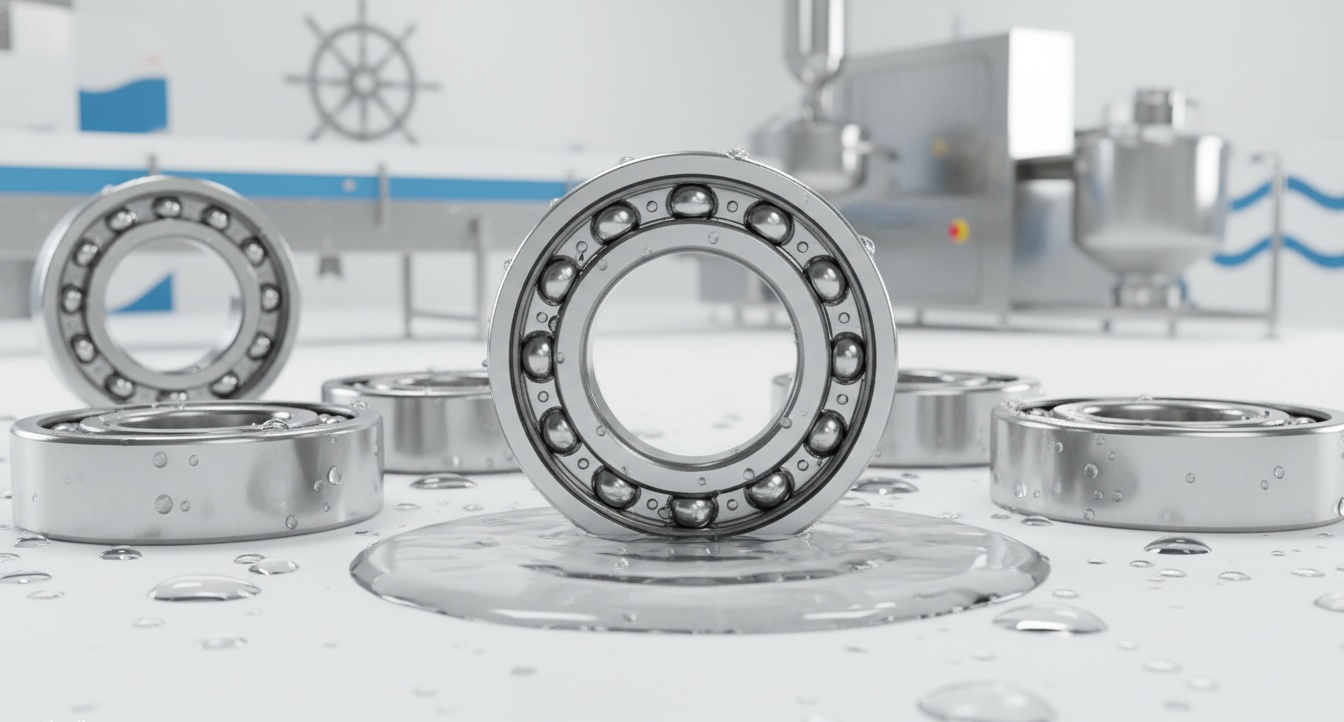
When specifications demand absolute corrosion resistance and material integrity in challenging environments, the S6200 series stainless steel deep groove ball bearings from JUDING Engineering deliver proven performance for wholesale buyers serving food processing, marine, pharmaceutical, and chemical processing industries. These bearings combine 440C stainless steel construction with precision-machined components to withstand moisture, washdown cycles, and salty atmospheric conditions without degradation. This article examines the technical advantages of the S6200 series, the material considerations that make these bearings suitable for hostile environment applications, industry-specific application criteria, and the practical benefits of sourcing these components through a specialized wholesale distribution partner with ISO 9001 quality management certification.
Understanding Why Stainless Steel Deep Groove Bearings Are Essential for Harsh Environment Applications
Standard chrome steel bearings perform reliably in controlled indoor environments, but their susceptibility to corrosion becomes a critical liability in food processing facilities with high-pressure washdown procedures, marine vessels operating in salt spray conditions, and pharmaceutical production lines requiring repeated sanitization. A stainless steel deep groove bearing wholesale procurement strategy eliminates the unplanned downtime, contamination risks, and costly emergency replacements that accompany corrosion-related bearing failures in these demanding applications.
The S6200 series bearings feature rings and rolling elements manufactured from AISI 440C stainless steel, a high-carbon chromium alloy that achieves a typical hardness of 58–60 HRC after heat treatment. This material specification provides significantly superior resistance to rust and pitting corrosion compared to standard bearing steel, even when exposed to water, alkaline cleaners, acidic food products, and saltwater. The deep groove raceway configuration enables these bearings to accommodate both radial and axial loads simultaneously, making them versatile across diverse mounting configurations found in food processing conveyors, marine deck equipment, and chemical processing agitators. The corrosion resistance of 440C stainless steel is verified per DNV maritime standards for components deployed in saltwater-exposed marine environments.
S6200 Series: Technical Specifications and Performance Characteristics
The S6200 designation follows the ISO 15 standard dimension series for extra-light bearings, featuring a 10mm inner diameter across the lineup’s common bore sizes and angular contact geometry optimized for combined load conditions. The primary dimensional and performance parameters that wholesale buyers should specify when sourcing these bearings include bore diameter of 10mm (with S6200, S6201, S6202 as common configurations), outer diameter ranging from 30mm to 35mm depending on the specific series variant, section width of 9mm to 14mm supporting compact housing designs, rolling element material in AISI 440C stainless steel that is vacuum-degassed for purity, retainer material in 316 stainless steel or PTFE fabric with food-grade options available, dynamic load rating (C) of 5,000N to 8,000N depending on exact bore size, maximum operating temperature of 250°C with standard lubrication and 300°C for high-temperature variants, and noise level at V2 specification with 20 μm/s maximum vibration velocity per ISO 51089 quality standards for precision components.
The 440C stainless steel composition includes approximately 1.0% carbon and 16–18% chromium, creating a hard, wear-resistant structure that retains mechanical properties through repeated washdown cycles and long-duration exposure to corrosive media. When chromium content exceeds approximately 12% in an iron alloy, a stable chromium oxide passive layer forms spontaneously on the metal surface, self-healing in the presence of oxygen and dramatically reducing electrochemical corrosion rates. The 440C specification at 16–18% chromium exceeds this threshold comfortably, providing passive layer protection even when the surface is scratched during mounting or routine maintenance. This self-healing characteristic is particularly valuable in marine environments where salt deposits continuously challenge the bearing surfaces and in food processing facilities where acidic food products such as tomato sauce, citrus juices, and vinegar-based marinades may contact bearing housings during production spills. Per EU food contact materials regulation, these characteristics allow the S6200 series to be specified for food-contact applications with appropriate documentation.
Material Selection: 440C Stainless Steel vs. Standard Chrome Steel
Understanding the metallurgical basis for stainless bearing performance helps procurement teams make informed specification decisions. Standard bearing steel (GCr15 / AISI 52100) contains approximately 1.5% carbon and 1.5% chromium, achieving excellent hardness and load capacity but lacking the chromium content required to form a passive corrosion-resistant surface layer. When standard chrome steel bearings are exposed to the high-humidity, high-chloride environments typical of marine deck applications or the acidic food products common in processing facilities, the corrosion rate accelerates dramatically, leading to surface pitting, raceway roughness, and premature failure that often occurs without visible warning signs.
Marine classification societies including DNV require documented material certifications and corrosion resistance verification for all bearing components installed in saltwater-exposed applications on classed vessels. Per ISO 18969 (Bearing Testing and Evaluation), buyers sourcing S6200 series bearings for marine deck machinery, propeller shaft supports, and steering gear assemblies should verify that their wholesale supplier can provide DNV-accepted material test certificates (MTCs) demonstrating compliance with the relevant marine classification requirements. These certificates confirm the chemical composition and mechanical properties of the bearing material and are typically issued per heat number, enabling full traceability from raw material through finished component.
Industry Applications: Food Processing and Marine Environments
Food Processing Industry
Food processing equipment operates under some of the most demanding bearing environment conditions encountered in mechanical engineering. Production lines run continuously for 20–24 hours per day in many facilities, bearing temperatures rise during operation, and sanitation protocols require high-pressure hot water and chemical cleaner jets directed at equipment housings. Any bearing lubricant leak in a food production environment creates both a contamination liability and a line stoppage event costing thousands of dollars per hour.
The S6200 series addresses these challenges through design features optimized for food processing applications. Fully sealed or shielded configurations prevent washdown water and cleaning solutions from penetrating the bearing cavity and displacing lubricant. Food-grade greases such as USDA H1 registered synthetic polyalphaolefin (PAO) greases provide lubrication performance across the typical –20°C to +120°C operating range of food processing equipment without risk of contamination. For baked goods and confectionery production lines where sugar or chocolate residues accumulate on machine surfaces, stainless bearings resist the corrosive effects of sugar solutions that would rapidly degrade standard chrome steel components. Typical food processing applications include dough mixing bowl drives, slicing and portioning equipment, conveyor belt support rollers, bottle and can filling machine spindles, and high-speed packaging equipment where washdown accessibility is essential between product changeovers. The EU machinery regulation and ISO 66094 manufacturing equipment standards provide the framework for documenting compliance with food safety equipment requirements.
Marine and Offshore Applications
Marine environments present a uniquely demanding combination of salt spray exposure, dynamic loads from vessel motion, and the difficulty of performing bearing maintenance on equipment installed in confined or elevated deck locations. The S6200 series stainless deep groove bearing serves as a critical component across the full range of marine mechanical systems where corrosion resistance and reliability are non-negotiable.
On commercial cargo vessels and offshore support boats, these bearings support deck crane slew bearings, hawser winch gearboxes, gangway lifting mechanisms, and pump shafts handling saltwater coolant and ballast water. The 316 stainless steel retainer option provides additional galvanic corrosion resistance when the bearing is installed in housings or on shafts made from dissimilar metals, reducing the risk of electrochemical attack at the bearing-to-shaft interface. For offshore wind installation vessels and heavy-lift cargo ships engaged in mooring operations, the reliability of deck machinery bearings directly affects operational safety and project scheduling. Classification society rules for offshore vessels require documented testing and material verification for all critical deck machinery components, and buyers should confirm their wholesale supplier can provide the supporting documentation package required for classification submission.
Wholesale Sourcing Advantages for S6200 Series Bearings
Wholesale buyers should establish clear technical specifications with their supplier, including required bore and outer diameter tolerances per ISO standards, required load ratings, seal configuration preferences, and any industry-specific certification requirements such as USDA Food Safety and Inspection Service acceptance or marine classification society type approval documentation. Establishing these parameters upfront prevents specification mismatches and ensures that the bearings received match the exact requirements of the target application.
The JUDING Engineering wholesale program provides volume pricing for qualified buyers, with order quantities starting at 50 units per SKU for standard catalog items. Lead times for standard S6200 series bore sizes typically run four to six weeks from order confirmation, with expedited production available for urgent requirements at premium pricing. All shipments include full traceability documentation including heat numbers, lot codes, and dielectric testing records where applicable. Buyers establishing ongoing wholesale accounts benefit from preferred pricing tiers, dedicated account management, and priority access to new product introductions in the deep groove bearing range.
Installation and Maintenance Best Practices
Proper installation procedures directly affect the service life of stainless steel deep groove bearings in demanding environments. The most common installation errors that lead to premature bearing failures include excessive press-fit force that damages the raceway surfaces, misalignment that imposes additional loads on the bearing, and contamination of the bearing cavity during handling and assembly.
For food processing and marine applications where washdown exposure is routine, the bearing housing seal condition should be verified as part of every planned maintenance interval. A worn or damaged housing seal allows high-pressure washdown water to penetrate the bearing cavity, displacing lubricant and introducing contamination that rapidly degrades bearing performance. Replacing housing seals at the manufacturer’s recommended interval — typically annually in high washdown environments — is a low-cost maintenance action that reliably prevents the much more costly bearing replacement and associated unplanned downtime.
Storage conditions for stainless steel deep groove bearings should maintain the original packaging integrity until the bearing is ready for installation. Bearings stored in humid or corrosive atmospheric conditions — including coastal storage facilities with high salt content in the ambient air — can develop surface corrosion on the machined raceway surfaces that compromises performance even before the bearing is installed. Inspection of bearing surfaces upon removal from packaging and before installation is a recommended quality verification step that adds minimal cost and can prevent installation of compromised components.
Quality Assurance and Traceability for Stainless Bearing Procurement
Quality assurance for stainless deep groove bearing procurement extends beyond dimensional conformance to include material certification, heat treatment verification, and performance testing documentation. Per DNV maritime standards, material test certificates confirming chemical composition, hardness, and mechanical properties must accompany bearings supplied for marine classification applications.
For food processing applications, the EU food contact materials framework requires that the bearing supplier provide a Declaration of Compliance documenting that the materials — including the 440C stainless steel, cage material, and lubricant — have been assessed against applicable regulations and found compliant for the intended food contact application.
Storage, Handling, and Pre-Installation Inspection
Stainless steel deep groove bearings must be stored and handled correctly to preserve their machined surfaces and corrosion resistance properties before installation. The original packaging should be maintained until the bearing is ready for installation, and storage should be in a dry, low-humidity environment to prevent surface condensation that could initiate corrosion on the machined raceway surfaces.
Upon removal from packaging, the bearing should be inspected for any surface corrosion, contamination, or damage that may have occurred during transit or prior storage. The raceway surfaces should be examined under adequate lighting for any signs of pitting, surface rust, or discoloration that indicates the passive corrosion resistance of the 440C stainless steel has been compromised. Any bearing exhibiting surface corrosion should be rejected and replaced rather than installed, as corrosion on the raceway surface will lead to rapid performance degradation and premature failure under the high-speed rolling contact conditions inside an operating bearing.
For marine and offshore applications where the bearing may be subject to salt air exposure during storage and transit, sealed polyethylene bags with desiccant packs provide an additional barrier against moisture-induced surface corrosion. Upon delivery at the installation site, the bearing should be installed promptly after inspection — prolonged exposure even in sealed packaging is not a substitute for timely installation and the establishment of a proper lubrication film between the rolling elements and raceways.
Lifecycle Cost Analysis: Why Quality Assurance Matters
The total cost of ownership for stainless steel deep groove bearings in demanding applications encompasses the initial procurement cost, the cost of installation labor, the cost of planned maintenance intervals, and the cost of unplanned downtime if a bearing fails prematurely. For food processing operations where a bearing failure can halt a production line at a cost of USD 5,000 to 20,000 per hour, or for marine deck equipment where access for maintenance is constrained by weather windows and vessel scheduling, the economic case for specifying higher-quality bearings from a reputable wholesale supplier with robust quality documentation is straightforward.
A stainless steel deep groove bearing wholesale procurement strategy that focuses exclusively on unit price without accounting for quality consistency, traceability documentation, and supplier reliability is a false economy. The bearing cost represents a small fraction — typically 5–15% — of the total lifecycle cost of the bearing in an industrial application. The remaining 85–95% is dominated by installation, maintenance, and downtime costs that are directly driven by the reliability and quality consistency of the bearing itself. Per ISO 51089 quality management principles, total cost of ownership analysis should be the basis for procurement specification decisions in critical industrial applications.
JUDING Engineering’s wholesale program for stainless deep groove bearings is built on the principle that quality documentation and traceability are as important as the physical product specifications. Every shipment includes full traceability back to the production lot, including material test certificates, heat treatment records, and dimensional inspection reports that procurement teams can present during customer audits, classification society inspections, or internal quality reviews. This documentation is the foundation for the total cost of ownership optimization that a well-structured bearing procurement strategy delivers over the bearing’s service life.
Supply Chain Resilience and Inventory Strategy for Industrial Buyers
For buyers procuring stainless deep groove bearings for critical process equipment, the supply chain resilience strategy is as important as the unit specification. Stocking a minimum inventory of critical bearing sizes — based on the failure probability distribution of the installed bearing population and the lead time for replacement procurement — is a proven approach to managing unplanned downtime risk.
The optimal stocking quantity for each bearing size is determined by the criticality of the application (higher criticality justifies higher stock), the historical failure rate of the bearing in the specific application environment, the supplier lead time for emergency orders, and the budget available for inventory carrying costs. A spring washer manufacturer or bearing supplier who offers consignment stocking programs can help buyers optimize their inventory investment while maintaining adequate protection against unplanned bearing failures in critical process equipment.
JUDING Engineering’s wholesale program includes technical consultation on inventory optimization based on the specific application profile and the installed equipment base. Buyers establishing a wholesale account receive access to the technical sales team’s application engineering support, which includes recommendations on critical bearing sizes for stocking and guidance on the reorder triggers that should be used to maintain adequate inventory levels without over-investing in slow-moving SKUs.
Conclusion
The S6200 series stainless steel deep groove ball bearing represents the standard specification for demanding food processing, marine, and pharmaceutical applications where corrosion resistance, reliability, and total cost of ownership are the primary procurement drivers. For wholesale buyers seeking a reliable supply partner with demonstrated quality management system performance, JUDING Engineering’s ISO 9001-certified production process, comprehensive testing protocols, and responsive technical sales support provide the confidence required for demanding application environments.
Contact the JUDING Engineering technical sales team to discuss your S6200 series requirements and establish a wholesale account with volume pricing and priority order fulfillment.
About the Author
JUDING Engineering Technical Team — specialists in stainless steel bearings and industrial bearing solutions for demanding environments. Contact via juding-engineering.com/products/
Post time: Jun-05-2026