


In the world of industrial machinery, bearings are the unsung heroes, silently supporting rotation and reducing friction. However, for procurement managers, maintenance engineers, and equipment operators, a string of alphanumeric characters on a bearing’s outer ring can sometimes look like an indecipherable secret code. Misinterpreting this code can lead to costly downtime, premature equipment failure, or ordering the wrong replacement part.
Understanding how to read a bearing number is not just about matching dimensions; it is about grasping the engineering intent behind the component. This guide will demystify the standard bearing nomenclature, helping you confidently decode prefixes, basic codes, and suffixes to ensure you select the exact bearing your application demands.
The Anatomy of a Bearing Number
According to international standards (such as ISO 15) and national standards (like GB/T 272), a complete bearing designation is typically divided into three main sections:
- Prefix (Optional): Indicates special structural features, split components, or non-standard dimensions.
- Basic Designation (Mandatory): The core of the bearing number, defining the bearing type, dimension series, and bore size.
- Suffix (Optional): Specifies internal design, seals, cages, precision, clearance, and special materials.
Let’s break down these components using the widely used 6205-2RS-C3 as our primary example.
Decoding the Basic Designation
The basic designation is the foundation of the bearing number. It usually consists of a type code, a dimension series code, and a bore code.
1. Bearing Type
The first digit or letter identifies the fundamental design of the bearing.
| Type Code | Bearing Type | Primary Application |
|---|---|---|
| 6 | Deep Groove Ball Bearing | Most common; handles radial and light axial loads (e.g., electric motors). |
| 3 | Tapered Roller Bearing | Heavy combined radial and axial loads (e.g., automotive wheel hubs). |
| 7 | Angular Contact Ball Bearing | High axial loads in one direction; often paired (e.g., machine tool spindles). |
| N | Cylindrical Roller Bearing | High radial loads, moderate speeds (e.g., gearboxes, rolling mills). |
| 5 | Thrust Ball Bearing | Pure axial loads only (e.g., turntables, vertical pumps). |
In our example 6205-2RS-C3, the ”6″ tells us it is a Deep Groove Ball Bearing.
2. Dimension Series
The next two digits represent the dimension series, which dictates the bearing’s physical proportions and load-carrying capacity. The first digit represents the width series, and the second represents the diameter series.
For instance, in 6205, the ”2″ indicates a “Light” series. This means the bearing has a standard width and a light outer diameter profile, making it ideal for general-purpose applications with moderate loads. A “3″ (e.g., 6305) would indicate a “Medium” series with a thicker cross-section for heavier loads.
3. Bore Size (Inner Diameter)
The last two digits of the basic designation indicate the bore size. The calculation method depends on the size:
- Standard Bore (≥ 20mm): Multiply the last two digits by 5. In 6205, the “05″ means the inner diameter is 05 × 5 = 25 mm.
- Special Small Bores (< 20mm):
- 00 = 10 mm
- 01 = 12 mm
- 02 = 15 mm
- 03 = 17 mm
- Micro Bores (< 10mm): The bore size is stated directly. For example, a 608 bearing has an 8 mm bore.
Understanding Suffixes: The Fine Print
Suffixes provide critical information about the bearing’s internal modifications, protective features, and performance tolerances. They are usually separated by hyphens or slashes.
Seals and Shields
Protection against contaminants is vital for bearing longevity.
| Suffix | Description | Best For |
|---|---|---|
| Z / ZZ | Metal shield(s). Non-contact, allows high speeds. | General dust protection, high-speed motors. |
| RS / 2RS | Rubber seal(s). Contact seal, superior sealing. | Washdown environments, high moisture/dirt. |
| N / NR | Snap ring groove / Snap ring and groove. | Securing the bearing axially in the housing. |
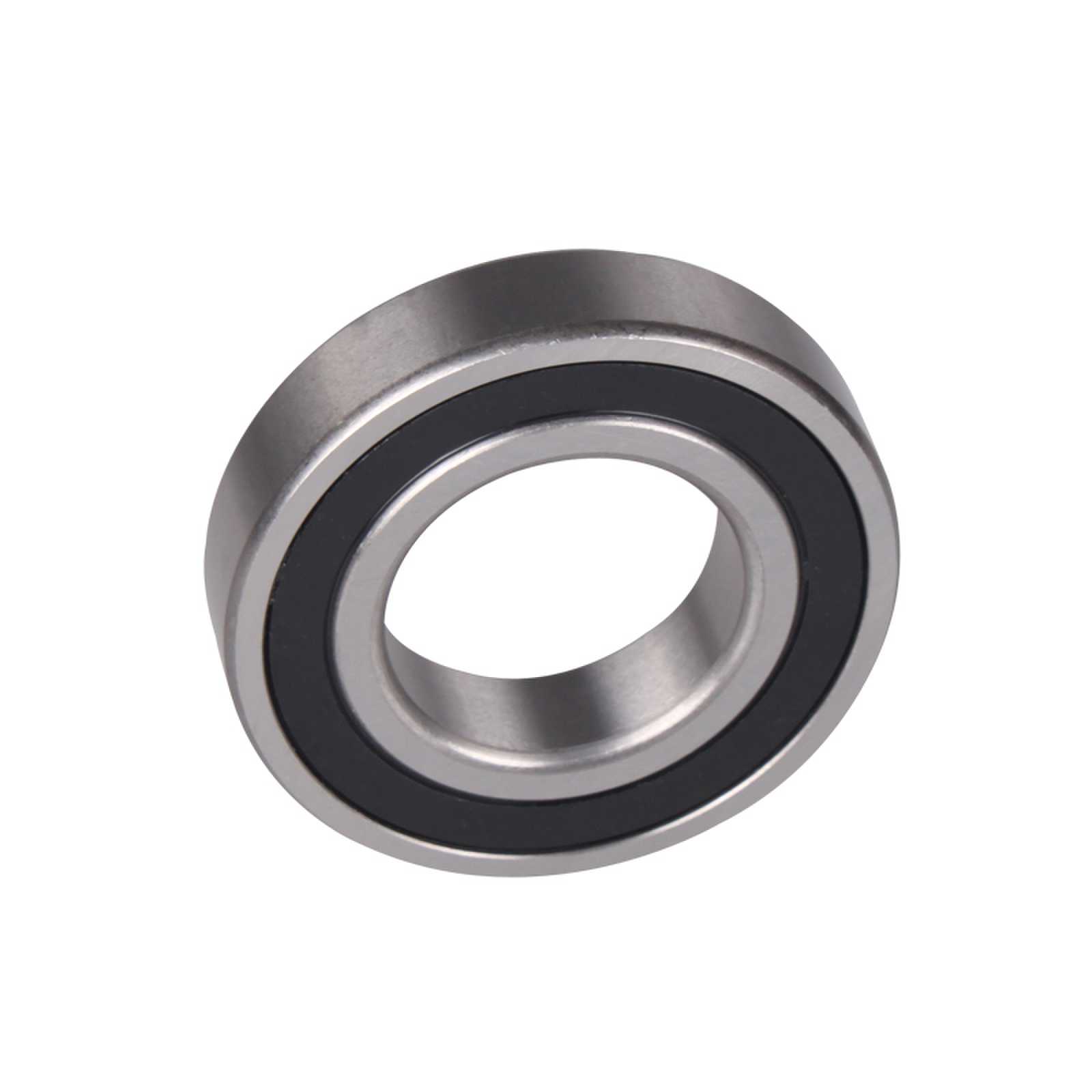
In 6205-2RS-C3, the ”2RS” means the bearing features rubber seals on both sides, providing excellent protection against water and dust ingress.
Internal Clearance
Radial internal clearance is the total distance the rings can move relative to each other. Standard clearance is usually unmarked (C0).
The ”C3″ in our example indicates a clearance greater than standard. C3 bearings are essential for applications involving high operating temperatures (where thermal expansion occurs), heavy interference fits, or high-speed operations.
Precision and Cage Materials
- Precision Grades: Denoted by “P” followed by a number. The hierarchy from standard to ultra-precision is P0 (Standard) → P6 → P5 → P4 → P2. A P5 suffix indicates high precision, commonly required for machine tool spindles.
- Cage Materials: “M” denotes a machined brass cage (high strength, high temperature), while “TN” or “TVH” indicates a polyamide (nylon) cage (lightweight, low noise).
The Role of Prefixes
While less common in everyday replacements, prefixes denote structural variations or split components. For example:
- K: Indicates a roller and cage assembly without inner or outer rings.
- NU: Cylindrical roller bearing with no inner ring ribs (allows axial displacement).
- R: Non-standard inner ring.
Why Correct Decoding Matters for Your Business
Misreading a bearing number is not just a technical error; it is a business risk. Ordering a standard clearance (C0) bearing for a high-temperature oven application will result in premature seizure due to thermal expansion. Conversely, specifying a C3 clearance for a precision, low-vibration application might introduce unwanted play and noise.
Furthermore, choosing the wrong seal type can be disastrous. Using a metal shield (ZZ) in a wet environment will allow water to bypass the non-contact shield, leading to rapid corrosion. In such cases, a contact rubber seal (2RS) is mandatory.
Final Thoughts
Reading a bearing number is a systematic process of elimination and identification. By breaking down the designation into its basic type, dimension series, bore size, and specific suffixes, you can confidently verify that the component matches your engineering requirements.
At our company, we believe that empowering our clients with technical knowledge is just as important as supplying high-quality products. If you ever encounter a complex bearing designation or need assistance cross-referencing a specific application, our engineering team is always ready to help you decode the numbers and find the perfect mechanical solution.
Frequently Asked Questions (FAQ)
Q: What does the “6″ in 6205-2RS-C3 mean?
A: It indicates a Deep Groove Ball Bearing, the most common type for handling radial and light axial loads.
A: It indicates a Deep Groove Ball Bearing, the most common type for handling radial and light axial loads.
Q: How do I calculate the inner diameter from a bearing number?
A: For standard bearings, multiply the last two digits by 5. For example, “05″ x 5 = 25 mm inner diameter.
A: For standard bearings, multiply the last two digits by 5. For example, “05″ x 5 = 25 mm inner diameter.
Q: What is the difference between “ZZ” and “2RS” suffixes?
A: “ZZ” means double-sided metal shields (non-contact, high-speed), while “2RS” means double-sided rubber seals (contact, better water/dust protection).
A: “ZZ” means double-sided metal shields (non-contact, high-speed), while “2RS” means double-sided rubber seals (contact, better water/dust protection).
Q: Why would I need a C3 clearance bearing?
A: C3 bearings have a larger internal clearance than standard. They are essential for high-temperature applications or heavy interference fits where thermal expansion occurs.
A: C3 bearings have a larger internal clearance than standard. They are essential for high-temperature applications or heavy interference fits where thermal expansion occurs.
Q: What does the “P5″ suffix indicate?
A: It signifies a high precision grade, typically required for demanding applications like machine tool spindles.
A: It signifies a high precision grade, typically required for demanding applications like machine tool spindles.
Q: Are bearing prefixes and suffixes standardized across all brands?
A: Generally, yes. Most global brands follow ISO standards, though some manufacturers may use slight variations in suffix letters. Always consult the specific brand’s catalog if unsure.
Post time: Jun-26-2026