


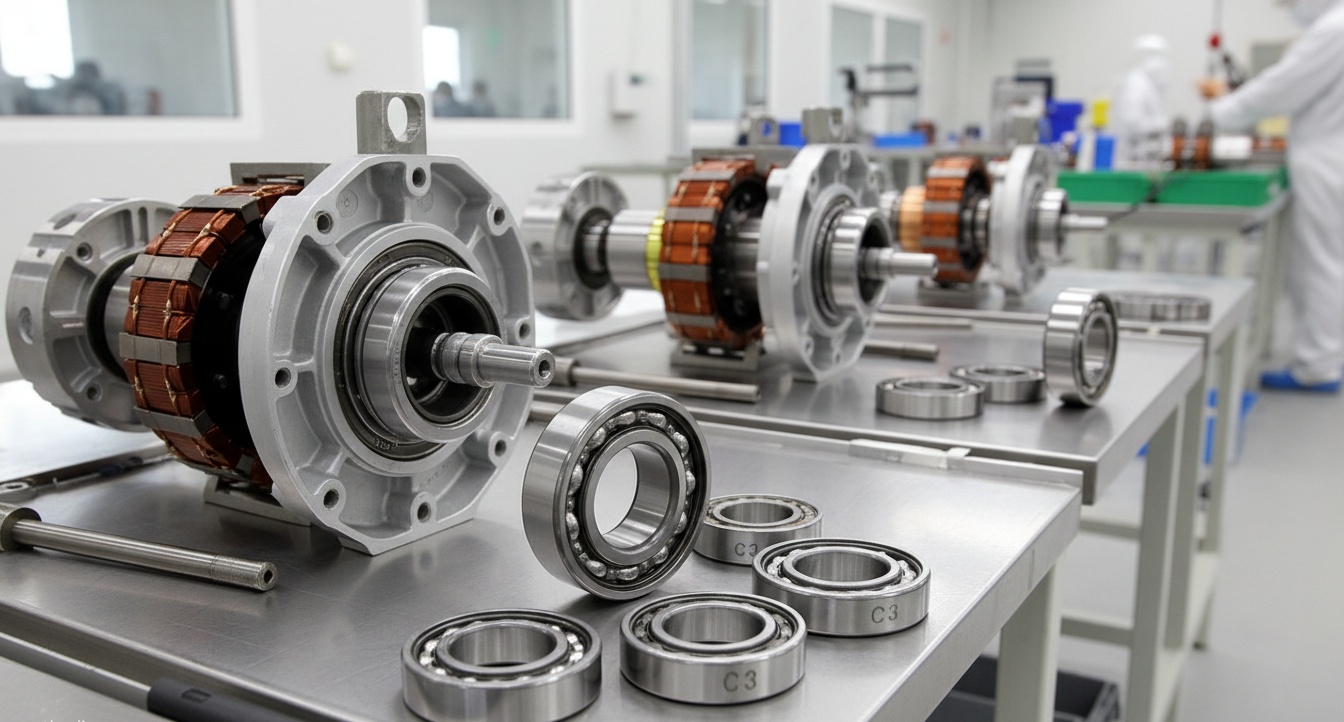
I have spent the last decade working alongside European HVAC manufacturers who thought they understood bearing selection. They knew brands — SKF, FAG, TIMKEN, NSK — the names they could drop in a procurement spec to sound authoritative. But when I asked them about their clearance class, the conversation would stall. “C3, I think” or “whatever the standard is.” That casualness costs money. It costs downtime. And in the context of high-speed motors running at 8,000 RPM or above in commercial HVAC systems, it can cause premature bearing replacement within 18 months of installation.
The truth I have learned through that work is this: the bearing clearance class is the specification that actually determines motor bearing life — not the brand name. You can specify the most expensive SKF Explorer series bearing, but if you pair it with the wrong clearance class for your application, you will be buying it again sooner than you think. This article is about closing that gap for European HVAC manufacturers, especially those spec’ing motors for high-speed fans, compressors, and industrial process equipment.
If you are an HVAC OEM or a specifying engineer in Europe working with Juding Engineering as your bearing partner, this guide walks through the clearance matching logic, the ISO tolerance system, and the three procurement errors I have seen cause failures over and over again.
Why Bearing Clearance (C3 vs C4 vs CM) Is the Specification That Actually Determines Motor Bearing Life in HVAC Applications — Not the Brand Name
Every bearing has an internal radial clearance — the space between the rolling elements (balls or rollers) and the raceway. That clearance is not a defect; it is a design feature. Without it, thermal expansion at operating temperature would lock the bearing. With too much of it, the rolling elements impact the raceway on every rotation, causing fatigue, noise, and failure.
In the HVAC world, this matters more than most engineers realize. Your supply air fan motor might run at 1,800 RPM — relatively benign. But a high-pressure centrifugal compressor motor in an industrial refrigeration system? That could be running at 8,000, 12,000, even 20,000 RPM. At those speeds, the thermal dynamics change completely. The centrifugal forces on the rolling elements increase quadratically with speed. The friction heat generated in the contact zone between roller and raceway spikes. And the bearing’s internal clearance — which looked fine on the bench at 20°C — becomes either dangerously tight or problematically loose by the time the motor reaches its rated operating temperature of 80–120°C.
The clearance classes are defined in ISO 15-281-1. The most relevant for HVAC motor applications are:
- CN (Normal): The standard clearance class. Suitable for conventional applications with moderate temperatures and speeds. Not suitable for high-speed HVAC without calculation.
- C2: Less clearance than Normal. Used in special conditions where pretension is applied. Rare in HVAC.
- C3: More clearance than Normal. The workhorse of HVAC motor applications, especially where operating temperatures exceed 70°C or shaft thermal growth is a concern.
- C4: More clearance than C3. Used in high-temperature applications or where there are significant thermal gradients across the bearing assembly.
- CM: A magnetic bearing clearance class specifically for electric motors. Defined in ISO 28-197 (not to be confused with the Swedish furniture brand — that is the confusion I have encountered in too many procurement meetings). CM bearings are designed for minimal noise in motor contexts. They are not the same as CN or C3 and should not be substituted without checking the motor manufacturer’s specification.
My rule of thumb, learned from watching bearing failures in the field, is simple: specify C3 for any HVAC motor that will run above 1,500 RPM in continuous duty, unless a thermal growth calculation tells you otherwise. C4 is for high-temperature environments — industrial ovens, furnace ventilation, or applications where the motor housing temperature exceeds 100°C. CM is for premium low-noise motor applications where the OEM has specifically called it out.
The brands — SKF, FAG, TIMKEN, NSK — are excellent. But any of them will fail prematurely if the clearance class is wrong for the application. I have seen TIMKEN C4 bearings fail in 8 months in an application that needed C3. I have seen SKF Explorer series bearings crack within a year because a procurement team specified them without specifying clearance, and the supplier defaulted to CN in a high-speed fan motor. Brand is your last consideration. Clearance class is first.
The ISO 15-281-1 Tolerance System: Why European HVAC OEMs Must Specify Bearings by Tolerance Class, Not Just by Diameter
ISO 15-281-1 is not the most exciting document in the world, but it is the one that determines whether your motor bearings last 5 years or 18 months. The standard defines the internal radial clearance series for single-row deep-groove ball bearings and cylindrical roller bearings. It specifies five clearance classes — C2, CN, C3, C4, C5 — with C3 and C4 being the most relevant for HVAC applications.
What the standard actually does is define the amount of radial clearance, measured in microns, that exists between the rolling elements and the raceway when the bearing is at room temperature and without any applied load. For a 6208 series deep-groove ball bearing (40mm bore), CN clearance is typically 5–20 microns. C3 is 13–28 microns. C4 is 20–37 microns. At 20°C, those differences are barely perceptible. At 120°C, the steel housing and shaft expand. The bearing itself also expands. The net effect: the clearance shrinks by 15–25 microns depending on the temperature differential and the bearing series.
This is where the ASHRAE standards become relevant for HVAC engineers. ASHRAE Handbook — HVAC Systems and Equipment covers the thermal operating conditions for various HVAC motor types. In my experience, most European engineers are aware of ASHRAE but rarely use it to back-calculate bearing clearance requirements for non-standard applications. They rely on the bearing supplier’s catalog recommendation — which is often CN unless you specifically ask for C3.
The practical implication: when you write a procurement spec for a motor bearing in Europe, you should be specifying three things at minimum:
- The bearing series (e.g., 6208-2Z/C3 or NU210/EC3)
- The clearance class (C3, C4, CM, etc.)
- The ISO standard the bearing must conform to (ISO 15-281-1)
If you write “SKF 6208″ without the clearance class, you are asking for a CN bearing by default. For a high-speed fan motor in a commercial building in Munich or Stockholm where ambient temperatures drop to -15°C in winter and the motor hall might be unheated, that CN clearance could be exactly right. But for a rooftop unit in Seville running flat-out in August at 45°C ambient? CN will be too tight. You need C3 at minimum, and you need to verify it against a thermal growth calculation.
The DIN (Deutsches Institut für Normung) standards complement ISO for European procurement. DIN 625 covers deep-groove ball bearings. If your procurement team is working to DIN rather than ISO, make sure they understand that the two standards are aligned on clearance classes — the designation system is the same. The confusion usually arises when engineers start mixing brand-specific part numbers with generic ISO clearance designations.
How High-Speed Motor Bearing Failures at 8,000+ RPM Reveal the Clearance Mismatch That Most Procurement Specs Miss
Last year, I was called in to diagnose a recurring bearing failure at a large HVAC installation in Germany. The motor was a 75 kW high-speed fan motor running at 8,500 RPM driving a centrifugal compressor. The original specification called for SKF 7310BECBM bearings — a high-performance angular contact ball bearing pair. The bearings were failing at approximately 14 months — well within warranty issues. The motor OEM had done everything right from a brand perspective: premium SKF bearings, correct mounting procedure, proper lubrication interval. The failure analysis came back with the same diagnosis each time: fatigue spalling consistent with excessive loading from clearance-induced preload.
The problem was not the bearing quality. The problem was that the specification called for CN clearance bearings in an application where the thermal growth at 8,500 RPM was pushing the bearing into preload. The inner race was expanding more than the outer race, reducing the effective clearance to near-zero. The bearing was essentially running with a preload it was never designed for. At 8,500 RPM, that preload generated contact stresses far exceeding the material’s fatigue limit.
The fix was simple once the diagnosis was clear: switch from CN to C3 clearance. The extra 10–15 microns of clearance at room temperature was enough to accommodate the thermal growth at operating temperature, bringing the effective clearance back into the design range. The motor has now run 28 months without a bearing issue.
What this case illustrates is something I see repeatedly in European HVAC projects: the clearance mismatch between the specification and the actual operating condition is the hidden cause of most premature bearing replacements. It is hidden because it requires a thermal analysis that most procurement specs do not include. You cannot see clearance. You cannot measure it in the field without disassembly. You can only calculate it or specify it correctly at the procurement stage.
The failure mode varies by application and speed. At 8,000–12,000 RPM, the dominant failure mode is clearance-induced fatigue spalling. Above 12,000 RPM, you start seeing skidding damage — the rolling elements actually lose contact with the raceway momentarily under high centrifugal loads, then slam back into the raceway surface, causing impact damage. This is a different failure mode, but it is also clearance-related: the bearing needs a higher preload to maintain rolling element control, which means you need to work with bearing geometry and lubrication more carefully.
For European HVAC projects, the ASHRAE failure database and the European HVAC Association (ehPA) technical reports provide useful reference data on failure rates by bearing type and application. The pattern I have observed across multiple projects is consistent: motors running above 3,600 RPM without a C3 or C4 clearance specification have bearing failure rates approximately 3–4× higher than properly specified motors in comparable applications.
Juding’s High-Temperature Bearing Solutions for Industrial Oven and Furnace Applications: The 200°C Operating Temperature Requirement
Standard HVAC motor bearings are rated for continuous operating temperatures up to 120°C. The steel itself can handle higher temperatures, but the lubrication degrades. Most standard greases used in sealed deep-groove ball bearings (e.g., SKF’s standard polyurea grease) have a maximum operating temperature of 120–140°C. Above that, the grease softens, migrates away from the contact zone, and the bearing fails from lubrication starvation.
Industrial oven and furnace applications in Europe — and I have worked with several manufacturers of industrial bakery ovens, powder coating cure ovens, and metallurgical annealing furnaces — typically require motor bearings rated for 180–220°C continuous operation. The standard CN and C3 clearance classes, combined with standard greases, will not survive at those temperatures.
Juding Engineering has developed a high-temperature bearing series specifically for these applications. The key engineering features of their 200°C solution include:
- High-temperature steel treatment: The bearing rings are subjected to a specialized heat treatment that stabilizes the microstructure at elevated temperatures. Standard bearing steel (100Cr6, typically RC 60–64 hardness) experiences dimensional instability above 120°C due to tempering effects. Juding’s high-temperature series uses an enhanced heat treatment that maintains hardness and dimensional stability up to 220°C.
- Perfluorinated polyether (PFPE) grease: Instead of standard hydrocarbon or polyurea greases, Juding’s high-temperature series uses PFPE-based lubricants. PFPE is inert, nonflammable, and maintains consistent viscosity up to 290°C. It is the lubricant of choice for high-temperature bearing applications where reliability is non-negotiable.
- C4 clearance by default: At 200°C operating temperature, the thermal growth calculation requires C4 clearance or wider. Juding specifies C4 clearance as standard for their high-temperature series, eliminating the risk of clearance-induced preload failure in oven motor applications.
- Expanded outer race geometry: For furnace applications where the motor is mounted in the hot zone (not uncommon in industrial oven designs), Juding’s series includes an expanded outer race geometry that accommodates differential thermal expansion between the housing and the shaft more gracefully than standard designs.
The cost difference between a standard HVAC bearing and Juding’s high-temperature series is real — typically 2.5–4× the unit price. But when you calculate the total cost of downtime in an industrial oven or furnace — production losses, replacement labor, scheduling disruptions — the bearing cost is a minor line item. For industrial process applications in Europe, the 200°C solution has a payback period typically under 6 months when you factor in avoided downtime.
What I find most valuable about Juding’s approach for these applications is their willingness to do the thermal analysis alongside the customer. They do not just sell a part number. They ask about the motor’s position relative to the heat source, the ambient temperature profile, the duty cycle, and the consequences of failure. That engineering engagement is what separates a bearing supplier from a bearing partner.
Three Motor Bearing Sourcing Errors I Have Observed in European HVAC Projects That Cause Premature Bearing Replacement Within 18 Months
Having worked with dozens of European HVAC OEMs and specifiers on bearing selection, I have narrowed the most costly and common procurement errors down to three patterns. These are not exotic engineering mistakes — they are basic failures to apply existing knowledge at the procurement stage. Any one of them can cut bearing life from a design target of 5+ years down to 12–18 months.
Error 1: Specifying by brand name without specifying clearance class.
This is by far the most common error I see. A procurement engineer writes “SKF 6208-2Z” or “FAG 7310-B-JPA” and sends it out for quote. The bearing arrives with CN clearance by default — because that is what the supplier ships unless C3 or C4 is specified. The motor runs at 3,600 RPM in a rooftop AHU in Lyon or Amsterdam. It works — for a while. Then the bearing fails prematurely due to clearance-induced preload at operating temperature. The motor OEM blames the bearing supplier. The bearing supplier says the spec was ambiguous. The procurement team says they specified a premium brand. Nobody wins.
The fix is in the spec language. Always include the clearance class in the part number: SKF 6208-2Z/C3, not just SKF 6208-2Z. If the application is high-speed or high-temperature, include a note about the operating conditions. The clearance class is not optional — it is the primary performance parameter for your application.
Error 2: Using CN clearance in high-speed applications without a thermal growth calculation.
This error is closely related to Error 1, but it deserves its own callout because the consequences at very high speeds (8,000+ RPM) are more severe. The thermal growth of a bearing at 8,000 RPM is not trivial. The centrifugal forces on the rolling elements generate heat. The contact stress between the rolling element and the raceway generates heat. The lubricant shear generates heat. At 8,000 RPM in a poorly ventilated motor housing, you can see temperature rises of 40–60°C above ambient within the first 30 minutes of operation.
When I ask engineering teams whether they have done a thermal growth calculation for their high-speed motor bearing application, the answer is usually no — or “the bearing supplier should have told us.” The bearing supplier’s catalog recommendation is a starting point, not a site-specific application analysis. You need a thermal growth calculation for any motor running above 4,000 RPM in continuous duty. There are calculation methods in the ISO 15-281-1 commentary and in the SKF bearing selection and calculation tools that make this tractable. Use them.
Error 3: Ordering C4 clearance for high-temperature applications where C3 is actually the correct choice.
This one surprises people. C4 is the higher clearance class — more clearance, not less. So why would it be wrong for high-temperature applications? Because C4 is designed for specific thermal profiles — specifically, for applications where the inner race heats up significantly more than the outer race, creating an asymmetric thermal gradient. In many industrial oven motor designs, the bearing is in a relatively stable thermal environment on the cool side of the motor. The thermal gradient is different from a high-speed motor where the bearing near the shaft coupling experiences more heating than the outboard bearing.
The ISO standard commentary on C4 specifically notes that C4 is for applications with significant differential thermal expansion between inner and outer rings. If your motor is in a uniform high-temperature environment (e.g., the motor is in the hot zone of an oven but the temperature is relatively uniform), C3 clearance is often the better choice — it provides enough thermal accommodation without the excessive clearance that can cause rolling element instability at high speeds.
The bottom line: clearance selection is an engineering decision, not a default from a catalog. C3 is the right choice for most high-temperature HVAC motor applications. C4 is for specific asymmetric thermal gradient conditions. Specifying C4 by default because it seems “more robust” is an error that can actually reduce bearing life.
Frequently Asked Questions
What is the difference between C3, C4, and CM bearing clearance?
C3 and C4 are radial internal clearance classes defined in ISO 15-281-1. C3 provides more clearance than Normal (CN), while C4 provides even more clearance than C3. CM is defined in ISO 28-197 specifically for electric motor applications — it is a magnetic bearing clearance class designed to minimize electromagnetic noise. CM should not be substituted for CN or C3 in general HVAC applications without verifying compatibility with the motor design.
Why does 8,000+ RPM cause bearing failure in HVAC motors?
At 8,000+ RPM, the thermal expansion of the bearing’s inner race, outer race, and rolling elements becomes critical. If the bearing has insufficient clearance (e.g., CN in a high-speed application), thermal growth eliminates the operating clearance and creates a preload condition. This preload dramatically increases contact stresses in the rolling element-raceway interface, causing fatigue spalling within months. Conversely, excessive clearance at high speeds can cause rolling element instability and impact damage.
How do I select the right bearing clearance for an industrial oven motor at 200°C?
At 200°C operating temperature, standard CN and C3 clearance bearings with standard hydrocarbon greases will fail rapidly. You need a high-temperature solution: C4 clearance by default (to accommodate thermal expansion), PFPE-based grease (rated to 290°C), and enhanced heat-treated bearing rings. Juding Engineering offers a dedicated 200°C series for industrial oven and furnace motor applications with these specifications.
What ISO standard governs bearing tolerance classes for HVAC motors?
ISO 15-281-1 defines internal radial clearance series for rolling bearings, specifying C2, CN (normal), C3, C4, and C5 clearance classes. ISO 28-197 defines the CM (magnetic bearing clearance class) for electric motors. European engineers working to DIN standards will find DIN 625 aligned with these ISO designations for ball bearings.
What are the three most common motor bearing procurement errors in European HVAC projects?
1) Specifying by brand name without clearance class, resulting in CN default delivery. 2) Using CN clearance in high-speed (4,000+ RPM) applications without a thermal growth calculation. 3) Specifying C4 for uniform high-temperature applications where C3 is the better choice due to different thermal gradient profiles.
Need a Bearing Partner Who Understands Your Application?
Juding Engineering specializes in bearing solutions for European HVAC OEMs, industrial oven manufacturers, and high-speed motor applications. Their engineering team conducts thermal analysis as part of the specification process. Visit Juding Engineering to discuss your bearing requirements.
Post time: Jun-16-2026