


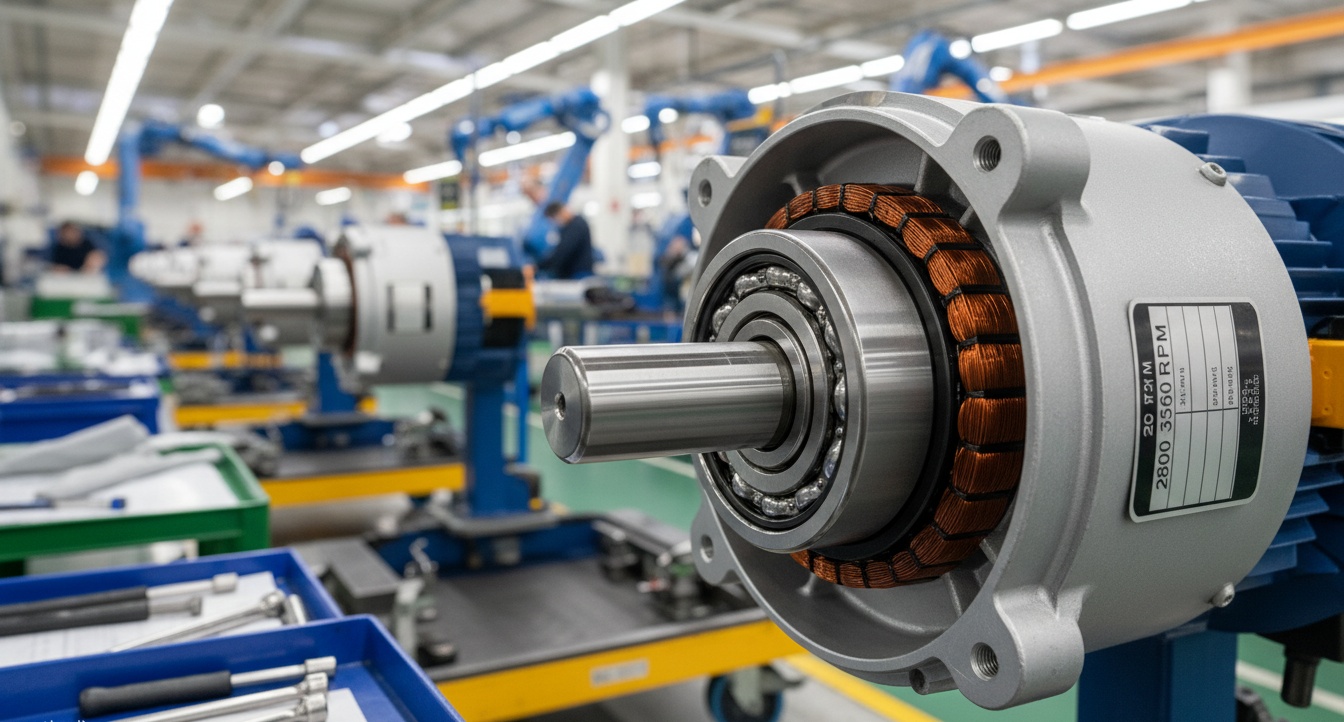
 When sourcing bearings for high-speed industrial motor applications, the difference between a reliable supplier and a compromised component can be measured in operating temperatures, vibration signatures, and unplanned downtime. Deep groove ball bearings with C3 internal clearance represent a critical solution for motors running in the 2800rpm to 3600rpm range, where thermal expansion, radial load, and speed capacity interact in ways that demand precise engineering tolerances. This article provides a comprehensive technical and commercial guide for procurement engineers, motor manufacturers, and industrial maintenance teams seeking to identify, evaluate, and partner with a capable electric motor deep groove bearing supplier who can deliver bearings engineered for these demanding operating conditions.
Understanding C3 Clearance in Deep Groove Ball Bearings
What C3 Clearance Means and Why It Matters
Bearing internal clearance refers to the residual space between the rolling elements and the raceways when the bearing is mounted on a shaft without any applied load. The International Organization for Standardization (ISO) defines clearance groups ranging from C2 (less clearance than normal) through C3, C4, and C5 (greater clearance than normal). C3 clearance specifically denotes a bearing with more internal space than the standard clearance group, which provides a critical buffer as the bearing assembly heats up during high-speed operation.
In electric motor applications, the relationship between speed, temperature, and clearance is not linear but rather a compounding interaction. When a deep groove ball bearing operates at 3000rpm or higher, the rolling elements and raceways generate frictional heat. Steel expands when heated, and if the bearing was fitted with CN (normal clearance), the thermal expansion could eliminate all operational clearance, leading to metal-to-metal contact, premature wear, and rapid failure. A C3 clearance bearing provides that essential thermal headroom, allowing the bearing to function correctly even as operating temperatures rise 30°C to 60°C above ambient conditions.
The mechanical rationale is straightforward: at 2800rpm, a standard deep groove ball bearing operating at elevated temperatures may see its inner race expand radially inward, reducing clearance. At 3600rpm, the centrifugal forces acting on the rolling elements increase further, and the heat generated per unit time grows substantially. The additional clearance in a C3-group bearing absorbs this thermal growth without compromising the bearing’s ability to maintain proper rolling element kinematics.
Clearance Measurement and ISO Standards
Understanding C3 clearance requires familiarity with how bearing manufacturers specify and measure this parameter. ISO 15:2017 defines the standard boundary dimensions for rolling bearings, while ISO 1132-2:2001 specifies the method for measuring and expressing clearance values. For a 6200-series deep groove ball bearing, a CN (normal) clearance might have a radial clearance of 6 to 20 micrometers (μm), while the same bearing in C3 group could range from 15 to 35μm depending on the bore diameter.
This variation is not arbitrary. Bearing manufacturers produce different clearance groups by controlling the raceway geometry during the grinding process. The selection of the appropriate clearance group depends on the specific application parameters: shaft fit (tight or loose), operating temperature range, rotational speed, and radial load magnitude. For industrial motors operating between 2800rpm and 3600rpm, C3 clearance is frequently the recommended starting point, though experienced bearing application engineers may specify C4 or even C5 for particularly high-temperature or high-speed configurations.
The Engineering of High-Speed Deep Groove Ball Bearings for Motor Applications
Why Deep Groove Ball Bearings Are the Standard for Electric Motors
Deep groove ball bearings are the dominant bearing type in electric motor applications for several interconnected engineering reasons. Their design accommodates both radial and axial loads simultaneously, although they are primarily specified for radial load capacity. The symmetrical raceway geometry allows the bearing to self-align to some degree, compensating for minor shaft deflection or housing misalignment without significant performance degradation.
In the context of industrial motor construction, deep groove ball bearings in the 6200 and 6300 series cover the vast majority of frame sizes encountered in general-purpose motors. A 6202 bearing, for example, features a 15mm bore diameter, 35mm outside diameter, and 11mm width, while a 6203 bearing provides a 17mm bore, 40mm outer diameter, and 12mm width. These standardized dimensions simplify replacement and interchangeability, which is critical in maintenance scenarios where a motor failure requires rapid bearing substitution.
The load capacity of deep groove ball bearings scales with their size. For high-speed applications in the 2800rpm to 3600rpm range, selecting the correct series involves balancing the bore size (which affects heat dissipation through the shaft), the dynamic load rating (which determines fatigue life under operating loads), and the limiting speed (which defines the maximum sustainable rotational velocity for a given lubrication condition).
RPM Range Considerations: 2800rpm to 3600rpm
Electric motors operating at synchronous speeds of 2800rpm and 3600rpm represent two-pole and four-pole configurations respectively at 60Hz power systems, or proportionally at 50Hz (roughly 2800rpm and 1400rpm for 50Hz). In practical industrial settings, motors rarely operate exactly at synchronous speed due to slip, but the nominal nameplate speed provides the reference point for bearing selection.
At 2800rpm, a deep groove ball bearing experiences moderate centrifugal loading on the rolling elements, moderate cage stress, and manageable frictional heat generation. At 3600rpm, these factors intensify significantly. The centrifugal force acting on a rolling element increases with the square of the rotational speed, meaning a bearing at 3600rpm experiences approximately 65% more centrifugal force than the same bearing at 2800rpm, all else being equal. This elevated force affects the contact angle, the load distribution across the rolling elements, and ultimately the fatigue life calculation.
Bearing manufacturers publish limiting speed ratings based on standardized test conditions, typically oil-bath lubrication at room temperature. In real motor applications, factors such as elevated operating temperatures, inadequate lubrication intervals, contamination ingress, and improper mounting can reduce the effective speed capability well below the catalog limiting speed. C3 clearance bearings help mitigate some of these real-world degradations by providing better thermal management characteristics.
C3 Clearance Deep Groove Ball Bearings: JuDing’s Product Capabilities
JuDing 6202 High-Temperature Grease Bearing
The JuDing 6202 deep groove ball bearing with high-temperature grease represents one example of a bearing engineered for demanding motor conditions, featuring dimensions of 15 × 35 × 11mm with C3 clearance as a standard option. The inclusion of high-temperature grease is particularly relevant for motor applications where operating environments may exceed the temperature limits of conventional lithium-based lubricating greases.
High-temperature greases, typically based on polyurea or complex ester thickeners, can withstand continuous operating temperatures of 160°C or higher, compared to 80°C to 100°C for standard lithium greases. In a motor bearing application at 2800rpm to 3600rpm, the frictional heat generated within the bearing can elevate internal temperatures significantly above ambient. When combined with heat conducted from the motor windings, the bearing assembly may approach temperatures that cause conventional greases to oxidize, liquefy, or lose their lubricating film integrity.
By specifying a bearing pre-filled with high-temperature grease from a reputable motor bearing supplier, maintenance teams reduce the risk of grease-related bearing failures. JuDing’s 6202 bearing in this configuration addresses both the clearance requirement (C3 for thermal headroom) and the lubrication requirement (high-temperature grease for extended grease life under thermal stress).
JuDing 6203 Ceiling Fan Ball Bearing
The JuDing 6203 deep groove ball bearing represents another critical product in the motor bearing portfolio, featuring a 17mm bore, 40mm outer diameter, and 12mm width. The 6203 bearing is frequently specified in ceiling fan motors and similar fractional horsepower motor applications where the combination of moderate radial loads and continuous high-speed operation demands reliable performance.
Ceiling fan motor bearing failures are often preceded by visible symptoms that experienced maintenance technicians learn to recognize: increased bearing noise (grinding or humming), elevated motor housing temperature, and reduced rotational smoothness. Many of these failure modes trace back to inadequate clearance selection or improper lubrication. A C3-clearance 6203 bearing pre-filled with appropriate grease provides an engineered solution that addresses these failure modes proactively rather than reactively.
JuDing’s capability to produce deep groove ball bearings across multiple dimensional series (6200, 6300, and custom configurations) with various clearance groups and grease specifications positions the company as a comprehensive C3 clearance bearing for motor applications specialist. The ability to produce consistent C3 clearance in high volumes requires tight process control in the grinding and finishing operations, as variations in raceway geometry directly translate to clearance deviations.
Selecting the Right Motor Bearing Supplier: Technical and Commercial Criteria
Technical Evaluation Criteria
Selecting an electric motor deep groove bearing supplier requires evaluation across multiple technical dimensions before commercial terms are discussed. The following criteria represent the most important factors that distinguish capable bearing suppliers from those who may deliver marginal or non-conforming products.
Manufacturing Process Control. The ability to produce C3 clearance bearings consistently depends on the supplier’s grinding process capability, measurement systems, and quality assurance protocols. Look for suppliers who can provide statistical process control (SPC) data, production capability indices (Cpk) for clearance measurements, and documentation traceable to specific production batches. A supplier who cannot articulate their process control methodology may produce bearings with clearance distributions too wide for reliable high-speed motor applications.
Material Specifications. Bearing steel quality varies significantly across manufacturers. The standard material for most deep groove ball bearings is high-carbon chromium steel (typically around 1% carbon, 1.5% chromium), heat-treated to achieve the hardness and core toughness required for rolling contact fatigue resistance. Some suppliers offer bearings manufactured from stainless steel or through-hardened steels for corrosion-resistant applications. Verify that the supplier’s material specifications align with the target application environment and load requirements.
Dimensional Verification. ISO tolerance standards (ISO 286:2010 for fits) define the acceptable dimensional variation for bearing bores, outer diameters, and widths. However, dimensional conformance alone does not guarantee bearing performance. The raceway geometry, which determines the clearance group, may vary even when bore and OD are within tolerance. A thorough technical evaluation should include review of the supplier’s raceway measurement procedures and their correlation with ISO 1132-2 clearance measurement methods.
Lubrication Specifications. Pre-greased bearings require careful specification of the grease type, fill quantity, and lubricant degradation characteristics. For high-speed motor applications, the grease must maintain its film strength at the expected operating temperature, resist oxidation, and avoid bleeding or migration that could deplete the bearing’s lubricant supply. Request the grease manufacturer’s data sheet and verify the grease type is appropriate for the motor’s operating speed and temperature range.
Commercial and Logistics Considerations
Technical excellence means little if the supplier cannot deliver bearings reliably, at competitive pricing, with adequate documentation for quality assurance purposes. When evaluating commercial criteria, consider the supplier’s production capacity relative to your volume requirements, their lead time consistency, and their ability to accommodate order flexibility as demand fluctuates.
A qualified motor bearing supplier for industrial motor applications should offer reasonable minimum order quantities that reflect the realities of motor manufacturing (where individual motor SKUs may require only a handful of bearings per unit) while providing pricing structures that scale favorably for higher volumes. JuDing, as a bearing manufacturer, offers the advantage of direct-from-manufacturer pricing and the ability to customize clearance groups, grease specifications, and dimensional tolerances to match specific motor designs, rather than requiring customers to select from a limited off-the-shelf catalog.
C3 Clearance for Industrial Motors: Application Engineering Deep Dive
Thermal Behavior and Clearance Selection
The thermal behavior of a bearing in a motor application is a function of multiple interacting variables: ambient temperature, motor efficiency and heat generation, bearing speed, bearing load, lubrication type, and mounting conditions (shaft fit, preload if any, and housing stiffness). Application engineers use thermal analysis models to predict the equilibrium operating temperature of a bearing assembly and select the clearance group accordingly.
A practical approach used by bearing application engineers involves calculating the expected temperature rise and comparing it against the clearance available at operating temperature. For a bearing operating at 3000rpm in a motor where ambient temperatures may reach 60°C, and where conducted heat from motor windings adds another 20°C to 30°C, the bearing may reach equilibrium temperatures of 80°C to 90°C. Steel expands at approximately 11 to 12 micrometers per meter per degree Celsius, so a bearing with a 20μm radial clearance at room temperature may see that clearance reduced by 10μm to 15μm at elevated operating temperatures before considering other effects.
For motors in the 2800rpm to 3600rpm range operating in ambient temperatures up to 50°C or higher, C3 clearance provides a reasonable safety margin. The additional clearance of the C3 group compared to CN (normal) may range from 5μm to 15μm, depending on the bearing size, which meaningfully extends the temperature range over which the bearing maintains adequate operational clearance.
Speed Ratings and Dynamic Load Capacity
The basic dynamic load rating (C) published in bearing catalogs represents the load that a bearing can theoretically withstand for one million revolutions under standardized conditions before showing signs of fatigue. For a 6202 deep groove ball bearing, the dynamic load rating typically ranges from 9.4kN to 12.8kN depending on the manufacturer and steel grade, while a 6203 bearing may exhibit a dynamic load rating from 10.8kN to 15.3kN.
In high-speed motor applications, the actual loading on the bearing is often far below the catalog dynamic load rating. This is because motor bearings primarily support the weight of the rotor assembly and any belt or coupling loads transmitted through the shaft. The speed, rather than the load, often becomes the limiting factor in bearing selection for electric motors. The limiting speed (also called the speed index) for a bearing is influenced by the cage material (steel cage vs. polyamide cage), the lubrication method, and the bearing series.
C3 clearance bearings used in high-speed motor applications should be evaluated for their cage design and material. Steel cages are generally suitable for speeds up to approximately 10,000rpm for smaller series bearings, while polyamide (nylon) cages may degrade at sustained temperatures exceeding their glass transition temperature, typically 100°C to 120°C for standard nylon 6/6. In high-temperature motor applications, verify that the cage material is appropriate for the expected operating temperature range.
ISO Tolerances and Fitting Practice
Bearing fit selection (the relationship between the bearing bore and the shaft, and between the bearing outer diameter and the housing) directly affects the operational clearance of the bearing. When a bearing is press-fitted onto a shaft, the interference fit causes the inner ring to expand slightly, reducing the radial clearance. Similarly, an interference fit in the housing compresses the outer ring, also reducing clearance. These fit-related clearance reductions must be accounted for when selecting the clearance group.
ISO standard fits provide guidance on appropriate shaft and housing tolerances for different application requirements. For electric motor applications, a common fit specification is k6 (tight interference) for the shaft and H7 (close clearance fit) for the housing. When C3 clearance bearings are specified for high-speed applications, the bearing supplier or the application engineer should calculate the residual clearance after accounting for the interference fit effects.
A qualified bearing application engineer will verify that the selected fit tolerances, combined with the bearing’s initial clearance group, result in a residual operational clearance that remains positive (non-negative) under the maximum expected operating temperature. This calculation is particularly critical for high-speed motors where the temperature margin before clearance exhaustion is smaller.
Why C3 Clearance Matters for Motor Reliability
Preventing Bearing Failures in High-Speed Applications
Bearing failures in electric motors rarely occur without warning signs, but the rate at which a degraded bearing progresses from initial symptoms to complete failure varies widely. In high-speed applications, the consequences of clearance-inappropriate bearing selection can manifest rapidly. A bearing with insufficient clearance may experience metal-to-metal contact between rolling elements and raceways within hours of operation at full speed, leading to immediate noise, temperature elevation, and eventual seizure if not corrected.
The failure modes associated with inadequate clearance include spalling (fatigue pitting of the raceway surface), Brinell damage (deformation of the raceway from rolling element impacts), and overheating. Each of these failure modes has distinct signatures that experienced maintenance technicians learn to identify. C3 clearance bearings, when correctly specified, prevent these clearance-related failure modes by providing the operational margin necessary to accommodate the combined effects of fit, thermal expansion, and dynamic loading.
Extending Motor Service Life
The service life of an electric motor is directly correlated with the health of its bearing assembly. Motors that experience repeated bearing failures undergo cumulative damage to shafts, housings, and windings from the vibration and thermal effects associated with bearing degradation. Even before a bearing fails completely, a degraded bearing contributes to increased motor power consumption (due to elevated friction), reduced efficiency, and higher operating temperatures that accelerate winding insulation degradation.
By selecting C3 clearance bearings from a capable deep groove ball bearing supplier, motor manufacturers and maintenance teams invest in the motor’s long-term reliability. The additional cost of a C3 clearance bearing compared to a standard clearance bearing is marginal relative to the total cost of motor downtime, rewind expenses, and production losses associated with unexpected motor failures.
Sourcing Strategy: Working Directly with a Manufacturer
Advantages of Direct Sourcing from JuDing
Sourcing deep groove ball bearings directly from a manufacturer like JuDing offers advantages that are not available when purchasing through intermediate distributors. Direct sourcing provides access to technical engineering support during the specification phase, where JuDing’s application engineers can assist in selecting the appropriate clearance group, grease specification, and dimensional tolerance for a specific motor design.
Volume pricing from a direct manufacturer relationship is typically more favorable than distributor pricing, particularly for motor manufacturers or large maintenance operations that consume bearings in significant quantities. Direct access to production traceability documentation, including batch-level material certifications, dimensional inspection reports, and grease conformance certificates, simplifies the quality assurance processes required by ISO 9001 and other quality management standards.
JuDing’s specialization in deep groove ball bearings for electric motor applications means the company has accumulated application-specific engineering knowledge that general-purpose bearing distributors may lack. This expertise is particularly valuable when addressing non-standard applications, such as motors operating at extreme temperatures, high altitudes, or in chemically corrosive environments that require special material selections or sealing configurations.
Supply Chain Reliability for Motor Manufacturers
Motor manufacturers require supply chain reliability that allows production scheduling without concern about bearing shortages or quality excursions. A direct relationship with a bearing manufacturer provides better visibility into production scheduling and inventory availability, reducing the risk of production interruptions due to bearing supply issues.
When evaluating a bearing supplier for electric motor applications, request information about the supplier’s production capacity, their ability to scale volume rapidly during demand peaks, and their quality system certifications. JuDing’s manufacturing capabilities for deep groove ball bearings in the 6200 and 6300 series provide the capacity necessary to support both small-batch custom orders and high-volume production runs, with quality systems designed to meet the requirements of ISO 9001 and customer-specific quality requirements.
Conclusion: Partnering with the Right Electric Motor Deep Groove Bearing Supplier
Selecting the correct electric motor deep groove bearing supplier for high-speed industrial motor applications requires integrating technical knowledge of clearance groups, thermal behavior, speed ratings, and fitting practice with commercial considerations of pricing, supply reliability, and engineering support capability. For motors operating in the 2800rpm to 3600rpm range, C3 clearance deep groove ball bearings provide the thermal headroom and operational margin necessary for reliable long-term performance.
JuDing’s capability to produce deep groove ball bearings with consistent C3 clearance, high-temperature grease options, and standard industrial dimensions (6202, 6203, and related series) positions the company as a capable partner for motor manufacturers and industrial maintenance operations seeking to improve bearing reliability. The combination of application engineering expertise, manufacturing process control, and direct-sourcing advantages creates a compelling value proposition for organizations that prioritize motor uptime and total cost of ownership over lowest-first-cost procurement decisions.
For technical specifications, custom clearance requirements, or application engineering support for electric motor bearing selection, engaging directly with JuDing’s engineering team provides access to the specialized knowledge necessary to optimize bearing selection for specific motor designs and operating conditions.
Post time: Jun-03-2026