


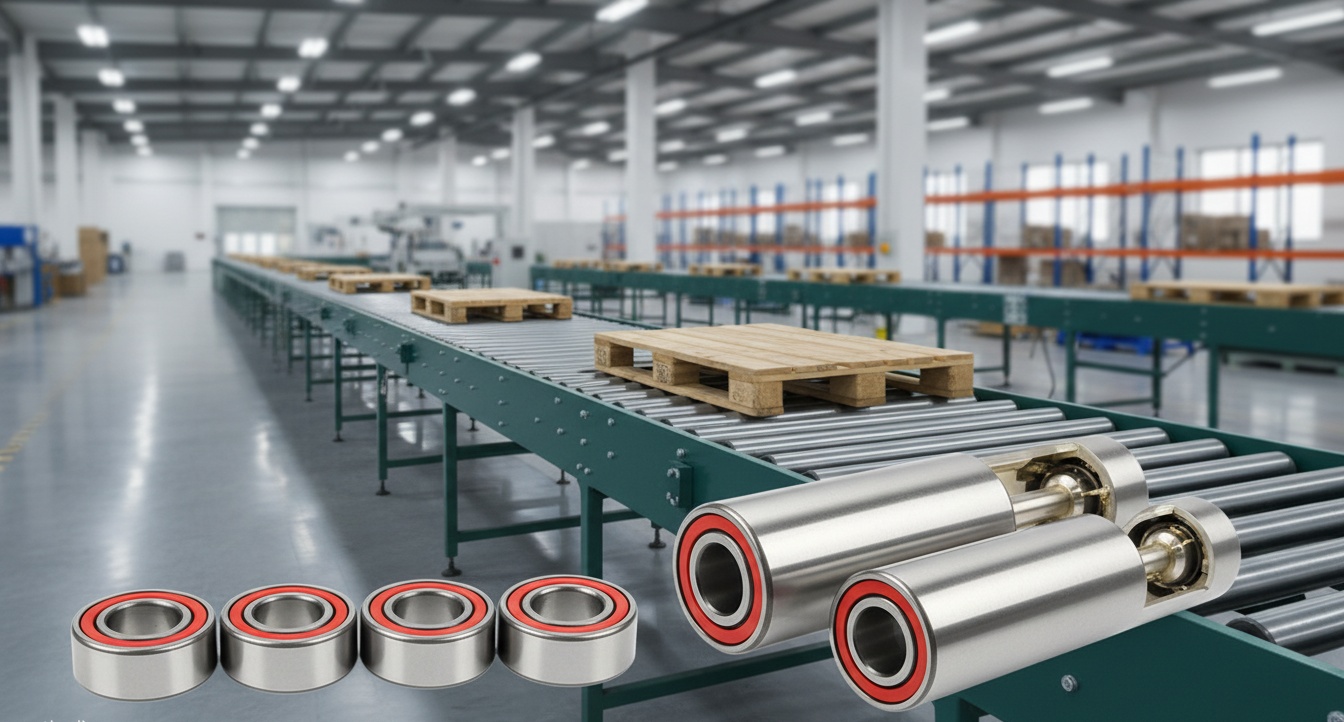
A technical procurement guide covering 6204, 6205, and 6206 deep groove ball bearing specifications for conveyor idler rollers — from internal clearance selection and sealing configuration to wholesale sourcing strategy for belt conveyor manufacturers.
Why the Right Deep Groove Bearing Makes or Breaks a Conveyor Idler
For any belt conveyor manufacturer or bulk material handling equipment supplier, the idler roller is the workhorse component of the system — and the bearing inside that idler is the component that determines whether the roller spins freely for 50,000 hours or seizes at 5,000 hours, destroying the belt in the process. At Juding-Engineering, we have supplied conveyor roller deep groove bearing wholesale quantities to idler manufacturers across Southeast Asia, the Middle East, and Africa for over 15 years, and we have seen firsthand the cost of bearing specification errors: entire conveyor lines shut down because idlers seized, belts abraded through on locked rollers, and replacement costs running into hundreds of thousands of dollars for a single unplanned outage at a mining operation or cement plant.
The 6204, 6205, and 6206 deep groove ball bearing series — with bore diameters of 20 mm, 25 mm, and 30 mm respectively — are the three most commonly specified bearing sizes for belt conveyor idler rollers in the 89 mm to 159 mm roller diameter range. These bearings handle radial loads from the belt weight and material burden, endure continuous rotation at 400–800 RPM (for a 4–6 m/s belt speed on a 108–133 mm diameter roller), and must survive in environments where dust, moisture, and vibration are constant. In this guide, we share the selection framework our engineering team uses when helping conveyor OEMs specify the right bearing for their idler design — covering internal clearance, sealing, grease fill, and the dimensional tolerances that matter most for idler roller performance.
6204, 6205, 6206: Dimensional Specifications and Load Ratings
Before diving into selection criteria, we want to establish the baseline specifications that every procurement engineer should have at their fingertips. The following table covers the critical dimensions and dynamic load ratings (the load at which 90% of bearings survive 1 million revolutions) for the three most commonly specified conveyor idler bearing sizes:
| Parameter | 6204 | 6205 | 6206 |
|---|---|---|---|
| Bore diameter (d) | 20 mm | 25 mm | 30 mm |
| Outer diameter (D) | 47 mm | 52 mm | 62 mm |
| Width (B) | 14 mm | 15 mm | 16 mm |
| Dynamic load rating (Cr) | 12.8 kN | 14.0 kN | 19.5 kN |
| Static load rating (C0r) | 6.6 kN | 7.85 kN | 11.3 kN |
| Limiting speed (grease) | 15,000 RPM | 12,000 RPM | 10,000 RPM |
| Typical idler roller OD range | 89–108 mm | 108–133 mm | 133–159 mm |
| Approx. weight | 0.11 kg | 0.13 kg | 0.20 kg |
Internal Clearance: C3 vs. C4 — The Most Critical Selection Decision
If we had to identify the single most common bearing specification error in conveyor idler applications, it would be ordering standard CN (normal) internal clearance instead of C3 or C4. We see this mistake in approximately 30% of the initial RFQs we receive — and we always flag it before production begins.
Internal clearance is the total radial distance the inner ring can move relative to the outer ring. The standard clearance grades for deep groove ball bearings are:
| Clearance Grade | 6204 (bore 20 mm) | 6205 (bore 25 mm) | 6206 (bore 30 mm) | Typical Application |
|---|---|---|---|---|
| C2 (reduced) | 1–11 μm | 1–11 μm | 1–11 μm | Precision spindles; not recommended for conveyors |
| CN (normal) | 5–20 μm | 5–20 μm | 5–20 μm | General industrial; inadequate for most conveyor idlers |
| C3 (greater than normal) | 13–28 μm | 13–28 μm | 15–33 μm | Conveyor idlers with press-fit mounting; standard for belt conveyors |
| C4 (greater than C3) | 20–36 μm | 23–41 μm | 28–46 μm | High-temperature conveyors; heavy interference fits; mining duty |
Why does C3 clearance matter so much for conveyor roller bearings? When a bearing is press-fitted into the idler roller shell and onto the shaft, the interference fit reduces the internal clearance — typically by 50–80% of the total interference. If you start with CN clearance (5–20 μm) and lose 12 μm to the press fit, you end up with a running clearance that can approach zero or even negative values. A bearing with zero clearance experiences metal-to-metal contact between the balls and raceways, generating heat, increasing friction, and dramatically shortening service life — often to less than 20% of the calculated L10 fatigue life.
We standardize on C3 clearance for all our conveyor idler bearings unless the customer specifically requests otherwise, and we recommend C4 for applications where the idler runs continuously in ambient temperatures above 60°C (common in cement plant clinker conveyors and steel mill sinter conveyors) or where heavy interference fits (>30 μm) are specified. Our 6305ZZ bearing with high-temperature grease exemplifies this approach — designed specifically for roller chain and conveyor applications where thermal expansion must be accommodated by the bearing’s internal geometry.
Sealing Configuration: ZZ (Metal Shield) vs. 2RS (Rubber Seal) for Idler Rollers
The choice between ZZ (double metal shield) and 2RS (double rubber contact seal) sealing is another decision where we see significant variation in practice — and strong opinions — across the conveyor industry. Our recommendation, based on field performance data from dozens of customer installations, is as follows:
ZZ (Metal Shield) — When to Use
Metal shields are non-contact closures — a thin steel disc pressed into the outer ring that forms a narrow labyrinth gap (typically 0.2–0.4 mm) with the inner ring shoulder. They provide no positive seal; their function is to exclude large particles while retaining the grease fill. The advantage is zero frictional torque from the seal itself, which means lower running temperature and marginally lower power consumption at the conveyor drive. We recommend ZZ shields for:
- Indoor conveyors in clean environments (warehousing, food processing, packaging lines)
- Applications where the idler roller housing provides a secondary labyrinth seal (common in premium idler designs with a multi-stage labyrinth at the roller end cap)
- Low-speed conveyors below 2 m/s belt speed where seal friction is proportionally more significant
2RS (Rubber Contact Seal) — When to Use
Rubber contact seals (typically nitrile/NBR with a molded steel insert) make physical contact with the inner ring shoulder via a flexible lip, creating a positive barrier against moisture and fine dust ingress. The trade-off is higher frictional torque — typically 2–4× that of a ZZ shield at the same speed — which generates more heat and requires a slightly higher starting torque. We recommend 2RS seals for:
- Outdoor conveyors exposed to rain, humidity, and washdown (mining, aggregate, cement)
- Conveyors handling fine particulate material (coal dust, cement powder, grain dust) where sub-10-micron particles can penetrate a ZZ shield’s labyrinth gap
- Idler rollers in the return strand where the bearing faces downward and is exposed to material spillage falling from the carry strand
Grease Fill: How Much, What Type, and Why It Matters
We are frequently asked about bearing grease specifications for conveyor idler applications, and we provide the following guidance based on both international standards (SKF, NSK, NTN recommendations) and our own field experience:
Grease fill quantity: For deep groove ball bearings in conveyor idler service, the grease fill should be 25–35% of the bearing’s free internal volume. Overfilling (above 40%) causes churning losses — the balls must push through excess grease, generating heat and increasing running torque. Underfilling (below 20%) risks inadequate lubrication of the ball-to-raceway contact, especially during the first hours of operation before the grease has distributed evenly. Our production line fills every conveyor-spec bearing to 30% ± 3% using automated metering equipment.
Grease type selection: We standardize on two grease types for conveyor idler bearings:
- Lithium-complex grease, NLGI Grade 2, with mineral base oil (ISO VG 100–150): This is our standard fill for ambient temperature ranges of -20°C to +80°C. It provides good mechanical stability (resists softening under shear), adequate water resistance, and a service temperature range that covers virtually all standard conveyor applications except extreme heat.
- Polyurea grease, NLGI Grade 2, with synthetic base oil (ISO VG 68–100): This is our premium fill for high-temperature applications (up to 150°C continuous) and for conveyors where extended relubrication intervals are desired. Polyurea thickener has superior oxidation resistance at elevated temperatures and is the standard grease type specified by major Japanese bearing manufacturers (NSK, NTN) for their sealed-for-life conveyor bearings.
For customers operating in food-processing environments where incidental food contact is possible, we can supply bearings with NSF H1-registered food-grade grease (aluminum-complex thickener with white mineral oil). We maintain a separate production cell for food-grade bearings to eliminate cross-contamination risk.
Wholesale Sourcing Strategy: How to Reduce Bearing Procurement Costs by 20–40%
For conveyor idler manufacturers and belt conveyor OEMs who consume 50,000 to 500,000 bearings per year, the conveyor roller deep groove bearing wholesale procurement strategy can make the difference between profitable production and margin erosion. Drawing on our 15 years of experience supplying bearing wholesale quantities, we offer the following framework:
1. Consolidate Your Bearing Specifications
We frequently see idler manufacturers stocking six or more bearing variations (different clearance grades, seal types, grease fills) when three would cover 95% of their production. Each unique SKU adds procurement complexity, inflates safety stock requirements, and reduces per-order volume — which increases unit cost. We recommend auditing your bill of materials and standardizing on:
- One primary specification: 620X-2RS C3 with standard lithium grease (covers 80% of production)
- One high-temperature variant: 620X-2RS C4 with polyurea grease (covers high-temperature conveyors)
- One economy variant: 620X-ZZ C3 with standard lithium grease (for clean-environment indoor conveyors where cost sensitivity is highest)
2. Optimize Order Quantities for Container Efficiency
Our logistics team works with customers to maximize the bearing count per shipping container. A 20-foot container can hold approximately 120,000–150,000 bearings in the 6204–6206 size range when packed in our standard export cartons (10 bearings per box, 480 boxes per pallet, 20 pallets per container). The freight cost per bearing in a full container load (FCL) is typically 60–70% lower than in a less-than-container load (LCL) shipment. For customers whose annual consumption does not justify a full container, we offer consolidated shipping — combining bearings from multiple customers in the same destination region into shared containers — which achieves approximately 70% of the FCL freight savings.
3. Negotiate on Total Cost, Not Unit Price
A bearing with a $0.02 lower unit price but 30% shorter service life costs far more when you factor in field failure costs: idler replacement labor, conveyor downtime, and belt damage from seized rollers. We encourage our customers to evaluate bearing proposals on a total-cost-per-idler-hour basis, not on the unit price alone. Our production quality control — which includes 100% dimensional inspection on bore, OD, and width using automated optical gauging, plus batch-sample noise/vibration testing (ISO 15242) and radial clearance verification — ensures that the bearings you receive deliver their rated L10 life, not a fraction of it.
Quality Verification: What to Check When Receiving a Wholesale Bearing Shipment
We recommend that every conveyor idler manufacturer implement an incoming inspection protocol for bearing shipments. The following checks — which require basic metrology equipment (micrometer, dial bore gauge, surface roughness tester) and can be performed on a statistical sampling basis — catch the vast majority of quality issues before bearings enter production:
- Dimensional accuracy (AQL 1.0, normal inspection): Measure bore diameter (tolerance: 0 to -10 μm for P0 grade), outer diameter (tolerance: 0 to -11 μm for 6204, 0 to -13 μm for 6205/6206), and width (tolerance: 0 to -120 μm). Out-of-tolerance dimensions indicate either incorrect grinding or bearing ring distortion — both of which will produce excessive noise and premature failure in operation.
- Radial internal clearance (sample size: 5 per 1,000): Mount the bearing on a tapered mandrel and measure the radial play with a dial indicator under a specified reversing load (typically 50–100 N). Verify the measured clearance falls within the specified C3 or C4 range.
- Noise/vibration test (sample size: 5 per 1,000): Spin the bearing at 1,800 RPM under a light axial preload and measure the vibration velocity in three frequency bands (low: 50–300 Hz, medium: 300–1,800 Hz, high: 1,800–10,000 Hz) per ISO 15242. Bearings with vibration exceeding the specified limit likely have raceway surface defects, ball size variation, or contamination that will produce audible noise and accelerate wear.
- Grease fill verification (sample size: 3 per batch): Disassemble the bearing seal, extract the grease, and weigh it. For 6204-2RS, the target fill is 0.8–1.2 g; for 6205-2RS, 1.0–1.5 g; for 6206-2RS, 1.5–2.2 g. Under-filled bearings will experience lubricant starvation; over-filled bearings will run hot.
- Seal integrity (sample size: 10 per 1,000): Pressurize the bearing cavity to 0.5 bar and submerge in water. No continuous bubble stream should emerge from the seal lip within 30 seconds. This test verifies the 2RS seal’s ability to exclude moisture during outdoor operation.
The Cost of Getting It Wrong: A Real-World Example
In 2024, we were approached by a belt conveyor manufacturer in Vietnam who had been experiencing idler roller bearing failures at approximately 8,000–10,000 hours of operation — far short of their target 50,000-hour service life. Upon investigation, we identified three contributing factors:
- The bearings being used were 6205-ZZ CN clearance — metal shields in a dusty quarry environment, with normal clearance that was being consumed by the press fit into the idler shell.
- The grease fill was approximately 18% — below the minimum for adequate initial lubrication.
- The bearings were sourced from multiple suppliers with inconsistent dimensional tolerances, resulting in variable interference fits that produced unpredictable clearance loss.
We transitioned the customer to our 6205-2RS C3 specification with a guaranteed 30% lithium-complex grease fill, supplied from a single production batch for dimensional consistency. After 14 months of operation — approximately 12,000 hours — the failure rate had dropped from their previous 12% at 10,000 hours to 0.8% at 12,000 hours. The customer’s cost per bearing increased by $0.11 (from $0.38 to $0.49 in wholesale quantity), but their total cost per operating idler-hour decreased by 62% when factoring in reduced replacement labor, reduced conveyor downtime, and elimination of belt damage from seized rollers.
This example illustrates the core principle we apply to every conveyor roller deep groove bearing wholesale order: unit price is a poor proxy for value. The right bearing specification — correct clearance, correct sealing, correct grease fill, consistent quality — pays for itself many times over in reduced field failures and extended service intervals.
Why Choose Juding-Engineering for Conveyor Roller Bearing Wholesale Supply
We are a specialized bearing manufacturer and exporter based in Ningbo, China, with over 15 years of experience supplying deep groove ball bearings to conveyor idler manufacturers, belt conveyor OEMs, and industrial equipment distributors across Southeast Asia (Vietnam, Thailand, Indonesia, Malaysia), the Middle East, and Africa. Our production facility maintains ISO 9001:2015 certification, and we operate dedicated production cells for conveyor-spec bearings — ensuring that the clearance grades, seal configurations, and grease fills are consistent from batch to batch.
We understand that for a conveyor idler manufacturer producing 5,000 rollers per day, a bearing shortage stops the production line. That is why we maintain buffer stock of our most-demanded conveyor bearing specifications (6204-2RS C3, 6205-2RS C3, 6206-2RS C3) in quantities sufficient to cover 30 days of typical customer demand — and we can ship within 5–7 working days from order confirmation for stock items, or 15–25 days for custom-specification production orders.
For bearing specifications and wholesale pricing, visit our conveyor bearing product page or browse our complete products catalog. Our engineering team is available to review your idler roller bearing specification and provide a technical recommendation before you place your order — because we would rather help you get the specification right the first time than ship bearings that fail prematurely in the field.
Post time: Jun-04-2026