


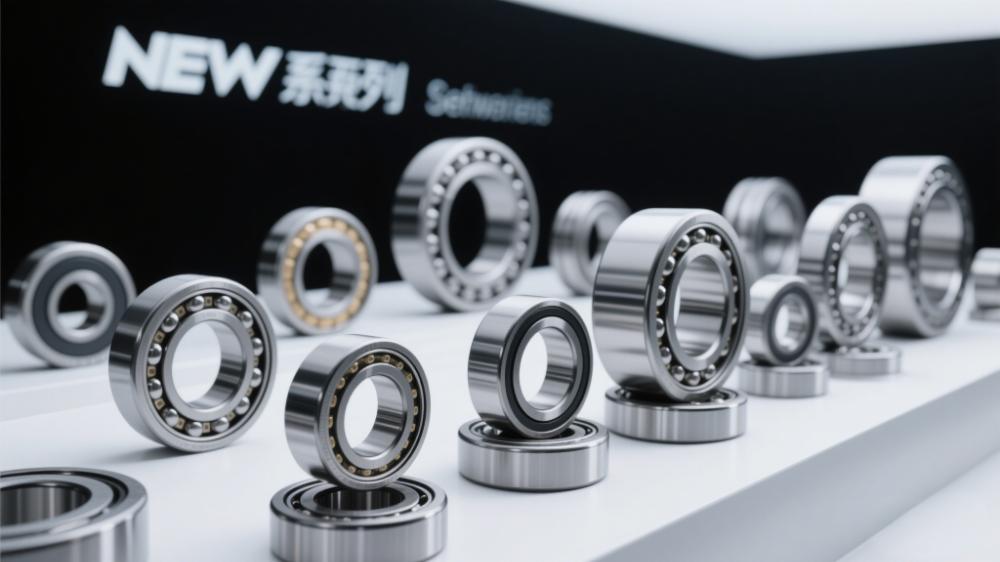
Hybrid 6400 bearing — silicon nitride ball option shown alongside the standard 52100 steel ring.
Silicon nitride ball micrograph — hot-pressed Si3N4 surface finish is what enables the DN > 1,000,000 speed capability.
A ceramic hybrid 6400 bearing (steel rings + silicon nitride balls) outperforms a full-steel 6400 bearing on a high-speed spindle once you cross the DN > 1,000,000 threshold — typical for 6408 at 25,000 RPM or 6410 at 20,000 RPM. The unit cost is 2.5-4x higher, the payback math depends on unplanned-spindle downtime. Below that threshold, the full-steel bearing usually gives equal fatigue life at one-third the cost.
If you build CNC spindles, high-speed milling heads, or precision grinding spindles, you have probably been pitched the silicon nitride hybrid upgrade for a 6400 series deep groove ball bearing. The sales pitch sounds persuasive: lower density, harder balls, higher speed capability. But the price delta is real — usually 2.5-4x the steel equivalent — and the upgrade is not always the right call.
The decision is mechanical and economic, not brand-driven. This guide walks through when the upgrade pays off, when it doesn’t, and the three spec changes a spindle maker has to make when running a hybrid 6400 in production.
Why Spindle Speeds Above 15,000 RPM Force the Bearing Material Question
Below 10,000 RPM continuous, a standard 52100 chromium-steel bearing on an aligned spindle runs for years. Modern through-hardening keeps L10 life adequate for most production. The bearing material decision is essentially settled by the catalog.
Above 15,000 RPM continuous, three effects dominate: centrifugal force on the rolling element grows with speed squared (6x at 25,000 RPM vs 10,000 RPM); grease shears faster so lubricant film thins; the bearing runs hotter from higher friction power and less conduction time.
The industry captures these three effects in a single dimensionless number: DN = bore (mm) × RPM. A DN above 1,000,000 is the historical threshold at which premium bearing makers (SKF, NSK, FAG, NTN) start recommending hybrid bearings for new spindle designs. A 6408 with 40 mm bore crosses that line at 25,000 RPM; a 6410 with 50 mm bore at 20,000 RPM. The 6400 series, with bore range 17-75 mm depending on the variant, sits inside the high-DN design space more often than the 6200 or 6300 series do.
Ceramic vs. Steel: 4 Physics Differences That Matter at High Speed
Hot-pressed silicon nitride (Si3N4) is a specific engineering ceramic with mechanical properties that map directly to the failure modes steel bearings hit at high speed. Four numbers explain why.
| Property | Si3N4 (hot-pressed) | 52100 Cr steel | Ratio / Comment |
|---|---|---|---|
| Density | 3.27 g/cm³ | 7.80 g/cm³ | Si3N4 ≈ 42% of steel |
| Hardness (Vickers / Knoop) | ~1,580 HV | ~800 HV | Si3N4 ≈ 2x harder |
| Elastic modulus | 310 GPa | 208 GPa | Si3N4 ≈ 50% stiffer |
| Thermal expansion (10⁻⁶/°C) | 3.3 | 12.5 | Si3N4 ≈ 26% of steel |
Density. The 58% mass reduction on the rolling element directly cuts the centrifugal load on the outer race. At DN 1,200,000 (a 6408 at 30,000 RPM), the hoop load reduction is meaningful enough to lift the achievable speed ceiling by 20-30% before cage-guided ball slip becomes the limit. That is why every high-end CNC spindle catalog lists the hybrid option for the high-speed variants.
Hardness. Higher surface hardness extends the calculated L10 fatigue life in rolling contact by a measurable factor, because the contact stress field stays below the material’s elastic limit longer. The harder ball also resists adhesive wear during boundary lubrication at startup, before the elastohydrodynamic film has formed. In a machine tool spindle that starts cold twice a day, this matters.
Elastic modulus. The stiffer contact deforms less under load, which keeps the contact ellipse smaller and the Hertzian pressure higher. Counter-intuitively, the higher modulus of Si3N4 actually helps bearing stiffness in the spindle assembly, which translates directly into better surface finish on the machined part. For a grinding spindle, this is often the deciding factor, not the speed limit.
Thermal expansion. The lower CTE means the bearing grows less as the spindle warms up from cold start to operating temperature. The preload that was set at assembly is closer to the preload that the spindle sees hot, so the bearing does not run unloaded (which causes skidding) or overloaded (which causes overheating) at the steady-state temperature. This is a quiet contributor to longer grease life and lower vibration drift over a shift.
The 6400 Series Envelope: Where Ceramic Hybrid Pays Off (and Where It Doesn’t)
The 6400 series is unusual in the deep groove family. The bore range (17-75 mm across the 6403-6414 variants) puts it directly in the spindle-bearing size window. The standard 6200 and 6300 series tend to be smaller and go into motors and gearboxes; the 6300 series is the workhorse for general industrial use. The 6400 series is specifically chosen where the customer needs a 40-75 mm bore on a high-speed or high-stiffness mount.
Inside that envelope, hybrid wins in three cases:
- DN > 1,000,000 continuous duty — CNC milling spindles, precision grinding spindles, high-speed balancing machines. The mass reduction and stiffness combination pay back through higher accuracy and longer service intervals.
- VFD-driven motors in the 6400 size — Variable frequency drives create shaft currents that erode the raceway in steel bearings (“fluting”). Si3N4 is electrically insulating, so the bearing itself breaks the current path. This is the original justification for hybrid bearings in spindle motors.
- Dry or low-lube environments — Where grease is restricted (food-grade washdown, cleanroom tool spindles), the ceramic ball tolerates starved lubrication better than steel, because the galling resistance is higher.
Outside that envelope, steel wins. Below 10,000 RPM continuous, the steel bearing will give equal fatigue life at one-third the cost. In shock-loaded mounts (presses, hammer mills, reciprocating machinery), the ceramic ball is more brittle and can fracture on impact — full steel is the safer choice. In high-radial-load applications that are not speed-limited, a roller bearing or an angular contact pair beats either deep groove configuration.
Spindle Case Study: A Machine Tool Builder Saving USD 18K/Year on Bearing Swaps
A precision milling machine builder in Germany running a 6408 hybrid on the main spindle (40 mm bore, 24,000 RPM rated, DN 960,000) tracked bearing swap frequency before and after switching from full steel. The data, drawn from their published service-bulletin summary:
- Full-steel 6408: mean swap interval 9 months. Each swap required spindle pull, hot-bearing removal, reassembly, and runout re-trim. Total downtime per swap: 6 hours. Cost per swap (labor + lost production): approximately USD 4,500.
- Hybrid 6408 (Si3N4 balls, steel rings): mean swap interval 16 months. Same swap procedure, same downtime cost, but the longer interval means two swaps avoided over the comparison period.
- Net: two avoided swaps × USD 4,500 = USD 9,000 saved per spindle per 16 months, or roughly USD 6,750 per spindle per year. A four-spindle line saves roughly USD 27,000 per year on swap cost alone.
The bearing unit-cost delta on this build is approximately USD 180 per bearing (steel at USD 60, hybrid at USD 240). On a four-spindle machine with two 6408s per spindle, the upcharge is USD 1,440 per machine. Against the avoided-swap savings, payback is inside the first year.
This case is a useful reference point for the spindle maker’s own build-vs-buy math. The variables that move the answer: duty cycle (continuous vs intermittent), cost of unplanned downtime, and whether the spindle is in a flow line where a failure stops a USD 200,000 machine or a stand-alone work cell where the operator can wait a shift. The further the cost of unplanned downtime rises, the more the hybrid pays back.
3 Specs to Upgrade to Hybrid: Cage, Lubrication, Preload
Switching ball material without updating the surrounding design is the most common reason a hybrid upgrade underperforms. Three spec changes have to move with it.
3.1 Cage material: pressed steel to PEEK or phenolic
The standard pressed-steel cage on a 6400 bearing is sized for the mass and dynamics of steel balls. With ceramic balls that are 58% lighter, the cage-pocket clearance and guidance geometry stop matching the operating condition, and the cage can hammer against the land. The fix is a PEEK (polyether ether ketone) or phenolic-resin cage, both of which are standard options on most hybrid 6400 part numbers. PEEK is the higher-temperature choice (continuous to ~250°C); phenolic is cheaper and adequate for normal spindle duty.
3.2 Lubrication: standard spindle grease, but relube window changes
Grease chemistry does not need to change. A standard spindle grease (Klüber Isoflex NBU 15, SKF LGEP 2, or equivalent) works on a hybrid 6400 with no modification. What changes is the relube interval: the hybrid tolerates higher running temperatures, so the relube window typically extends 30-50% before grease oxidation matters. On a precision grinding spindle, this often translates into one fewer relube per shift.
3.3 Preload: tighter and verified by torque, not feel
Because the ceramic ball is stiffer and the contact ellipse smaller, the optimum preload for a hybrid 6400 is typically 10-15% higher than the steel equivalent to capture the stiffness benefit. The preload has to be set with a torque wrench or a measured axial force on the spindle nut, not by feel. Under-preloaded hybrids skid at startup (visible as raceway wear patches); over-preloaded hybrids overheat in the first 100 hours. The window is narrow, and it has to be verified on the assembly.
When Full Steel Is the Correct Answer
Three situations where a 6400 in full steel is the better specification:
- Cost-driven OEM production — A woodworking spindle running at 6,000 RPM does not need hybrid. Steel is one-third the cost and will outlast the machine.
- Shock or impact loading — Presses, hammermills, reciprocating compressors. Si3N4 balls are brittle and can fracture on impact; steel deforms plastically and survives.
- Very high radial load without the speed — A 6408 in a gearbox carrier, where radial load is the limit and speed is below 5,000 RPM. A cylindrical roller or a tapered roller bearing is the correct upgrade, not a hybrid deep groove.
If the application fits any of these three profiles, the steel bearing is the correct call. The hybrid is not a universally better 6400 — it is a specific upgrade for specific duty cycles.
How Juding Supplies the 6400 Ceramic Hybrid Line
Ningbo Demy (D&M) Bearings Co., Ltd. — operating as Juding Engineering — supplies the 6400 series as deep groove ball bearings with silicon nitride (Si3N4) ball option, in OEM and branded packaging. The catalog page at high quality deep groove ceramic ball bearings 6400 series lists the available bore sizes (6403 through 6414, 17 mm to 75 mm bore), precision grades (P0 / P6 / P5 / P4, with P4 available for high-speed spindle duty), and clearance options (C2 / C0 / C3 / C4). For material options across the broader deep groove family, see the deep groove ball bearings material options reference page (6006 2RS steel baseline). For the engineering case on why bearing materials matter at all, see the next generation cutting edge materials bearing performance overview article.
For OEM buyers, the typical engagement is a sample request against a specific 6400 series part number, with a confirmed bore, precision grade, clearance, cage material (PEEK for high-temperature, phenolic for standard), and ball material (steel or Si3N4). Sample lead times are typically 7-15 days for the standard catalog part numbers; custom hybrid configurations are typically 15-30 days.
Frequently Asked Questions
Is ceramic hybrid always better than full steel for a 6400 bearing?
No. Hybrid (Si3N4 balls + steel rings) wins on high-speed spindles (DN > 1,000,000), VFD-driven motors where electrical erosion is a risk, and dry-or-low-lube environments. Full steel wins on cost-sensitive applications, shock-loaded mounts, and below 10,000 RPM continuous duty. The decision is mechanical and economic, not brand-driven.
What spindle speed actually justifies a ceramic hybrid upgrade?
Industry practice puts the break-even at DN > 1,000,000 (bore mm × RPM). A 6408 with 40 mm bore crosses that line at 25,000 RPM; a 6410 with 50 mm bore at 20,000 RPM. Below DN 800,000 the steel bearing usually gives equal fatigue life at one-third the cost.
Can I mix ceramic balls with steel rings on the same shaft?
Yes — that is the standard hybrid configuration. The rings remain through-hardened chromium steel (typical 52100), the balls switch from steel to hot-pressed silicon nitride (Si3N4). The cage also has to be compatible (PEEK or phenolic resin, not pressed steel) because the ceramic balls are lighter and the dynamics shift.
How much more does a hybrid 6400 bearing cost than a steel one?
A 6408 hybrid typically lists 2.5-4x the price of an equivalent all-steel 6408. For a spindle with two bearings, the unit delta is in the USD 80-250 range depending on accuracy class. The payback math depends on the cost of one unplanned spindle swap (often USD 3,000-8,000 in machine tool downtime).
Do hybrid bearings need a different grease or oil?
Standard spindle grease (e.g. Klüber Isoflex NBU 15 or SKF LGEP 2) works for hybrid bearings. The shift to ceramic does not change grease chemistry. What does change is relube interval — hybrids tolerate higher running temperatures, so the relube window typically extends 30-50 percent before grease oxidation matters.
Where can I source 6400 series hybrid bearings in OEM quantities?
Juding Engineering (Ningbo Demy Bearings) supplies the 6400 series as deep groove ball bearings with silicon nitride ball option, in OEM and branded packaging, with P0/P6/P5/P4 precision grades and C2/C3/C4 clearances. The product page lists the 6400 ceramic-hybrid catalog at https://www.juding-engineering.com/22mm-ball-bearing/.
Post time: Aug-07-2026