


The quest for longer life, higher speed, and greater efficiency in machinery is relentless. While the fundamental geometry of the deep groove ball bearing remains timeless, a quiet revolution is occurring at the material level. The next generation of these bearings is moving beyond traditional steel, incorporating advanced engineering ceramics, novel surface treatments, and composite materials to shatter previous performance limits. This is not just an incremental improvement; it’s a paradigm shift for extreme applications.
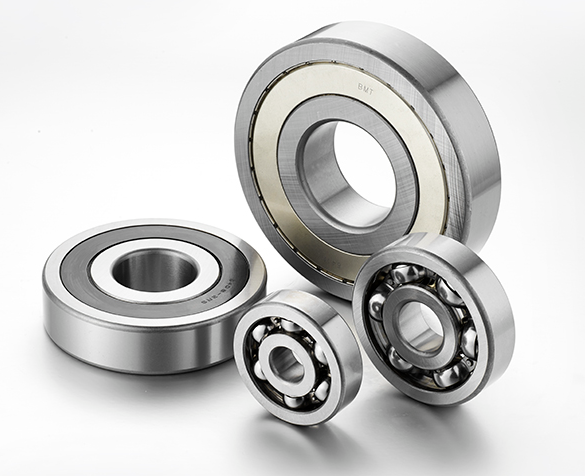
The Rise of Hybrid and Full-Ceramic Bearings
The most significant material evolution is the adoption of engineering ceramics, primarily Silicon Nitride (Si3N4).
Hybrid Deep Groove Ball Bearings: These feature steel rings paired with silicon nitride balls. The benefits are transformative:
Lower Density & Reduced Centrifugal Force: Ceramic balls are about 40% lighter than steel. At high speeds (DN > 1 million), this dramatically reduces centrifugal load on the outer ring, allowing for up to 30% higher operating speeds.
Enhanced Stiffness & Hardness: Superior wear resistance leads to a longer calculated fatigue life under ideal conditions.
Electrical Insulation: Prevents damage from electrical arcing (fluting) in variable frequency drive (VFD) motors, a common failure mode.
Operational at Higher Temperatures: Can function with less lubrication or in higher ambient temperatures than all-steel bearings.
Full-Ceramic Bearings: Made entirely of silicon nitride or zirconia. Used in the most aggressive environments: full chemical immersion, ultra-high vacuum where lubricants cannot be used, or in magnetic resonance imaging (MRI) machines where absolute non-magnetism is required.
Advanced Surface Engineering: The Power of a Few Microns
Sometimes, the most powerful upgrade is a microscopic layer on the surface of a standard steel bearing.
Diamond-Like Carbon (DLC) Coatings: An ultra-hard, ultra-smooth, and low-friction coating applied to raceways and balls. It drastically reduces adhesive wear during startup (boundary lubrication) and provides a barrier against corrosion, significantly extending service life in poor lubrication conditions.
Physical Vapor Deposition (PVD) Coatings: Titanium Nitride (TiN) or Chromium Nitride (CrN) coatings increase surface hardness and reduce friction, ideal for applications with high slip or marginal lubrication.
Laser Texturing: Using lasers to create microscopic dimples or channels on the raceway surface. These act as micro-reservoirs for lubricant, ensuring a film is always present, and can reduce friction and operating temperature.
Innovations in Polymer and Composite Technology
Next-Generation Polymer Cages: Beyond standard polyamide, new materials like Polyether Ether Ketone (PEEK) and Polyimide offer exceptional thermal stability (continuous operation > 250°C), chemical resistance, and strength, enabling lighter, quieter cages for extreme-duty applications.
Fiber-Reinforced Composites: Research is ongoing into rings made from carbon-fiber reinforced polymers (CFRP) for ultra-high-speed, lightweight applications like aerospace spindles or miniature turbochargers, where weight reduction is critical.
The Integration Challenge and Future Outlook
Adopting these advanced materials is not without challenges. They often require new design rules (different thermal expansion coefficients, elastic moduli), specialized machining processes, and come at a higher initial cost. However, their Total Cost of Ownership (TCO) in the right application is unbeatable.
Conclusion: Engineering the Boundary of the Possible
The future of the deep groove ball bearing is not just about refining steel. It is about intelligently combining materials science with classic mechanical design. By deploying hybrid ceramic bearings, DLC-coated components, or advanced polymer cages, engineers can now specify a deep ball bearing that operates faster, longer, and in environments previously considered prohibitive. This material-led evolution ensures that this foundational component will continue to meet and drive the demands of tomorrow’s most advanced machinery, from all-electric aircraft to deep-well drilling tools. The era of the “smart material” bearing has arrived.
Post time: Dec-26-2025