


When designing a rotating assembly, engineers often face a critical choice between two fundamental ball bearing types: the versatile deep groove ball bearing and the specialized angular contact ball bearing. While both are indispensable, understanding their distinct characteristics is key to optimal machine performance. So, what sets them apart, and when should you specify a standard deep ball bearing?
The Core Difference: Raceway Geometry and Load Handling
The divergence lies in the design of the raceways. A deep groove ball bearing features symmetrical, deep raceways on both rings, allowing it to handle significant radial loads and moderate axial loads from both directions. It is essentially an “all-rounder.”
In contrast, an angular contact bearing has asymmetric raceways, where the inner and outer rings are displaced relative to each other. This design creates a contact angle, enabling it to support very high axial loads in one direction, often combined with radial loads. It’s a “specialist” for thrust applications.
Application Scenarios: Where Each Bearing Excels
Choose a Deep Groove Ball Bearing When:
Your primary load is radial.
You have moderate bidirectional axial loads (e.g., from gear meshing or slight misalignment).
Simplicity, cost-effectiveness, and high-speed capability are priorities.
Applications include: electric motors, pumps, conveyors, and household appliances.
Choose an Angular Contact Bearing When:
The dominant load is axial (thrust), such as in machine tool spindles, vertical pumps, or worm gear supports.
You need precise axial positioning and high rigidity.
You can use them in pairs (back-to-back or face-to-face) to handle thrust in both directions.
The Hybrid Approach & Modern Solutions
Modern machinery often uses both. A common configuration pairs two angular contact bearings to manage heavy thrust, while a deep groove ball bearing elsewhere in the system handles radial loads and provides axial location. Furthermore, manufacturers now offer “universal” or “X-life” designs that push the performance boundaries of standard deep groove ball bearings, blurring the lines between the two types for certain applications.
Conclusion: Aligning Design with Function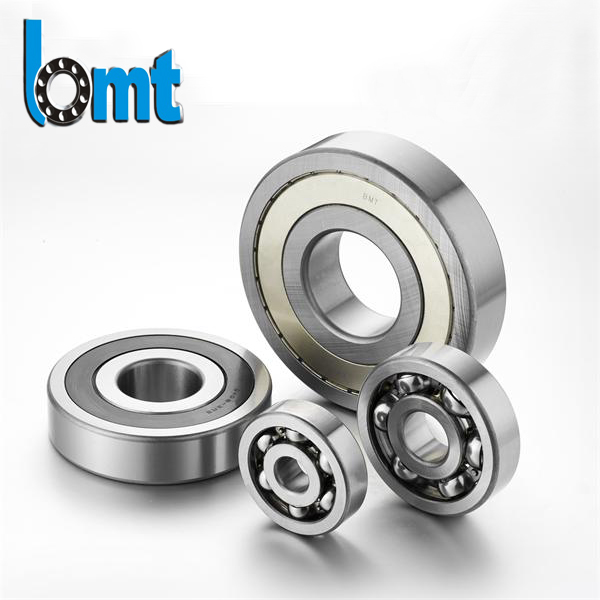
The choice isn’t about which bearing is superior, but which is optimal for the task. The humble deep ball bearing remains the default, go-to solution for the vast majority of general-purpose applications due to its unbeatable combination of versatility, affordability, and reliability. For specialized high-thrust scenarios, the angular contact bearing is the clear choice. By understanding this fundamental distinction, engineers ensure longevity, efficiency, and precision in every design.
Post time: Dec-16-2025